
Abstract nouns: What they are and what they do

Language is a powerful tool that allows us to capture both the tangible and the intangible aspects of our existence. Among its many building blocks, abstract nouns hold a unique place. Unlike objects we can touch or see, these nouns embody the invisible—ideas, emotions, qualities, and states of being that shape our thoughts and experiences.
These intangible concepts enrich our communication, giving voice to the complexities of the human mind. In this guide, we will explore the definition of abstract nouns, how they differ from concrete nouns, and how to use them effectively in English.
Also included:
- Comprehensive list of abstract nouns by suffix
- 3 Tips for using abstract nouns in your writing
- The Abstract Noun Quiz
Nouns are the foundation of every sentence you write. This guide explores every category and rule, providing you with the tools to identify, use, and master them with total confidence.
- All about nouns in English: Types, examples, and usage
- Compound nouns in English: Rules, examples, and types
- Nominalization: Definition, examples, and how to improve your writing
- Uncountable nouns: A complete guide to mass nouns in English
- Countable nouns: A complete guide to grammar and usage
- Collective nouns: The ultimate guide to group names and usage
- Abstract nouns: Definition, examples, and how to use them (this article)
- What are concrete nouns? Definition, examples, and usage
- Proper nouns: Definition, examples, and usage rules
- Infinitives: A complete guide to understanding and using the base verb form
- Understanding gerunds: A complete guide to grammar, rules, and examples
What is an abstract noun?
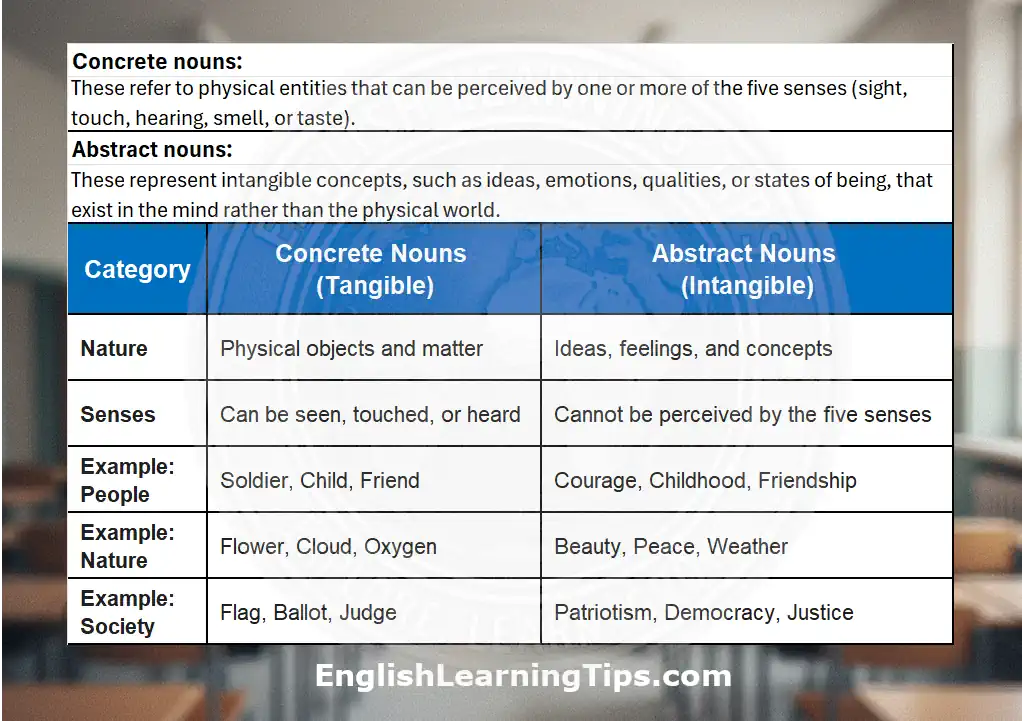
An abstract noun is a noun that refers to an idea, quality, or state of being rather than a concrete object. You cannot perceive an abstract noun with the five senses; you cannot touch, see, hear, smell, or taste it.
Key characteristics of abstract nouns
- Intangible concepts: They represent things that are not physical.
- Mental constructs: They exist in our minds and are understood through thought and experience rather than physical interaction.
- Subjective nature: Concepts like “beauty” or “happiness” may mean different things to different people.
Abstract nouns vs. concrete nouns
The easiest way to identify an abstract noun is to compare it to its opposite: the concrete nouns. While abstract nouns are ideas, concrete nouns are physical objects.
| Feature | Abstract nouns | Concrete nouns |
| Perception | Cannot be sensed (touch, sight, etc.) | Can be perceived by the five senses |
| Examples | Freedom, courage, childhood | Bird, hammer, water |
| Function | Describes feelings or concepts | Describes physical entities |
Common examples of abstract nouns
To better understand how these function in grammar, it helps to categorize them by the type of “intangible” they represent.
Emotions and feelings
These describe internal states that we experience emotionally.
- Love, hate, joy, sadness, anger, sympathy, pride.
Qualities and traits
These refer to characteristics of a person, place, or thing.
- Honesty, courage, beauty, intelligence, patience, determination.
Ideas and concepts
These are often philosophical or societal constructs.
- Justice, truth, time, democracy, freedom, knowledge, belief.
States of being
These describe a condition or a period of life.
- Poverty, wealth, childhood, adulthood, chaos, peace.
Why abstract nouns are important in writing
Abstract nouns allow us to communicate complex thoughts that would be impossible to describe using only physical objects. They are essential for:
- Conveying emotions: Giving a name to what we feel (e.g., “She felt a sense of relief“).
- Discussing philosophy: Engaging with high-level theories like justice or ethics.
- Summarizing complex actions: Instead of describing someone telling the truth, we can simply discuss the concept of honesty.
Frequently asked questions about abstract nouns
Visual resources to help you learn
Video: What is an abstract noun?
This video is an interactive tutorial designed for children.
Video: How to identify abstract nouns
Summary of abstract nouns
In a world often defined by the physical, abstract nouns remind us of the profound depth of human experience. They bridge the gap between the concrete and the conceptual, allowing us to articulate emotions and grapple with philosophical ideas.
Comprehensive list of abstract nouns by suffix
One of the most effective ways to identify or create abstract nouns is by looking at their word endings (suffixes).
| Suffix | Examples |
| -ness | Happiness, kindness, darkness, weakness, fitness |
| -ion / -tion | Education, imagination, concentration, opinion, relation |
| -ity / -ty | Ability, beauty, responsibility, loyalty, charity |
| -ism | Optimism, pessimism, realism, patriotism, criticism |
| -ship | Friendship, leadership, hardship, ownership, citizenship |
| -ment | Movement, excitement, disappointment, amazement, argument |
| -ance / -ence | Confidence, brilliance, silence, tolerance, independence |
| -hood | Childhood, brotherhood, neighborhood, likelihood |
3 Tips for using abstract nouns in your writing
While abstract nouns are essential, using too many of them can make your writing feel “heavy” or vague. Here is how to balance them:
- Pair with concrete details: If you write about courage, follow it up with a concrete action (e.g., “His courage was clear when he jumped into the freezing water”).
- Avoid “nominalization”: This is when you turn a strong verb into a weak abstract noun. Instead of saying “We held a discussion about the budget,” say “We discussed the budget.”
- Check for countability: Remember that you can have “many ideas” (countable) but only “much bravery” (uncountable).
The Abstract Noun Quiz
Abstract nouns mastery quiz
Discover more from English Learning Tips
Subscribe to get the latest posts sent to your email.


