
Onomatopoeia: What it is and how to use it in English

“Sometimes a thousand twanging instruments
Will hum about mine ears, and sometime voices.” — The Tempest; Act 3, Scene 2
In this famous line from William Shakespeare, the words twanging and hum do more than just describe a scene; they allow the reader to hear it. This is onomatopoeia in action.
What is onomatopoeia?
Onomatopoeia (pronounced on-uh-mah-tuh-pee-uh) is a literary device where a word phonetically mimics or resembles the sound that it describes. Unlike most words, where the relationship between the word and its meaning is arbitrary, onomatopoeic words have a direct sensory connection to the noise they represent.
By using sensory language, writers can move beyond simple description to create an immersive auditory experience. It bridges the gap between the page and the real world, engaging the reader’s sense of hearing through text.
Common types of onomatopoeia
Onomatopoeic words vary depending on the source of the noise. By categorizing onomatopoeic words, writers can more easily select the specific “texture” of sound needed for a scene.
Examples of onomatopoeia by category
Not all sound words are created equal. We can generally categorize onomatopoeic words by the source of the noise they imitate.
| Category | Common words |
| Animal sounds | Meow, bark, buzz, hiss, oink, quack, tweet |
| Water sounds | Splash, drip, gurgle, slurp, plop, squelch |
| Impact & collision | Bang, crash, thud, clatter, thwack, boom |
| Voice & breathing | Giggle, whisper, grunt, murmur, hiccup |
| Mechanical & motion | Click, hum, zoom, beep, whir, clink |
How to use onomatopoeia effectively in writing
Using sound words isn’t just for comic books or children’s stories. When used with precision, it adds a layer of realism and immediacy to any narrative.
1. Set the atmosphere and mood
A “rustling” in the bushes creates suspense, while the “dripping” of a leaky faucet can emphasize silence or annoyance. These sounds help set the scene and evoke specific emotional responses without the need for lengthy adjectives.
2. Enhance action and impact
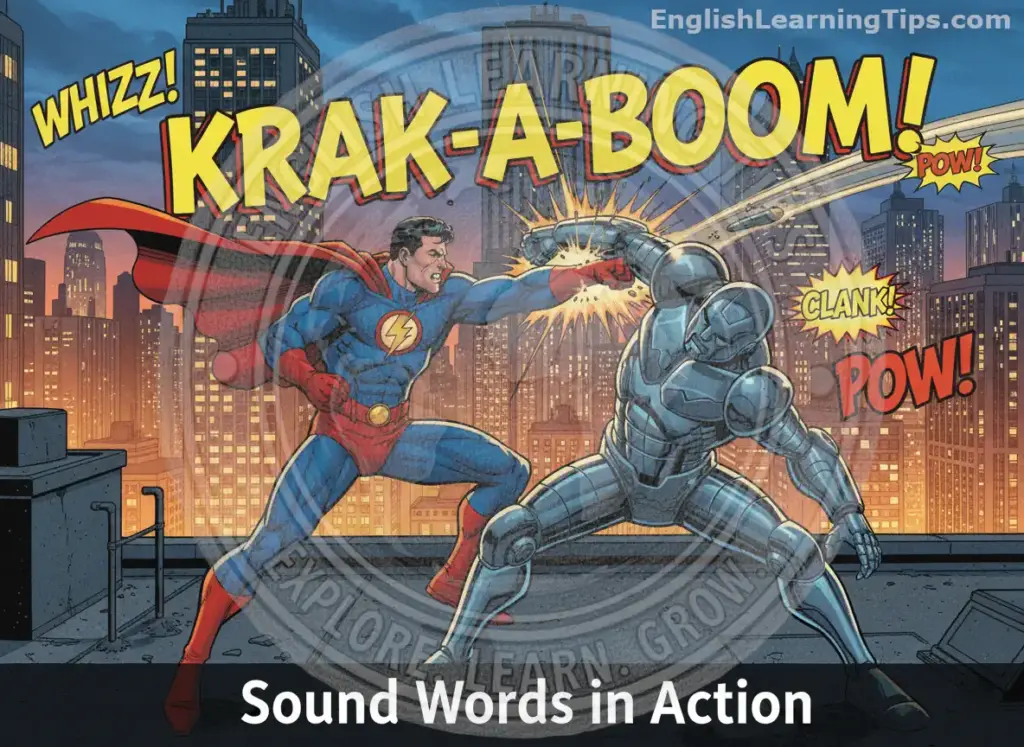
Action scenes benefit immensely from words like thud, smash, or zip. These words convey the force and speed of a dynamic event, making the prose feel more “alive.”
3. Create vivid imagery
Onomatopoeia is a form of figurative language that allows readers to “hear” the story. Instead of saying “the car moved fast,” saying “the car zoomed past” provides both the speed and the sound of the engine in one word.
Pro-tip: Don’t overdo it. In professional copy or serious journalism, too much sound-mimicry can make the tone feel juvenile. Save the ‘booms’ and ‘zaps’ for moments that truly need a sensory punch.
Why Shakespeare used “twanging” and “hum”
Notice how Shakespeare doesn’t just tell us the music is loud; he uses ‘twanging’ to mimic the physical snap of a string.
- Twanging: Mimics the sharp, vibrating sound of a plucked string on a lute or harp.
- Hum: Reflects a low, continuous vibration.
By using these specific sounds, he doesn’t just tell us there is music; he makes the audience hear the ghostly, magical orchestra of Prospero’s island.
Expand your literary toolkit
If you enjoyed learning about onomatopoeia, you might find these other literary devices useful for your writing:
- Alliteration: The repetition of initial consonant sounds.
- Hyperbole: The use of extreme exaggeration for effect.
- Personification: Giving human characteristics to non-human things.
- Simile: Comparing two things using “like” or “as.”
Frequently asked questions about onomatopoeia
Resources to master onomatopoeia
If you want to see sound words in action or need a deeper reference for your own projects, these highly-rated resources are excellent additions to any writer’s or student’s bookshelf.
Recommended books for writers
- The Elements of Eloquence by Mark Forsyth: A witty and engaging breakdown of rhetorical devices, including how sound and rhythm shape great sentences.
- The New Oxford Dictionary for Writers and Editors: The essential A–Z guide for ensuring your “sound words” are spelled and hyphenated correctly according to professional standards.
For creative kids and educators
- Mr. Brown Can Moo! Can You? by Dr. Seuss: The quintessential introduction to onomatopoeia for young readers. It is a masterclass in phonetic imitation.
- Squeak, Rumble, Whomp! Whomp! Whomp! by Wynton Marsalis: A “sonic adventure” that uses jazz-inspired onomatopoeia to teach children about the music of everyday life.
Visual storytelling and comics
- Understanding Comics: The Invisible Art by Scott McCloud: If you want to understand how “BOOM” and “POW” actually work on a psychological level in visual media, this is the definitive text.
Conclusion: Why sound matters in your writing
Onomatopoeia is a practical tool for any writer’s toolkit and is a vital tool for sensory storytelling. Whether you are writing a fast-paced thriller, a rhythmic poem, or a descriptive blog post, choosing the right sound words can bridge the gap between your imagination and your reader’s ears. By avoiding overused clichés and selecting words that truly echo the actions they describe, you can transform flat text into a vivid, multi-sensory experience.
Join the conversation
We want to hear from you! What is your favorite onomatopoeic word, or is there a specific sound that you find particularly difficult to describe in writing?
If you found this guide to onomatopoeia examples and literary devices helpful, please share this article with a fellow writer or student. Your comments and shares help us create more high-quality resources for the writing community.
Discover more from English Learning Tips
Subscribe to get the latest posts sent to your email.


