
Simile: Definition, examples, and how to use them in writing

“Is love a tender thing? It is too rough,
Too rude, too boisterous, and it pricks like thorn.” — Romeo and Juliet; Act 1, Scene 4
Great writing isn’t just about facts; it’s about making your reader see what you’re saying. That’s where the simile comes in. Whether you are writing a novel, a business presentation, or an essay, understanding how to bridge two unrelated concepts with “like” or “as” is a fundamental skill in the English language.
What is a simile?
A simile is a figure of speech that compares two different things to highlight a specific quality they share. To be a simile, the comparison must use the connecting words “like” or “as.”
By linking a familiar concept to a less familiar one, similes help readers visualize descriptions more effectively. For example, saying “the classroom was a zoo” is a metaphor, but saying “the classroom was as loud as a zoo” is a simile.
At a glance: What makes a simile?
- Keywords: Always uses like, as, or than.
- Purpose: Compares two unrelated things.
- Goal: To make a description more vivid or easier to understand.
The three pillars of an effective simile
If you want your similes to actually land, keep these three rules in mind:
- Explicit comparison: It must use “like” or “as” to signal the relationship.
- Unlike subjects: You aren’t just comparing two similar things (e.g., “The cat looks like a kitten” is a simple comparison, not a literary simile). You are comparing different categories, like “The stars looked like spilled salt.”
- Shared traits: The comparison must focus on a specific, recognizable characteristic (brightness, speed, texture, etc.).
Common simile examples in everyday English
We use similes more often than we realize. Here are some of the most common examples categorized by the quality they describe:
| Quality | Simile example | Meaning |
| Speed | As fast as lightning | Moving at extreme speeds. |
| Clarity | Clear as crystal | Very easy to see or understand. |
| Strength | Strong as an ox | Possessing great physical power. |
| Quietness | Like a ghost | Moving silently or being unnoticed. |
| Hardship | As tough as nails | Resilient or physically hard. |
Simile vs. metaphor: What is the difference?
The most common question for students and writers is how to tell these two apart.
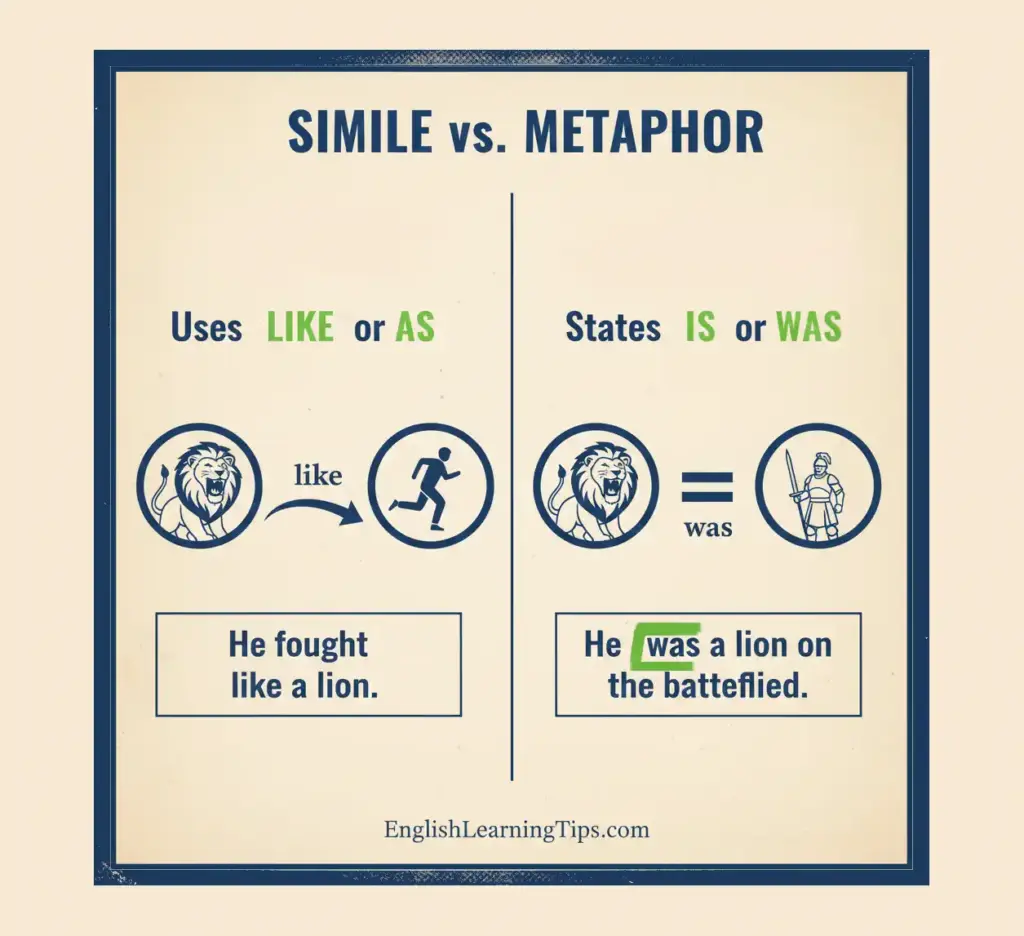
- Similes are indirect; they say something is like something else. They act as a bridge.
- Metaphors are direct; they say something is something else. They act as an equation.
Example:
- Simile: He fought like a lion.
- Metaphor: He was a lion on the battlefield.
Metaphors act as an equation rather than a bridge. If you want to move beyond ‘like’ and ‘as,’ learn the specific techniques in our tutorial on how to write a metaphor.
Visual learners often find it easier to grasp these concepts through storytelling. A fantastic resource for younger students is My Dog Is as Smelly as Dirty Socks, which uses playful similes to build a family portrait.
How to use similes to improve your writing
Using figurative language isn’t just about being “poetic.” It’s actually a practical tool for clearer communication.
1. Simplify complex ideas
If you are explaining a difficult technical concept, compare it to something your audience already knows.
- Example: “The computer’s processor is like the human brain.”
2. Add emotional emphasis
Similes can evoke feelings that literal descriptions cannot.
- Example: Instead of saying “I was sad,” you might say, “I felt as empty as a hollowed-out tree.”
3. Create vivid imagery
In the famous line from William Shakespeare’s Romeo and Juliet, Romeo laments:
“Is love a tender thing? It is too rough, too rude, too boisterous, and it pricks like thorn.”
By comparing the abstract emotion of love to the physical sting of a thorn, Shakespeare makes the character’s internal pain tangible and relatable to the audience.
Mastering these techniques takes practice. If you’re looking to sharpen your prose, we recommend keeping a reference guide like Literary Devices by Amy Jones at your desk for quick inspiration.
Tips for writing original similes
To avoid repetitive prose, stay away from clichés. “Busy as a bee” or “white as a sheet” have been used so often that they’ve lost their power.
- Be specific: Instead of “as fast as a car,” try “as fast as a bullet train.”
- Think about the mood: If you are writing a horror story, use dark comparisons (“The moon looked like a pale, unblinking eye”).
- Consider your audience: Ensure the “familiar” half of your comparison is actually something your reader understands.
Learn more about literary devices
If you want to master the English language, explore these other essential figures of speech:
- Alliteration: The repetition of consonant sounds.
- Hyperbole: Extreme exaggeration for effect.
- Onomatopoeia: Words that mimic sounds (e.g., “bang” or “hiss”).
- Personification: Giving human traits to non-human objects.
Frequently asked questions about similes
Visual tools to help you learn
Video: Similes found in movies
Check out these famous movie moments—see if you can spot how the similes change the mood of the scene instantly.
Video: Similes for kids
If you’re a teacher or parent, this video breaks the concept down into bite-sized pieces that actually stick.
Conclusion: Mastering the art of comparison
Learning how to use a simile effectively is more than just a grammar lesson—it is a tool for better communication. By mastering the “like” or “as” connection, you can turn a simple sentence into a memorable image that sticks with your reader long after they have finished your work. Whether you are writing a poem or a professional email, remember that the best comparisons are fresh, relevant, and clear.
Share your favorite similes
We want to hear from you! Do you have a favorite simile from a book or a movie? Or perhaps you have written an original one that you are particularly proud of?
Leave a comment below with your best example. If you found this guide helpful for your writing or studies, please share it with a friend or a classmate who wants to master literary devices. Your engagement helps us create more high-quality writing resources!
Discover more from English Learning Tips
Subscribe to get the latest posts sent to your email.


