


Homographs: Definition, examples, and how to use them

“You can’t fit a palm in your palm.”
English is famous for being a “tricky” language, and homographs are a primary reason why. Whether you are a student, a writer, or an English learner, mastering these words is essential for reading comprehension and clear communication.
What is a homograph?
A homograph is a word that shares the same spelling as another word but has a different meaning. The term comes from the Greek words homos (same) and graph (writing).
While they always look the same on the page, they don’t always sound the same. This leads to two specific categories:
- Homographic homophones: Spelled the same and pronounced the same (e.g., bark).
- Heteronyms: Spelled the same but pronounced differently (e.g., lead).
Recommended resources for mastering homographs
If you’re serious about mastering these tricky words, a dedicated reference guide is invaluable. Here are a few top-rated tools:
- Homonyms, Homophones, and Homographs by Manik Joshi: A comprehensive vocabulary builder specifically designed to help you navigate these linguistic overlaps.
- The American Heritage Dictionary of the English Language: Widely regarded for its superior etymology sections, which explain why two identical words have different origins.
Common homograph examples in English
The following table highlights how the same spelling can represent entirely different parts of speech and ideas.
| Word | Meaning A | Meaning B |
| Bark | The outer layer of a tree trunk | The sound a dog makes |
| Bass | A low-frequency sound or instrument | A type of freshwater fish |
| Bow | To bend at the waist (respect) | A weapon used to shoot arrows |
| Close | To shut a door or window | Being near in distance |
| Lead | A heavy, metallic element | To guide or go first |
| Minute | A unit of time (60 seconds) | Something extremely small |
| Palm | The inner surface of the hand | A type of tropical tree |
| Wind | Moving air (the weather) | To turn a key or clock |
Why homographs matter for writers and readers
Understanding these words is more than just a grammar exercise; it’s about mastering the nuances of context.
1. Navigating ambiguity
Because homographs look identical, they can create “speed bumps” for readers. For example: “The insurance agent decided to close the case because the witness lived too close.” Without clear context, a reader might stumble over the shifting pronunciation and meaning.
2. Creative wordplay and puns
Homographs are the engine behind much of English humor. Puns often rely on the “double meaning” of a single spelling to create a comedic effect.
3. The role of heteronyms
When a homograph has two different sounds, it’s called a heteronym. This is common with words that change their pronunciation based on whether they are used as a noun or a verb (e.g., record the song vs. a new record).
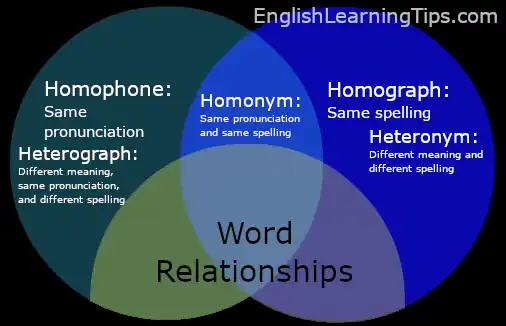
Homographs vs. homophones vs. homonyms
It is easy to get these “homo-” terms confused. Here is the quick breakdown:
- Homographs: Same writing (spelling), regardless of sound.
- Homophones: Same sound, regardless of spelling (e.g., their and there).
- Homonyms: A broad term often used for words that are both homographs and homophones.
Frequently asked questions about homographs
Visual tools to help you master homographs
Video: What are homographs?
Videos: 25 homograph pairs
Suggested further reading
- Understanding homophones: Words that sound the same but look different.
- Mastering homonyms: When spelling and sound overlap.
- Context clues: How to define words using surrounding text.
Mastering the world of homographs
English is a living, breathing language where one word can wear many hats. From a lead pipe to a lead singer, these words prove that context is everything. While homographs can be a bit of a linguistic “trick,” they are also what make writing and reading such a rewarding puzzle. Once you can spot the difference between a minute detail and a sixty-second minute, you are well on your way to mastery.
What is your favorite “tricky” word?
We want to hear from you! English is full of strange overlaps and confusing spellings that we didn’t even cover here.
- Leave a comment: What is the most confusing homograph you have ever encountered? Is there one that always trips you up when reading aloud?
- Share this guide: If you found these examples helpful, share this article with a fellow writer, a student, or a friend who loves wordplay.
- Join the conversation: Do you think English should be spelled more phonetically to avoid these “hidden” meanings?
Discover more from English Learning Tips
Subscribe to get the latest posts sent to your email.


