

Subjective and objective pronouns: A clear guide to using them correctly

“I‘ll buy the food if you’ll go out to eat with me.”
Subjective and objective pronouns are two categories of personal pronouns in English, and they serve different grammatical purposes based on their role in a sentence. In the sentence, “I’ll buy the food if you’ll go out to eat with me,” both types are in action. ‘I’ is doing the acting, while ‘me’ is receiving the action.
What is a subjective pronoun?
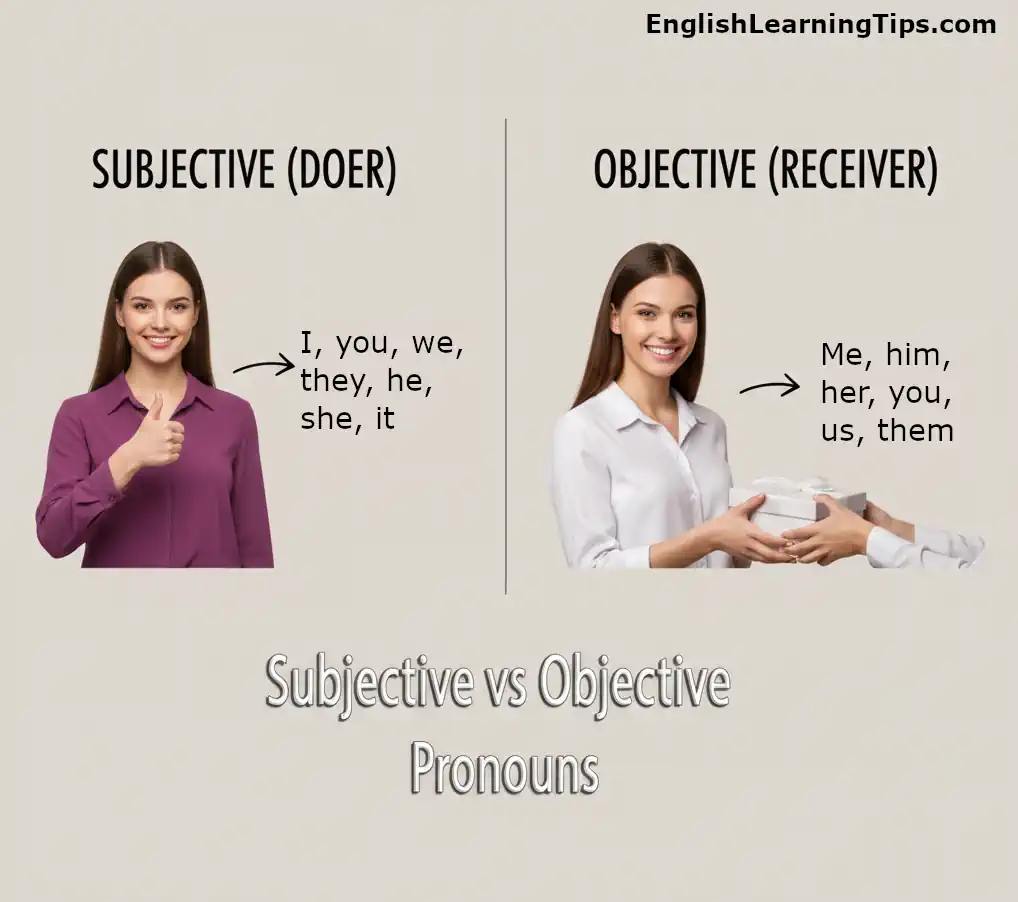
A subjective pronoun (also known as a nominative pronoun) acts as the subject of a sentence or a clause. This means the pronoun is the person or thing performing the action of the verb.
Subjective pronoun list
- Singular: I, you, he, she, it
- Plural: we, you, they
- Relative/Interrogative: who, whoever
Usage examples
- She went to the store. (‘She‘ is the one performing the action of going.)
- They are playing soccer. (‘They‘ are the ones playing.)
- We decided to stay home. (‘We‘ is the subject of the decision.)
What is an objective pronoun?
An objective pronoun acts as the object of a verb or a preposition. Instead of performing the action, these pronouns receive the action or follow a prepositional phrase (like “to,” “with,” or “for”).
Objective pronoun list
- Singular: me, you, him, her, it
- Plural: us, you, them
- Relative/Interrogative: whom, whomever
Usage examples
- The dog chased him. (‘Him‘ is receiving the action of being chased.)
- Give the book to me. (‘Me‘ is the object of the preposition “to.”)
- I saw them at the park. (‘Them‘ is the direct object of the verb “saw.”)
Subjective vs. objective pronouns at a glance
Use this table to quickly identify which pronoun case you need based on the person and number.
| Person | Subjective (The Doer) | Objective (The Receiver) |
| 1st Person (Singular) | I | me |
| 2nd Person (Singular/Plural) | you | you |
| 3rd Person (Singular) | he, she, it | him, her, it |
| 1st Person (Plural) | we | us |
| 3rd Person (Plural) | they | them |
| Relative Pronoun | who | whom |
Pro-tip: Keep a physical copy of The Elements of Style on your desk for those “Who vs. Whom” emergencies. It’s the ultimate quick-reference guide for every writer.
How to remember the difference: Simple grammar hacks
If you aren’t sure which pronoun to use, especially in complex sentences, try these two simple tests:
1. The “stand alone” test
If you are choosing between “He and I” or “Him and me,” remove the other person and see if the sentence still makes sense.
- Example: “Him and me went to the store.” → “Me went to the store.” (Incorrect)
- Example: “He and I went to the store.” → “I went to the store.” (Correct)
2. The “who vs. whom” shortcut
If you can replace the word with ‘he’, use ‘who’ (subjective). If you can replace it with ‘him’, use ‘whom’ (objective).
- Who/Whom wrote this? (He wrote this –> Who)
- To who/whom should I give this? (Give it to him –> Whom)
Frequently asked questions about pronouns
Test your knowledge: Subjective vs. objective quiz
Check your understanding by choosing the correct pronoun in the sentences below:
- Send the invite to Sarah and (I / me).
- (Who / Whom) should I address the letter to?
- It was (she / her) who finished the project first.
- My brother is much faster than (he / him).
- Between you and (I / me), I think we’re going to win.
1. me (Object of preposition) | 2. Whom (Object) | 3. she (Predicate nominative) | 4. he (Subject of implied verb “is”) | 5. me (Object of preposition)
Grammar summary table
| Category | Subjective Pronouns | Objective Pronouns |
| Usage | Performs the action | Receives the action |
| Placement | Usually before the verb | After the verb or preposition |
| Examples | I, You, He, She, It, We, They | Me, You, Him, Her, It, Us, Them |
Video: Subject vs. object pronouns
Recommend resources
Add a small “Recommended Resources” box just before the Conclusion.
| Recommended Product | Why we love it for grammar |
| Merriam-Webster’s Dictionary of English Usage | It goes deep into the “why” behind tricky pronoun rules. |
| Oxford Essential Writer’s Thesaurus | Helps you find the right verbs to go with your new pronouns. |
| The Blue Book of Grammar and Punctuation | Includes tons of quizzes just like the one in this article. |
Conclusion: Mastering your pronoun cases
Navigating the world of subjective and objective pronouns doesn’t have to be a struggle. Once you identify whether the pronoun is performing the action or receiving it, the choice between “I” and “me” or “who” and “whom” becomes second nature. Consistent, correct pronoun usage not only improves your writing flow but also establishes your authority as a communicator.
Whether you are drafting a professional email or polishing a creative piece, remember the simple “stand alone” test to keep your grammar on track. If you can master these fundamentals, you’re well on your way to more confident, error-free writing.
Join the conversation: What is your biggest grammar pet peeve?
Did this guide help clear up a “between you and me” debate? Or do you still find the “who vs. whom” rule a bit tricky?
We want to hear from you!
- Leave a comment below with the one grammar rule that always trips you up.
- Share this guide with a friend or colleague who is always asking about “John and I” vs. “John and me.”
- Bookmark this page as your quick reference for future writing projects.
Your feedback helps us create better resources for the writing community. Let’s help everyone write with more clarity!
Discover more from English Learning Tips
Subscribe to get the latest posts sent to your email.


