


Understanding subject pronouns in English: A complete guide

“He‘s the best puppy in the world!”
When you’re building a sentence in English, subject pronouns are the “doers” of a sentence. They replace specific nouns to prevent your writing from sounding repetitive or clunky. Instead of saying “Sarah went to the store because Sarah needed milk,” you use a subject pronoun: “Sarah went to the store because she needed milk.”
What is a subject pronoun?
A subject pronoun is a word used to replace a noun that functions as the subject of a verb. In any standard English sentence, the subject is the person, place, or thing that performs the action or exists in a certain state.
List of English subject pronouns with examples
English uses specific pronouns based on number (singular or plural), person (first, second, or third), and sometimes gender.
| Person | Singular | Plural |
| First person | I | We |
| Second person | You | You |
| Third person | He, She, It | They |
If you want to master these rules faster, the most recommended resource is English Grammar in Use by Raymond Murphy. It’s the world’s best-selling grammar book and includes a dedicated section on subject and object pronouns with practice exercises
1. I (First person singular)
Used when the speaker is the subject. It is always capitalized.
- Example: I enjoy hiking in the mountains.
2. You (Second person singular/plural)
Used for the person or people being addressed. “You” remains the same whether you are talking to one person or a group.
- Example: You should arrive ten minutes early.
3. He, she, it (Third person singular)
Used for people (masculine/feminine) or inanimate objects and animals.
- He: He is the lead architect on this project.
- She: She won the marathon in record time.
- It: It is a historic building.
4. We (First person plural)
Used when the speaker is part of a group.
- Example: We decided to move the meeting to Friday.
5. They (Third person plural)
Used for a group of people or things. It is also increasingly used as a gender-neutral singular pronoun.
- Example: They are the most delicious cookies in the bakery.
6. Who (Interrogative or relative)
Used to ask a question or link a relative clause to a person.
- Question: Who left the lights on?
- Relative clause: The professor who taught the lecture is from London.
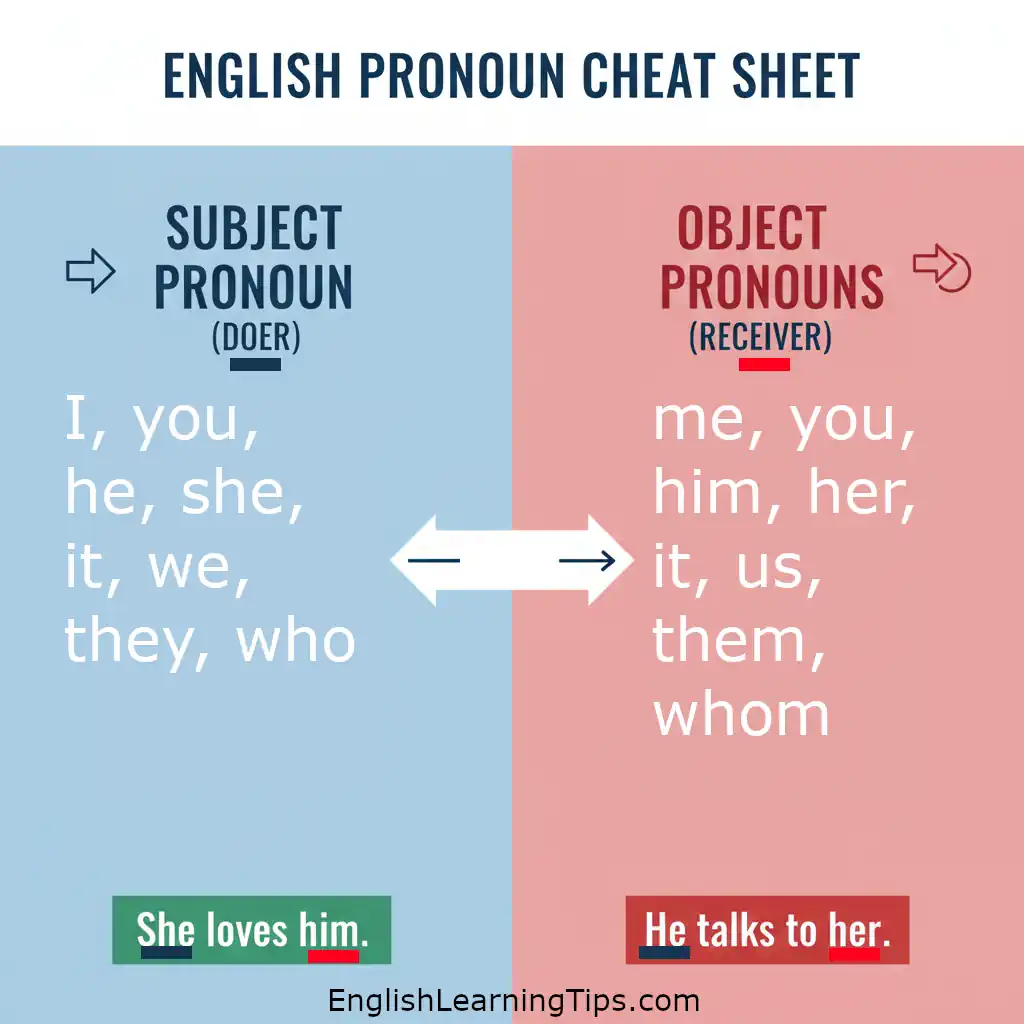
Subject vs. object pronouns: What is the difference?
The most common mistake in English is swapping a subject pronoun for an object pronoun. To keep it simple: Subjects do the action; objects receive it.
- Subject pronoun: They called us. (They performed the calling).
- Object pronoun: We called them. (They received the call).
| Subject (The doer) | Object (The receiver) |
| I | Me |
| You | You |
| He / She / It | Him / Her / It |
| We | Us |
| They | Them |
Frequently asked questions about subject pronouns
Final thoughts on subject pronouns in English
Mastering subject pronouns is the first step toward fluency in English. By replacing repetitive nouns with I, you, he, she, it, we, or they, you make your writing more professional and your speech more natural. While the difference between subjects and objects might seem small, using the correct form ensures your sentences are grammatically sound and easy to follow.
Join the conversation: How do you practice?
Do you have a trick for remembering the difference between subject and object pronouns? Or maybe there is a specific sentence that always trips you up?
Leave a comment below with your questions or your own example sentences! If you found this guide helpful, share it with a friend or a fellow student who is working on their English grammar. Your feedback helps us create better resources for everyone.
Discover more from English Learning Tips
Subscribe to get the latest posts sent to your email.


