
Point of view: A guide to first, second, and third person

Every story is a journey, but the narrator decides who sits in the driver’s seat. Whether you’re writing a memoir or a space opera, your choice of point of view (POV: First person, second person, third person) acts as the lens through which your reader experiences your world.
Choosing the right narrative perspective changes how much the reader knows and how emotionally connected they feel to the narrator.
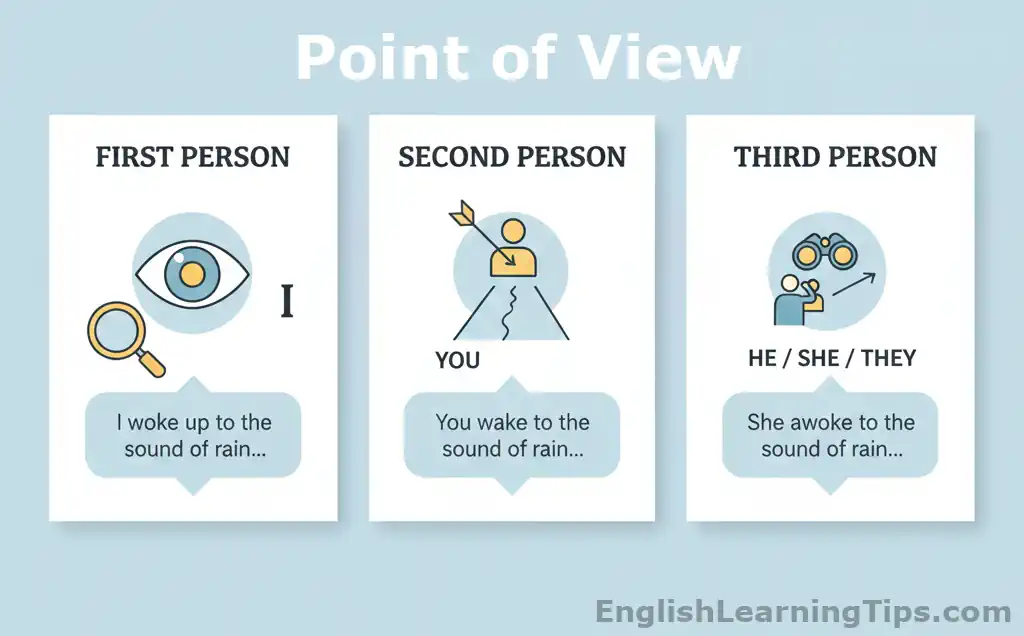
Point of view comparison at a glance
If you are looking for a quick breakdown of pronouns and perspective, use this table:
| Point of view | Primary pronouns | Narrator’s role | Common use cases |
| First person | I, me, we, us | A character in the story | Memoirs, personal essays, novels |
| Second person | You, your, yours | Addressing the reader | Instructions, self-help, gaming |
| Third person | He, she, they | An outside observer | News, fiction, biographies |
First-person point of view: The internal perspective
In the first-person perspective, the narrator is a character within the story. They share their own thoughts, feelings, and experiences directly with the reader. Because the narrator is limited to their own observations, this POV is highly subjective but creates a deep sense of intimacy.
- Keywords: I, me, my, we, our.
- Best for: Building a strong emotional bond between the reader and the protagonist.
Example of first-person narration
“I woke up to the sound of rain tapping against my window, a steady rhythm that matched the pounding in my chest. Last night’s argument with Sam still echoed in my mind—his sharp words cutting deeper than I’d expected. I rolled out of bed, my bare feet hitting the cold floor, and shuffled to the kitchen for coffee.”
Drafting scenes like this is much easier when you’re not staring at a screen. I do my best POV brainstorming in a classic Moleskine Hardcover Journal before I ever touch my keyboard.
Writer’s tip: I’ve found that many new writers default to First Person because it feels ‘easier,’ but it actually requires much more work to keep the voice consistent. If you find yourself constantly starting sentences with ‘I felt’ or ‘I saw,’ try switching a scene to Third Person Limited to focus more on the action.
Second-person point of view: The direct address
The second-person perspective turns the reader into the protagonist. It is most commonly found in instructional writing (like this article), “choose your own adventure” books, and persuasive speeches. It is the rarest form of POV in traditional fiction because it can feel restrictive for long-form storytelling but is common in literary short stories and experimental prose.
- Keywords: You, your, yours.
- Best for: Giving instructions, tutorials, or creating an immersive, experimental experience.
Example of second-person narration
“You wake to the sound of rain drumming against your window, a restless beat that mirrors the unease twisting in your gut. The memory of last night’s fight with Sam lingers—his words slicing through you like a knife you didn’t see coming. You swing your legs out of bed, the chill of the floor jolting you awake, and stumble toward the kitchen.”
Third-person point of view: The outside observer
The third-person perspective is the most versatile and common POV in literature. Here, the narrator is an external voice telling the story of others. This POV is generally categorized into three distinct types:
- Third-person limited: The narrator only knows the thoughts and feelings of one character (usually the protagonist).
- Third-person omniscient: The narrator is “all-knowing” and can jump between the thoughts and histories of any character.
- Third-person objective: The narrator describes only what can be seen or heard (like a camera), offering no insight into the characters’ inner thoughts.
- Keywords: He, she, they, him, her, them.
- Best for: Complex plots, epic fantasies, or journalistic reporting.
To master the third person, you need to understand the three distinct levels of narrator ‘distance’: Limited, Omniscient, and Objective.
Example of third-person narration
“She awoke to the gentle patter of rain against her window, a soft cadence that echoed the tension still simmering in her chest. The argument with Sam from the night before replayed in her mind. She slipped out of bed, her feet meeting the cold floor with a shiver, and made her way to the kitchen.”
The 3 Levels of “narrator distance”
Think of third-person POV like a camera lens. Depending on the type you choose, you are either sitting inside the character’s brain or watching them from a mile away:
- Limited (Close): The camera is over one character’s shoulder. You feel what they feel.
- Omniscient (Wide): The camera is in the sky. You see everyone’s secrets at once.
- Objective (Remote): The camera is a fly on the wall. You only see what happens; you don’t know what anyone is thinking.
Master your POV: If you’re struggling to keep your narrator’s voice consistent, I highly recommend Alicia Rasley’s The Power of Point of View. It’s the “gold standard” for understanding how to manipulate psychic distance.
Frequently asked questions about narrative perspective
Summary of POV differences
- First person = The speaker’s perspective (I am telling my story).
- Second person = The listener’s perspective (I am telling your story).
- Third person = The observer’s perspective (I am telling their story).
Conclusion: Choosing the right narrative voice
Selecting a point of view is more than a grammatical choice; it is the most powerful tool in a writer’s kit for building empathy and pacing. Whether you prefer the raw intimacy of first person, the immersive “you” of second person, or the expansive bird’s-eye view of third person, your POV defines how your audience experiences your world.
There is no “correct” perspective, only the one that best serves your story’s heart.
Share your thoughts: Which POV do you prefer?
We want to hear from you! Narrative perspective is a hot topic for both readers and writers, and everyone has a favorite style.
- Writers: Which point of view do you find the easiest (or hardest) to write?
- Readers: Do you find first-person narrators more relatable, or do they sometimes feel too biased?
Drop a comment below with your thoughts or any POV challenges you’ve faced in your own work. If you found this guide helpful, share it with your writing group or on social media—it helps other creators find the resources they need to succeed.
Discover more from English Learning Tips
Subscribe to get the latest posts sent to your email.


