

Reflexive pronouns: Definition, examples, and grammar rules

“He prepared himself for the exam.”
Have you ever said, “I told myself I wouldn’t do that”? If so, you’ve used a reflexive pronoun. They might seem like minor details, but using them correctly keeps your sentences from becoming confusing.
What is a reflexive pronoun?
A reflexive pronoun is a specific type of pronoun that refers back to the subject of a sentence or clause. It is used when the subject (the person or thing doing the action) and the object (the person or thing receiving the action) are identical.
List of reflexive pronouns in English
English uses eight standard reflexive pronouns, which change based on whether the subject is singular or plural, and which “person” is being used (first, second, or third).
| Subject pronoun | Reflexive pronoun | Number | Person |
| I | Myself | Singular | First |
| You | Yourself | Singular | Second |
| He | Himself | Singular | Third |
| She | Herself | Singular | Third |
| It | Itself | Singular | Third |
| We | Ourselves | Plural | First |
| You | Yourselves | Plural | Second |
| They | Themselves | Plural | Third |
How to use reflexive pronouns correctly
The primary function of a reflexive pronoun is to show that an action “reflects” back onto the person who started it. Here are the three most common ways they appear in everyday writing:
1. As a direct object
This occurs when the subject performs an action on themselves.
- Example: “The athlete prepared himself for the marathon.”
- Example: “I accidentally cut myself while chopping vegetables.”
2. As an indirect object
The subject performs an action for their own benefit.
- Example: “She bought herself a new laptop.”
- Example: “They poured themselves some coffee.”
3. As the object of a preposition
When a preposition refers back to the subject.
- Example: “The cat sat by itself in the sun.”
- Example: “You should be proud of yourselves.”
Reflexive vs. intensive pronouns: What is the difference?
It is easy to confuse reflexive pronouns with intensive pronouns because they look identical (ending in -self or -selves). However, their jobs are very different.
- Reflexive pronouns are necessary. If you remove them, the sentence no longer makes sense or its meaning changes.
- Intensive pronouns are optional. They are used only for emphasis to highlight that the subject did something without help.
Comparison:
- Reflexive: “I taught myself to play guitar.” (Without “myself,” the sentence is incomplete).
- Intensive: “I myself taught the class.” (If you remove “myself,” the sentence “I taught the class” still works perfectly).
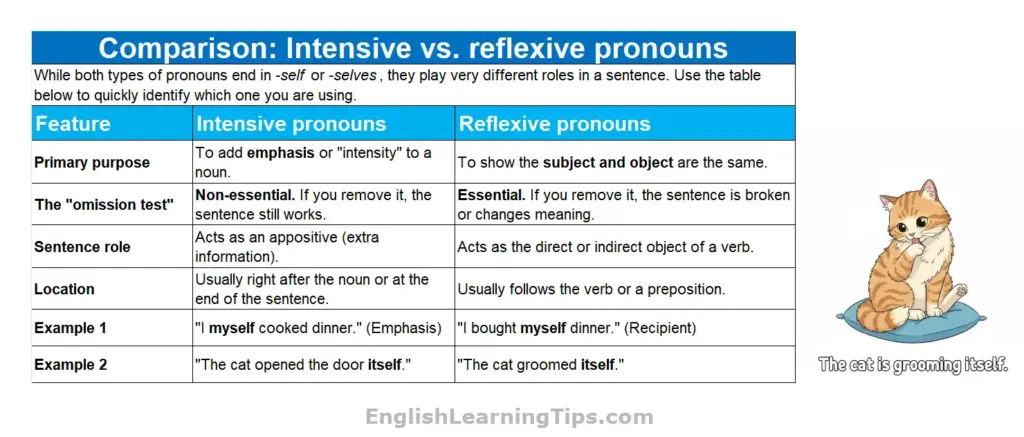
If you find the ‘omission test’ helpful but want to dive deeper into tricky sentence structures, keeping a reliable desk reference like The Blue Book of Grammar and Punctuation can be a lifesaver for professional writing.
Common mistakes to avoid
Even native speakers often trip up on reflexive pronoun grammar. Avoid these two common pitfalls to keep your writing professional:
- Don’t use them to sound “fancy”: A common error is using a reflexive pronoun when a personal pronoun (me, him, her) is required.
- Incorrect: “Please send the report to myself.”
- Correct: “Please send the report to me.”
- The “theirselves” myth: The word “theirselves” is not a standard English word. Always use “themselves.”
Pro-tip: If you aren’t sure, try removing the other person from the sentence. You wouldn’t say “The boss invited myself to lunch,” so you shouldn’t say “The boss invited Sarah and myself to lunch. Avoiding these pitfalls is easier when you have a quick-reference guide on your desk. I highly recommend The Only Grammar Book You’ll Ever Need for a no-nonsense look at common pronoun errors.
Frequently asked questions about reflexive pronouns
Master your grammar with reflexive pronouns
Reflexive pronouns might seem small, but using them correctly is a simple way to make your writing look more professional. Whether you are writing a formal email or a creative story, remembering the “mirror rule”—that the action must reflect back to the subject—will help you avoid the most common “me vs. myself” traps.
By mastering these eight simple words, you ensure your message is clear, your tone is confident, and your grammar is flawless.
What is your biggest grammar pet peeve?
We want to hear from you! Is there a specific reflexive pronoun mistake that drives you crazy, or do you have a trick for remembering when to use “me” instead of “myself”?
Drop a comment below to join the conversation. If you found this guide helpful, share it with a friend or colleague who loves (or struggles with!) the nuances of the English language. Your shares help us create more free resources like this one.
Discover more from English Learning Tips
Subscribe to get the latest posts sent to your email.


