


Indefinite pronouns: What they are and how to use them

“All of the cookies are gone.”
You use indefinite pronouns every day without realizing it. Instead of naming every person in a room, you simply say ‘everyone.’ These words are very important in general English, and they are also behind some of the most common grammar mistakes.
What is an indefinite pronoun?
An indefinite pronoun is a pronoun that does not refer to a specific person, amount, or thing. Unlike personal pronouns (like he, she, or it), which point to a distinct noun mentioned earlier, indefinite pronouns are broader.
They are particularly useful for making general observations or when the identity of the subject is unknown. For example, in the sentence “Someone left the lights on,” the speaker knows an action occurred but doesn’t know (or doesn’t need to specify) exactly who did it.
Indefinite vs. definite pronouns
While a definite pronoun (like ‘it’) refers back to a specific, previously mentioned noun, an indefinite pronoun (like ‘anything’) stands on its own without needing a prior reference.
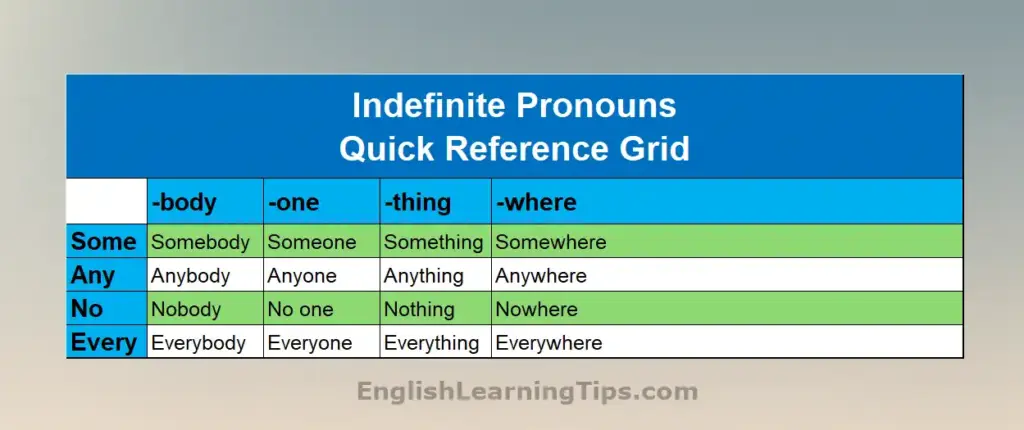
How to use indefinite pronouns in a sentence
Indefinite pronouns function just like other nouns or pronouns in a sentence. They can act as the subject (the one performing the action) or the object (the one receiving the action).
- As a subject: “Something smells delicious in the kitchen.”
- As an object: “I didn’t see anyone at the park.”
Singular vs. plural indefinite pronouns
One of the most common mistakes in English grammar involves subject-verb agreement with indefinite pronouns. To write clearly, you must know which pronouns are singular, which are plural, and which can be both.
| Category | Indefinite pronouns | Example sentence |
| Always singular | Anyone, everyone, nobody, someone, each, either, neither, everything | Everyone is invited to the party. |
| Always plural | Both, few, many, others, several | Many were chosen for the team. |
| Variable (Depends on context) | All, any, more, most, none, some | Some of the water is gone. / Some of the apples are gone. |
Mastering subject-verb agreement
The “variable” pronouns listed above—often remembered by the acronym SANAM (Some, Any, None, All, Most)—change based on the noun they refer to.
- Uncountable nouns: Use a singular verb. (“All of the milk has spilled.”)
- Countable nouns: Use a plural verb. (“All of the students have arrived.”)
Pro-Tip: Words ending in -body, -one, and -thing (like anybody, someone, or nothing) are always singular. Even though “everyone” sounds like a lot of people, it treats the group as a single unit, so it takes a singular verb: “Everyone is,” not “Everyone are.”
Frequently asked questions about indefinite pronouns
Video: Indefinite pronouns
Conclusion
Mastering indefinite pronouns is one of the fastest ways to polish your writing and avoid common grammatical “red flags.” While most people struggle with whether to use is or are after words like none or everyone, you now have the tools to navigate these tricky sentences with confidence.
Remember, when in doubt, check if the pronoun ends in -one, -body, or -thing—if it does, keep it singular. For the SANAM pronouns (Some, Any, None, All, Most), just look at the noun they are modifying to decide the verb form.
Join the conversation: What is your biggest grammar pet peeve?
Do you find yourself sticking to the “none is” rule, or do you prefer the modern “none are” approach? Grammar rules are constantly evolving, and we want to hear your take.
- Leave a comment: Is there a specific indefinite pronoun that always trips you up? Let us know below!
- Share this guide: If you found this breakdown helpful, share it with a fellow writer or student who wants to master subject-verb agreement.
- Bookmark it: Save this page as a quick reference for your next writing project.
Discover more from English Learning Tips
Subscribe to get the latest posts sent to your email.


