

Reciprocal pronouns: What they are and how to use them

“They love each other.”
We use reciprocal pronouns when two or more people are doing the same thing to one another. Instead of saying ‘James helps Sarah and Sarah helps James,’ you can just say they ‘help each other.
In English, there are only two reciprocal pronouns: each other and one another.
What is a reciprocal pronoun? A reciprocal pronoun is a word used to show that two or more people are performing the same action toward one another. The only two in English are each other and one another.
How reciprocal pronouns work
A reciprocal pronoun shows a mutual relationship. Instead of writing two separate sentences to describe a two-way action, you can use a reciprocal pronoun to make your writing more concise.
To use these correctly, you must have:
- Two or more subjects: You cannot use a reciprocal pronoun with a singular subject (e.g., “I talk to each other” is incorrect).
- A mutual action: Both parties must be performing the same action toward the one another.
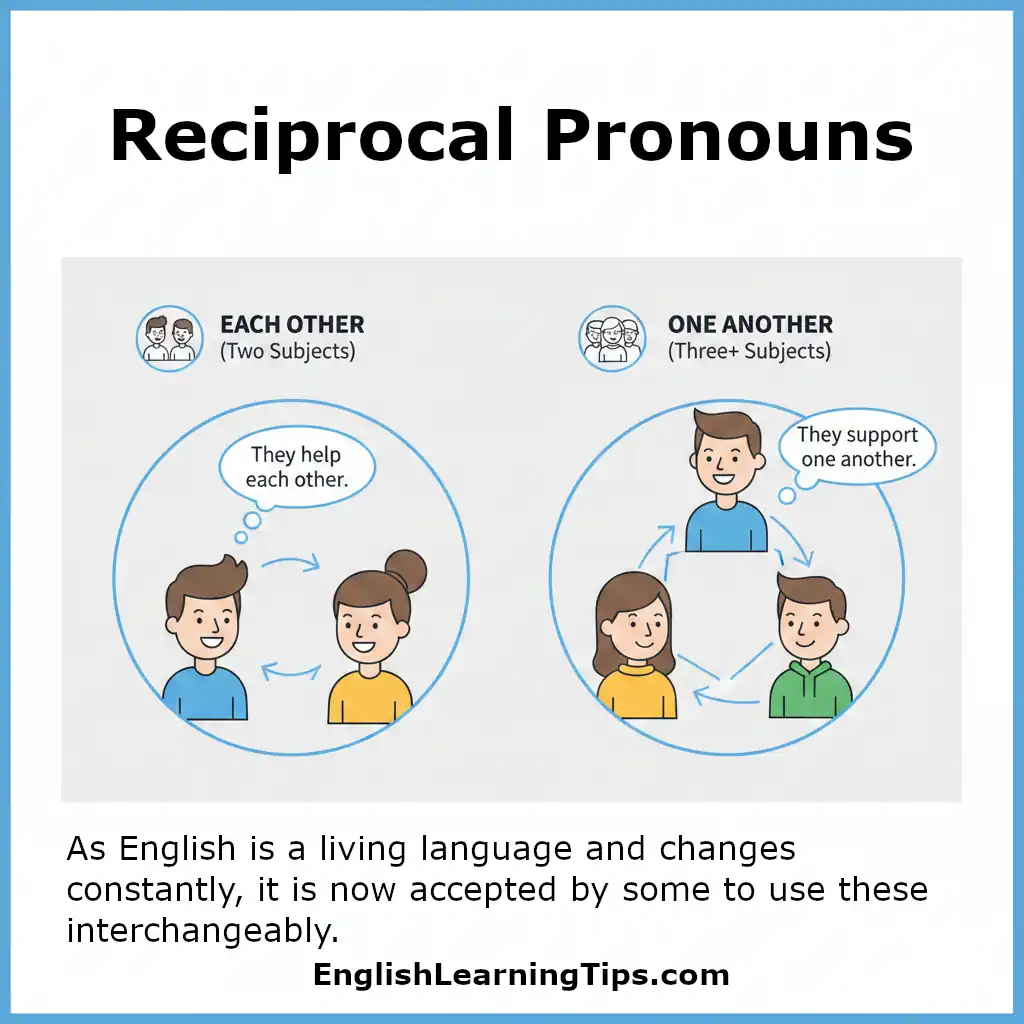
The difference between each other and one another
Many writers wonder if there is a strict rule for choosing between these two terms. While they are often used interchangeably in modern English, there is a subtle distinction used in formal writing.
Each other vs. one another at a glance
| Pronoun | Traditional usage | Example |
| Each other | Used for two people or things. | The twins miss each other. |
| One another | Used for three or more people or things. | The students cheered for one another. |
The bottom line: In everyday speech and most online writing, you can use these interchangeably. However, if you’re writing for a formal academic journal, stick to the ‘two vs. many’ rule. For a complete breakdown of these subtle rules, The Blue Book of Grammar and Punctuation is an essential desk reference.”
Examples of reciprocal pronouns in sentences
Using reciprocal pronouns helps avoid repetitive phrasing. Here are a few ways they appear in everyday English:
- Direct objects: “The boxers hit each other.”
- Indirect objects: “The colleagues gave one another gifts.”
- With prepositions: “They are perfectly suited for each other.”
- Possessive forms: “They held each other’s hands.” (Note: Always place the apostrophe before the ‘s’).
Reciprocal pronouns vs. reflexive pronouns
It is easy to confuse reciprocal pronouns with reflexive pronouns (words like themselves or ourselves). However, the meaning changes significantly depending on which one you choose.
- Reflexive: “The players blamed themselves for the loss.” (Each player feels personal guilt).
- Reciprocal: “The players blamed each other for the loss.” (Player A blamed Player B, and vice versa).
The meaning changes significantly depending on which you choose. If you want to master these differences through practice, we highly recommend English Grammar in Use—it’s the most popular self-study workbook for a reason.
Frequently asked questions about reciprocal pronouns
Visuals to help you learn
Video: Reciprocal pronouns for children
Video: Each other and one another (reciprocal pronouns)
Final thoughts on reciprocal pronouns
Reciprocal pronouns are essential for making your writing flow. By cutting out repetitive names and phrasing, your sentences become much easier to read.
Join the conversation
Grammar rules are constantly evolving, and we want to hear your take. Do you still follow the strict “two people vs. three people” rule for each other and one another, or do you think it’s outdated for modern writing?
If you found this guide helpful, share it with a fellow writer or student who is mastering English grammar. Drop a comment below with your toughest pronoun question—we respond to every single one!
Discover more from English Learning Tips
Subscribe to get the latest posts sent to your email.


