

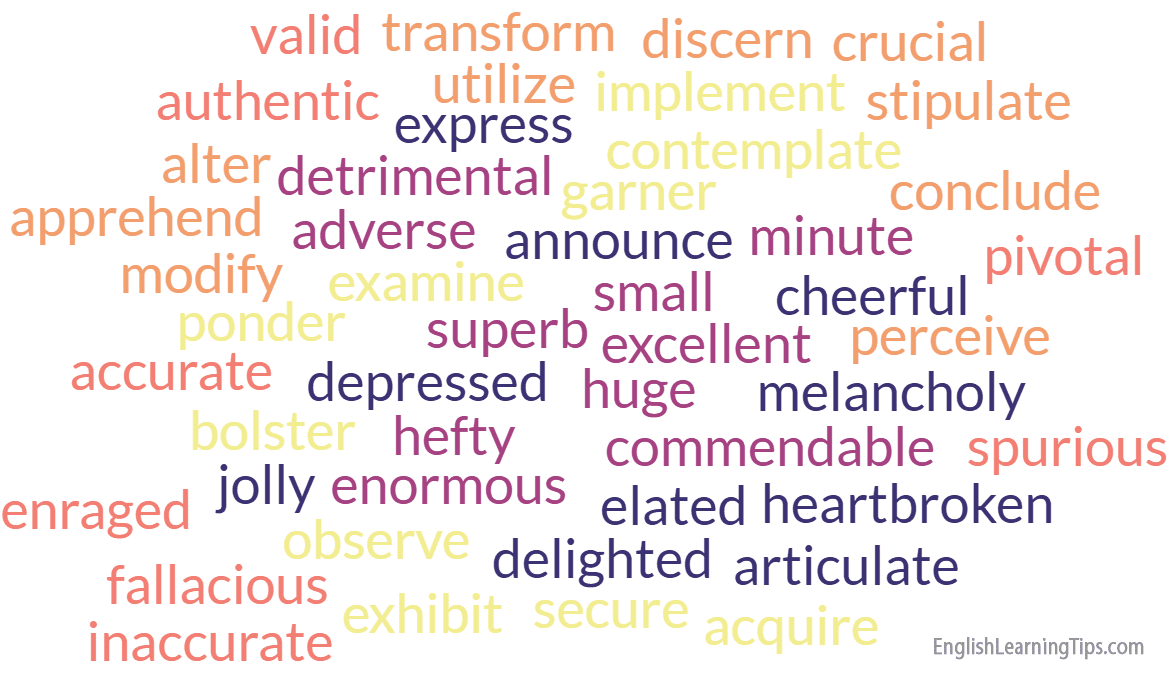
50 everyday words and advanced alternatives to make your writing more alive

Learning synonyms is very important for ESL learners. First, synonyms expand vocabulary. English is full of words that have similar meanings, like “happy,” “joyful,” or “cheerful.” Knowing these options helps you express yourself more precisely and avoids repetition, making your speech or writing sound more natural and engaging.
Why ESL learners should study synonyms
- Expand your vocabulary: English is famous for having multiple words for the same idea, such as “happy,” “joyful,” or “cheerful.” Using these options makes your speech sound more natural and engaging.
- Improve reading comprehension: When you know synonyms, you can often guess the meaning of unfamiliar words from context. If you understand the word “big,” you can easily grasp the meaning of “huge” when you see it in a book. Research on vocabulary thresholds suggests that a diverse vocabulary is the primary driver of successful reading comprehension.
- Master linguistic nuance: English speakers choose words based on subtle differences in tone. For example, there is a distinct difference in social context between calling someone “slim” versus “skinny”. This process of understanding word connotations is essential for achieving a near-native level of fluency.
- Boost speaking confidence: Having a deeper “linguistic toolkit” means you spend less time searching for the right word, leading to smoother, more comfortable real-life conversations.
The ultimate synonym list: 50 common words and their advanced alternatives
While the words below will improve your writing, remember that many advanced alternatives are formal. In casual conversation, plain speech is usually best. st. For further exploration of word relationships, the Merriam-Webster Thesaurus is an excellent tool for finding the exact nuance you need.
| Everyday word | Advanced alternatives | Contextual example |
| 1. Big | Enormous, substantial, voluminous, capacious, immense, hefty, huge | The elephant is an enormous animal. |
| 2. Small | Minute, diminutive, negligible, infinitesimal, paltry | He packed a minute amount of food for the trip. |
| 3. Good | Excellent, superb, commendable, exemplary, proficient | This is an excellent book with well-written characters. |
| 4. Bad | Detrimental, adverse, deleterious, pernicious, reprehensible | Stealing is a reprehensible choice. |
| 5. Happy | Jubilant, elated, ecstatic, exultant, convivial, delighted, jolly | She felt ecstatic after her promotion. |
| 6. Sad | Melancholy, depressed, sorrowful, heartbroken, despondent | She felt a sense of melancholy after his departure. |
| 7. Say | Articulate, express, declare, pronounce, enunciate, announce | He decided to express exactly what was on his mind. |
| 8. Look | Observe, scrutinize, examine, peruse, contemplate | She turned to observe the vibrant sunset. |
| 9. Get | Acquire, obtain, procure, garner, secure | He went to the bank to secure a loan. |
| 10. Think | Contemplate, deliberate, ruminate, speculate, ponder | She paused to contemplate the difficult question. |
| 11. Make | Fabricate, generate, construct, synthesize, formulate | He decided to construct a wooden shelf. |
| 12. Help | Facilitate, assist, aid, bolster, succor | She offered to assist the stranded motorist. |
| 13. Show | Demonstrate, exhibit, illustrate, delineate, manifest | He wanted to exhibit his artwork to the class. |
| 14. Use | Utilize, employ, exercise, implement, wield | She decided to utilize her extra space for a coffee bar. |
| 15. Start | Commence, initiate, inaugurate, instigate, embark, kickoff | He pressed the button to initiate the countdown. |
| 16. Stop | Cease, terminate, conclude, relinquish, desist | They were told to cease calling her immediately. |
| 17. Change | Modify, alter, transform, mutate, amend | We might need to alter our plans due to the storm. |
| 18. Know | Comprehend, discern, recognize, apprehend, perceive | I don’t recognize her. |
| 19. Need | Require, necessitate, demand, mandate, stipulate | We demand the city fix the roads. |
| 20. Important | Significant, crucial, pivotal, paramount, consequential | The election has significant consequences. |
| 21. Funny | Hilarious, comical, droll, facetious, whimsical | That joke was hilarious. |
| 22. True | Verifiable, accurate, authentic, valid, incontrovertible | That is a very accurate statement. |
| 23. False | Erroneous, fallacious, inaccurate, spurious, apocryphal | That was an erroneous statement. |
| 24. Angry | Incensed, irate, indignant, exasperated, acrimonious | Suzie became irate when they broke her window. |
| 25. Enough | Sufficient, adequate, ample, copious, commensurate | Two days is an adequate amount of time. |
| 26. Go | Proceed, depart, traverse, migrate, drive | We will depart for the airport at noon. |
| 27. Come | Arrive, convene, materialize, ensue, appear | Do you think your plans will materialize? |
| 28. Keep | Retain, preserve, maintain, conserve, uphold | We retain the right to sue in court. |
| 29. Let | Permit, authorize, sanction, concede, tolerate | I will permit you to retake the test. |
| 30. Put | Position, deposit, install, allocate, assign, place | Would you position the nameplates in order? |
| 31. Take | Extract, remove, seize, acquire, appropriate | We need to seize the next opportunity. |
| 32. Do | Execute, perform, conduct, accomplish, discharge | We need to conduct a new search for a president. |
| 33. Have | Possess, retain, encompass, comprise, wield, acquire | We possess the keys to the house. |
| 34. Give | Bestow, confer, impart, allocate, render | The university will confer your degree. |
| 35. Find | Discover, locate, ascertain, detect, unearth | Scientists discovered a new species. |
| 36. Feel | Perceive, sense, experience, discern, apprehend | The dog could sense someone inside the house. |
| 37. Leave | Vacate, abandon, relinquish, depart, forsake | We abandoned the building during the fire alarm. |
| 38. Call | Summon, convene, invoke, designate, proclaim | They summoned a new attorney. |
| 39. Want | Desire, aspire, covet, yearn, crave | I am really craving some ice cream. |
| 40. Work | Operate, function, labor, exert, endeavor | I operate a forklift at my job. |
| 41. Walk | Amble, stroll, traverse, step, stretch | We took a stroll through the park. |
| 42. Run | Sprint, dash, hasten, accelerate, scamper, race | Mark dashed to the store before it closed. |
| 43. Eat | Consume, devour, ingest, partake, assimilate | He devoured the whole pie by himself. |
| 44. Sleep | Repose, slumber, hibernate, doze, stagnate | I could doze off right now. |
| 45. Book | Reserve, schedule, register, enlist, arrange | We need to reserve our next hotel stay. |
| 46. Buy | Purchase, acquire, obtain, procure, secure | I purchased a new TV for the bedroom. |
| 47. Answer | Respond, reply, retort, acknowledge, reciprocate | I responded to the client’s email. |
| 48. Ask | Inquire, query, solicit, interrogate, postulate | Should I inquire about the hotel’s facilities? |
| 49. Fight | Contend, combat, dispute, grapple, oppose | My brothers had a dispute over their toys. |
| 50. Plan | Devise, formulate, strategize, organize, contrive | We need to strategize our next business move. |
Frequently asked questions about English synonyms
Master English fluency through precise vocabulary
Learning synonyms is a transformative step for ESL learners, providing the tools for richer expression, deeper comprehension, and greater communication confidence. By moving beyond common words and exploring advanced alternatives, you can adapt your language to any situation—whether it is a formal report or a casual chat. Remember to use these new tools wisely, favoring plain speech in daily conversation while utilizing sophisticated options to make your writing stand out.
Which synonym will you use first?
We would love to hear from you! Expanding your vocabulary is a lifelong journey, and sharing your experience helps the whole community.
- Leave a comment: Which word on this list was your favorite, or is there a “big” word you find yourself overusing?
- Share this guide: If you found these 50 synonyms helpful, share this article with a fellow learner or teacher to help them boost their writing too.
- Join the conversation: Tell us about a time when finding the “perfect” word changed the way you were understood.
Discover more from English Learning Tips
Subscribe to get the latest posts sent to your email.


