


Mastering small talk: A professional guide for business meetings

Small talk can help break the ice and build rapport during a business meeting. It builds trust and connection between people before discussing serious topics, making communication easier and more effective. For example, asking about the weather or someone’s day shows interest and respect, which can reduce nervousness and encourage teamwork.
In professional settings, small talk also fills awkward silences and helps people feel more relaxed, so they can focus better on the meeting. Overall, it’s a simple way to improve relationships and make conversations smoother.
Here are some ideas tailored to keep things light, professional, and engaging.
Why small talk matters in the workplace
- Eliminates friction: It fills awkward silences and encourages a sense of teamwork.
- Builds psychological safety: Asking about someone’s day shows genuine interest and respect.
- Reduces anxiety: Friendly banter helps participants feel relaxed, allowing them to focus better on the agenda.
For a deeper look at how different personality types navigate social friction, Susan Cain’s Quiet is a must-read for any professional.
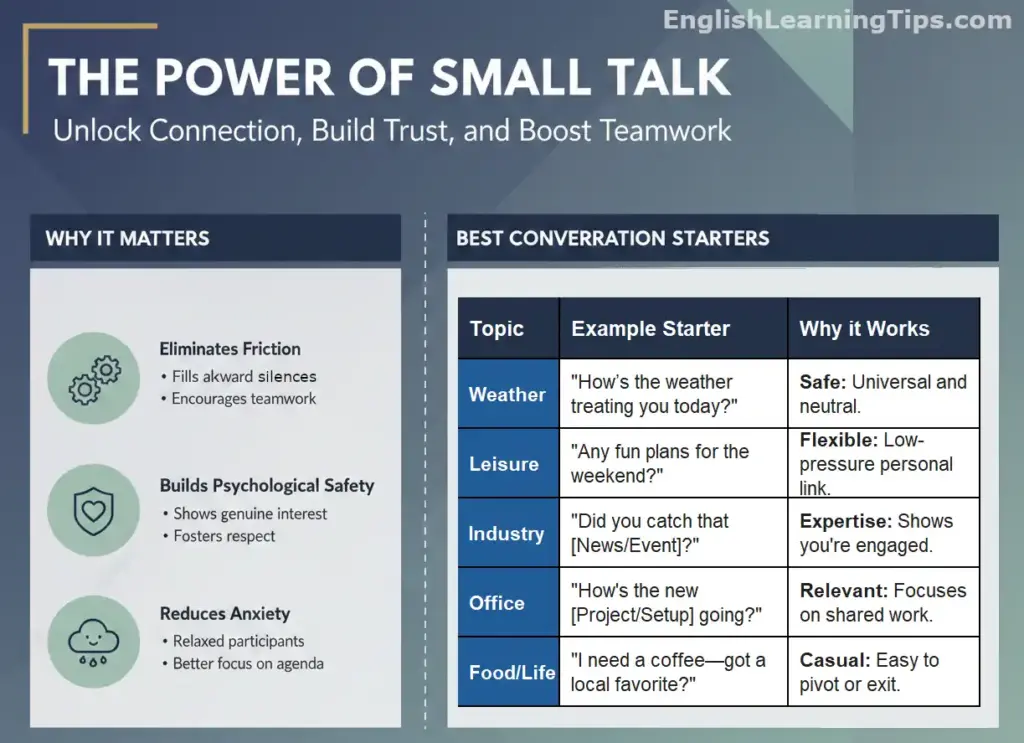
Best conversation starters for any meeting vibe
The “right” small talk depends on the setting and your relationship with the attendees. (Note: Most small talk relies on the present perfect, simple present, and past simple).
| Category | Conversation starter examples | Why it works |
| The weather | “Looks like spring is finally showing up—how’s the weather treating you?” | Neutral, relatable, and universally safe. |
| Weekend & leisure | “Did you do anything fun last weekend, or do you have big plans coming up?” | Allows the other person to share as much or as little as they like. |
| Industry news | “Did you catch that big industry conference last week? I heard some interesting takes.” | Shows you are informed and professionally engaged. |
| The office | “How is your team settling into the new hybrid setup?” | Relevant to current workplace trends. |
| Travel & food | “I’m surviving on coffee today—do you have a go-to spot around here?” | Casual and easy to pivot away from. |
Struggling to come up with questions on the fly? Keep a set of Table Topics: Business Edition cards on your desk to spark non-cliché dialogue during coffee breaks.
How to transition from small talk to the agenda
The most important part of small talk is knowing when to stop. Use these phrases to bridge the gap:
- The shared goal: “I know we’re all looking forward to discussing [topic] today.”
- The document lead-in: “I was just reviewing the [related document/email] and…”
- The compliment: “I was really impressed with your recent work on [project].”
- The follow-up: “Nice to see you again! Did your project go well after our last meeting?”
Need help transitioning to the next topic in a conversation? See our guide: Using transitional words and phrases to improve your communication skills.
Etiquette: What to avoid
To maintain professionalism, steer clear of topics that could create tension or discomfort:
- Controversial subjects: Avoid politics, religion, or sensitive social issues.
- Negativity: Skip gossip or complaints about colleagues and the company.
- Intrusive questions: Do not ask about deeply personal problems or health issues.
- Inappropriate comments: Avoid anything that could be construed as harassment.
Frequently asked questions about business small talk
Summary of tips for success
- Be genuine: Sincerity is easily detected; if you aren’t interested in a topic, don’t bring it up.
- Stay positive: A bright attitude helps build rapport faster.
- Be culturally aware: Remember that appropriate topics vary significantly across different cultures.
Professional small talk comparison table
| Situation | Recommended approach | Goal |
| First-time meeting | Focus on the venue, the commute, or how you are connected. | Establishing safety/familiarity. |
| Returning client | Mention a detail from a previous chat (e.g., “How was that trip to Italy?”). | Building long-term rapport. |
| Internal team sync | Light hobbies, streaming shows, or “low-stakes” weekend plans. | Team bonding and “vibe check.” |
| International call | Research local holidays or time-zone-appropriate greetings. | Demonstrating cultural |
Visuals to help you learn
Video: Making small talk with friends, family, and co-workers
Video: How to get good at small talk and even enjoy it
Final thoughts: Turning small talk into a big advantage
Mastering the art of the “pre-meeting” conversation is about more than just filling silence; it is about building a foundation of trust that makes professional collaboration possible. By using the strategies above—from the “FORD” method to cultural awareness—you can transform awkward moments into opportunities for genuine connection.
Remember, the most successful professionals aren’t necessarily the loudest ones in the room; they are the ones who know how to make others feel comfortable and heard before the first slide even appears on the screen.
Join the conversation
We want to hear from you! Small talk looks different in every industry and every office culture.
- What is your go-to “icebreaker” that never fails?
- Have you ever had a small talk moment go hilariously wrong?
- Are you a “Peach” or a “Coconut” when it comes to office socialising?
Leave a comment below to share your best tips, or share this article with a colleague who might be heading into a big networking event soon. Let’s help each other make the “dreaded” small talk a little more human.
Discover more from English Learning Tips
Subscribe to get the latest posts sent to your email.


