


Action verbs vs. stative verbs: Definitions, examples, and key differences

“He yawned after a long hike.”
Understanding the difference between action verbs and stative verbs is essential for mastering English grammar. Using the wrong verb form can make your writing feel clunky or confusing. Knowing when to avoid the ‘-ing’ form is the secret to sounding like a native speaker.
What are action verbs?
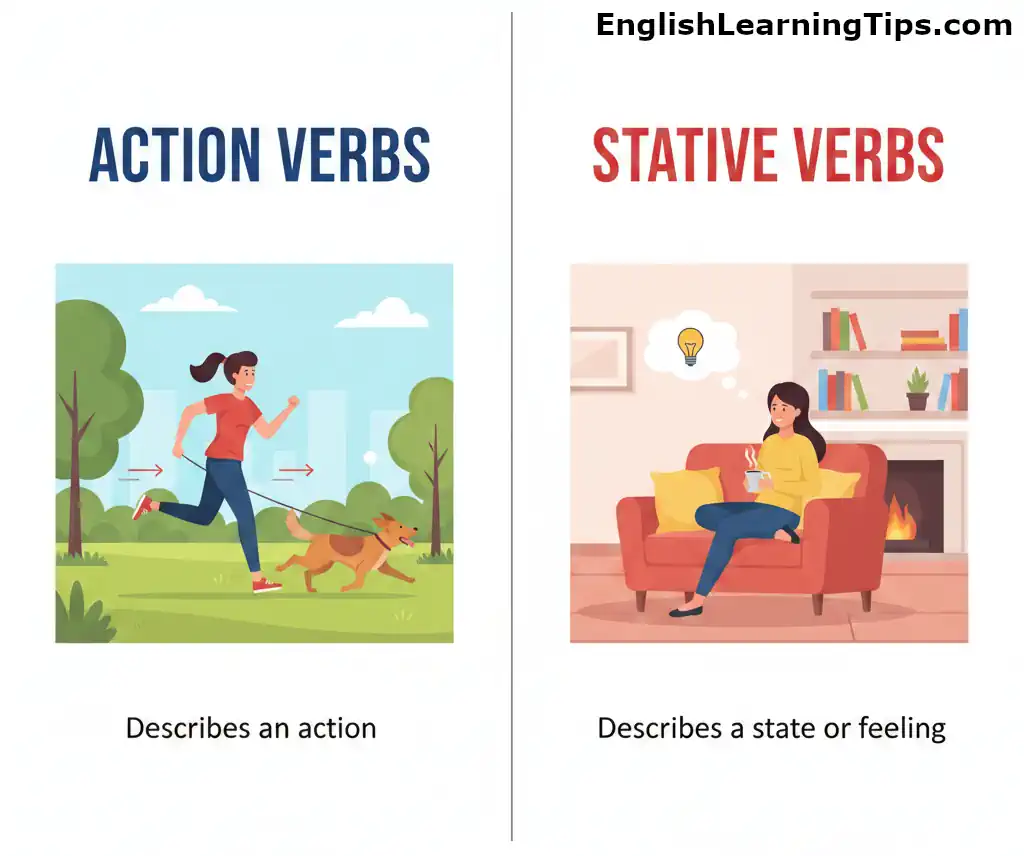
Action verbs, often called dynamic verbs, describe a physical or mental action performed by the subject. These verbs tell the reader what is happening in a sentence. Because they describe a process or a movement, they can be used in both simple and continuous (progressive) tenses.
Physical actions
These are actions you can see or hear.
- “He jumped with joy after winning the game.”
- “She kicked the ball into the net.”
- “The dog ran across the yard.”
Mental actions
Even if you can’t see the movement, these are still considered actions because the mind is actively processing information.
- “She analyzed the complex data.”
- “They thought about the problem for hours.”
- “We decided to leave early.”
What are stative verbs?
Stative verbs (or state verbs) describe a condition, a state of being, or a fixed situation. Unlike action verbs, they do not describe an active process.
The primary rule of stative verbs: They are rarely used in continuous (-ing) tenses. For example, you would say “I hate onions,” not “I am hating onions.”
Common categories of stative verbs
| Category | Examples |
| Emotions | Love, hate, like, prefer, want |
| Possession | Have, own, belong, possess, contain |
| Senses | Hear, see, smell, taste, seem |
| Thoughts/Beliefs | Believe, know, understand, doubt, remember |
| States of being | Be, exist, appear, weigh |
Key differences at a glance
| Feature | Action verbs | Stative verbs |
| Definition | Describes an activity or process | Describes a state or condition |
| Continuous tense (-ing) | Yes (e.g., “I am running”) | No (e.g., “I am knowing” is incorrect) |
| Duration | Usually has a beginning and an end | Usually constant or indefinite |
| Examples | Run, jump, eat, think, write | Love, own, belong, see, exist |
Verbs that can be both action and stative
Some verbs are ‘double agents’—they change meaning depending on how you use them. These are often called mixed verbs.
Think
- Stative (Opinion): “I think it’s a good idea.”
- Action (Process): “I am thinking about moving to Spain.”
Have
- Stative (Possession): “I have a car.”
- Action (Activity): “I am having lunch with a friend.”
See
- Stative (Perception): “I see a bird in the tree.”
- Action (Meeting/Relationship): “I am seeing the doctor tomorrow.”
Frequently asked questions about action and stative verbs
Video: Stative vs action verbs
Recommended practice tools for mastering verbs
If you want to move beyond theory and start using these verbs perfectly in conversation, we recommend these top-rated workbooks:
- For self-study: English Grammar in Use by Raymond Murphy – Frequently called the “grammar bible,” this book features excellent side-by-side explanations and exercises specifically for action and stative tenses.
- For quick reference: The Blue Book of Grammar and Punctuation – Perfect for professionals who need a “just the facts” guide to keep on their desk.
- For comprehensive rules: The English Grammar Workbook for Adults – A great choice if you prefer real-world examples and interactive quizzes to reinforce your learning.
Conclusion: Mastering the balance of action and state
Distinguishing between action verbs and stative verbs is more than just a grammar exercise; it is the key to writing with precision. By recognizing when a verb describes a physical process versus a mental state, you can avoid common “progressive tense” errors and make your English sound more natural.
Remember: if the verb describes a lasting condition or a feeling, keep it simple. If it describes an activity you can physically see or a mental process in motion, feel free to use that “-ing” form.
Join the conversation
Grammar can be tricky, and even native speakers disagree on some of these “mixed verbs.” We want to hear from you:
- Is there a specific verb that always trips you up?
- Have you noticed any famous brands using stative verbs “incorrectly” in their slogans?
Drop a comment below with your toughest grammar questions, and our team will help you break them down! If you found this guide helpful, share it with a fellow learner or colleague to help them master their verb tenses.
Discover more from English Learning Tips
Subscribe to get the latest posts sent to your email.


