

50 Cooking phrasal verbs: Master the language of the kitchen

Cooking is more than just following a recipe; it is a sensory experience that brings people together. To truly master the culinary arts, you need to understand the specific language used in the kitchen. Phrasal verbs—which combine a standard verb with a preposition or adverb—provide the precision needed to describe complex cooking actions.
Whether you are trying to chop up vegetables for a healthy stew or whip up a quick midnight snack, these expressions are essential for anyone navigating English recipes or culinary blogs.
This list covers 50 essential phrasal verbs with clear definitions and examples to help you navigate any kitchen with confidence.
What are phrasal verbs?
A phrasal verb is a unique type of English expression that combines a base verb (like cook, cut, or turn) with a particle—usually a preposition or an adverb (like up, down, off, or in).
What makes them tricky is that the combination often creates a new meaning that is different from the original verb. For example, the verb turn means to move in a circle, but turn down the heat means to reduce the temperature.
Why we use them in the kitchen
In a culinary context, phrasal verbs allow for “shorthand” instructions. Instead of saying “remove the liquid by pouring it through a strainer,” a recipe will simply say to drain off the liquid. Mastering these allows you to:
- Follow recipes faster: You won’t have to pause to look up long descriptions.
- Sound like a native speaker: Phrasal verbs are the “natural” way English speakers communicate in the kitchen.
- Improve precision: There is a subtle but important difference between chopping (cutting) and chopping up (cutting into many pieces).
Essential cooking phrasal verbs for every home chef
| Phrasal verb | Definition | Example sentence |
| Add in | To include an extra ingredient into a mixture. | Add in the sugar once the butter has melted. |
| Bake off | To finish cooking something in the oven. | Let’s bake off the cookies so they are fresh for the party. |
| Beat in | To mix an ingredient vigorously into a batter. | Beat in the eggs one at a time to keep the batter smooth. |
| Blend in | To mix ingredients until they are fully combined. | Blend in the flour slowly to avoid creating lumps. |
| Boil down | To reduce a liquid by heating until it thickens. | Boil down the balsamic vinegar to create a glaze. |
| Boil over | When liquid overflows from a pot due to heat. | Keep an eye on the stove so the milk doesn’t boil over. |
| Boil up | To bring a liquid to the boiling point quickly. | Boil up some water for the spaghetti. |
| Break up | To separate food into smaller pieces by hand. | Break up the chocolate bar into small chunks. |
| Brown off | To cook the surface of meat until it turns brown. | Brown off the beef before adding it to the slow cooker. |
| Burn off | To remove excess fat or alcohol through heat. | Simmer the red wine sauce to burn off the alcohol. |
| Chop up | To cut food into small, irregular pieces. | Chop up the onions and garlic for the base of the soup. |
| Cool down | To allow food to lower in temperature. | Let the loaf of bread cool down before you slice it. |
| Cook down | To reduce the volume of food by cooking it longer. | Cook down the spinach until it wilted and tender. |
| Cook up | To prepare a meal, often spontaneously. | I’m going to cook up a big breakfast this Sunday. |
| Cut back | To reduce the amount of an ingredient used. | You should cut back on sugar if you want a tart flavor. |
| Cut down | To decrease the quantity of something for health. | Try to cut down on salt to improve your heart health. |
| Cut in | To mix solid fat into flour using a cutting motion. | Cut in the cold butter until the dough looks crumbly. |
| Cut off | To remove an inedible or unwanted part of food. | Cut off the ends of the green beans before steaming. |
| Cut up | To slice food into bite-sized pieces. | Cut up the chicken so it cooks evenly in the stir-fry. |
| Dish out | To serve food onto individual plates or bowls. | Can you help me dish out the mashed potatoes? |
| Drain off | To remove excess liquid or fat after cooking. | Drain off the grease from the ground beef. |
| Dredge up | To coat food thoroughly with a dry ingredient. | Dredge up the chicken in seasoned flour before frying. |
| Dry out | To lose moisture, often from overcooking. | Be careful not to dry out the pork chops in the oven. |
| Eat up | To finish all the food that has been served. | Eat up your broccoli so you can have dessert! |
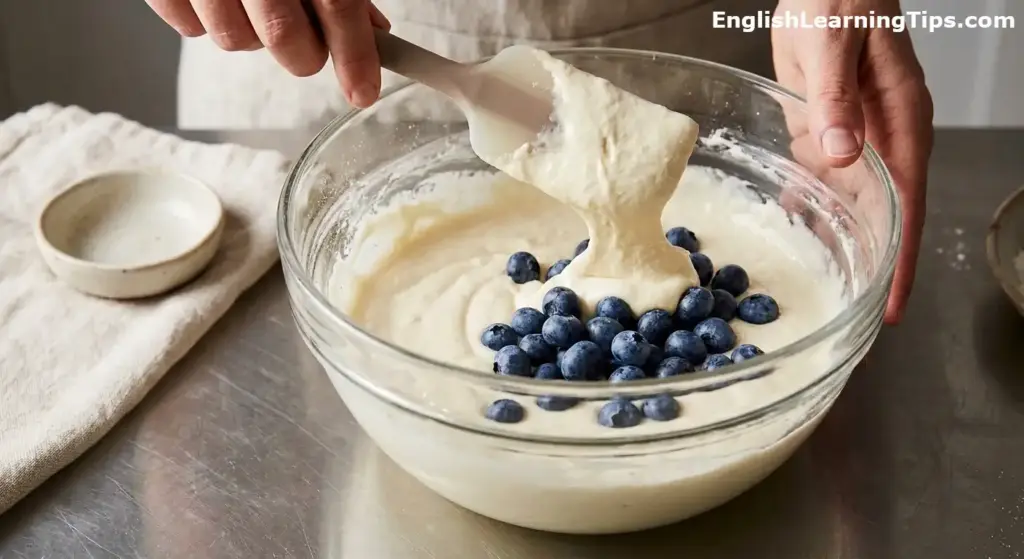
| Fold in | To gently combine a light ingredient into a heavy one. | Fold in the blueberries so you don’t crush them. |
| Fry up | To cook something quickly in hot oil or fat. | I’ll fry up some bacon and eggs for our guests. |
| Grind up | To process food into small particles or powder. | Grind up the peppercorns for a bolder flavor (with a peppercorn grinder). |
| Heat up | To increase the temperature of food or leftovers. | You can heat up the lasagna in the microwave. |
| Knead in | To work an ingredient into dough by hand. | Knead in the raisins once the dough has risen. |
| Mix in | To combine one ingredient with others. | Mix in the shredded cheese while the pasta is hot. |
| Mix up | To blend ingredients thoroughly together. | Mix up the pancake batter until there are no dry spots. |
| Peel off | To remove the outer layer of a fruit or vegetable. | Peel off the skin from the peaches before making the pie. |
| Pick over | To sort through food to remove debris. | Pick over the dry beans to remove any small stones. |
| Pour in | To add a liquid ingredient into a container. | Pour in the chicken stock slowly while stirring. |
| Pour out | To transfer or discard liquid from a container. | Pour out the pasta water once the noodles are al dente. |
| Roll out | To flatten dough with a rolling pin. | Use a tapered French rolling pin to roll out your pie crust evenly |
| Scoop out | To remove the inside of something with a spoon. | Scoop out the avocado and mash it with lime juice. |
| Scrape off | To remove burnt bits or residue from a surface. | Scrape off the charred bits from the grill. |
| Serve up | To present food for eating. | Serve up the soup with a side of crusty bread. |
| Shake up | To mix ingredients by shaking a closed container. | Shake up the salad dressing before you drizzle it. |
| Simmer down | To lower the heat for a gentle cook. | Let the chili simmer down for at least an hour. |
| Slice up | To cut food into thin, flat pieces. | Slice up the apples for the fruit platter. |
| Soak up | To absorb liquid with food. | Use the bread to soak up the extra garlic butter. |
| Spice up | To add flavor or heat to a dish. | Spice up your tacos with some extra jalapeños. |
| Stir in | To mix an ingredient using a spoon. | Stir in a dollop of sour cream right before serving. |
| Toss in | To casually add an ingredient to a mix. | Toss in a handful of parsley for some color. |
| Turn down | To lower the temperature setting on a stove. | Turn down the heat to low once the water boils. |
| Turn up | To increase the temperature setting on a stove. | Turn up the heat to get a good sear on the steak. |
| Warm up | To gently heat food to eating temperature. | I need to warm up the gravy before we eat. |
| Whip up | To quickly prepare a meal or froth a liquid. | I can whip up a salad in less than five minutes. |
Frequently asked questions about kitchen phrasal verbs
Conclusion: Spice up your culinary vocabulary
Mastering these verbs will help you follow recipes with precision or discuss food like a seasoned pro. From the delicate technique of folding in egg whites to the practical necessity of draining off excess fat, these terms provide the specific instructions you need to move from basic meal prep to advanced cooking.
By incorporating these expressions into your daily routine, you’ll find that both your cooking and your conversations become much richer. Whether you are whipping up a quick weeknight dinner or simmering down a complex sauce for a holiday feast, you now have the linguistic tools to handle any recipe that comes your way.
Join the conversation
Which of these phrasal verbs do you use most often in your kitchen? Or is there a tricky cooking term that always confuses you when you’re reading a recipe?
Tell us in the comments below! If you found this guide helpful, please share it with your fellow foodies or English learners—let’s help everyone cook with confidence.
Discover more from English Learning Tips
Subscribe to get the latest posts sent to your email.


