

Using transitional words and phrases to improve your communication skills

Transitional words act as logical roadmaps for your readers. Whether you are writing an academic essay, delivering a business presentation, or engaging in daily conversation, these “connecting words” act as a bridge between your ideas.
This guide explores the strategic importance of transitions and provides a comprehensive list of cohesive devices to sharpen your communication.
Why transitional words are essential for effective communication
Transitional words and phrases hold effective communication together. These linguistic tools—such as “however,” “therefore,” and “on the other hand”—guide your audience through your logic, ensuring clarity and engagement.
To master these transitions, having a reliable reference is key. Many learners find the English Grammar in Use by Raymond Murphy to be the most practical workbook for practicing these connections, and Word Power Made Easy (Norman Lewis) helps greatly with vocabulary expansion.
Incorporating transitions is a fundamental skill for several key reasons:
1. Enhancing clarity and coherence
Transitional words create logical connections between sentences. Without them, ideas feel disjointed, leaving readers to struggle to piece together your intended message.
Comparison of flow:
- Without transitions: “I wanted to attend the concert. It was raining. I stayed home.”
- With transitions: “I wanted to attend the concert; however, it was raining, so I stayed home.”
The second version is more cohesive because it clarifies the relationship (contrast and result) between the three facts.
2. Guiding the audience through structure
Transitions act as “signposts.” They prepare the listener for what is coming next—whether it is a counter-argument (“on the contrary”), an illustration (“for instance”), or a summary (“in conclusion”).
3. Improving readability and engagement
A natural rhythm keeps readers immersed. Choppy sentences frustrate the reader, whereas smooth transitions maintain momentum. In persuasive writing, phrases like “consequently” or “as a result” strengthen your case by clearly linking causes to effects.
Common types of transitional words and their functions
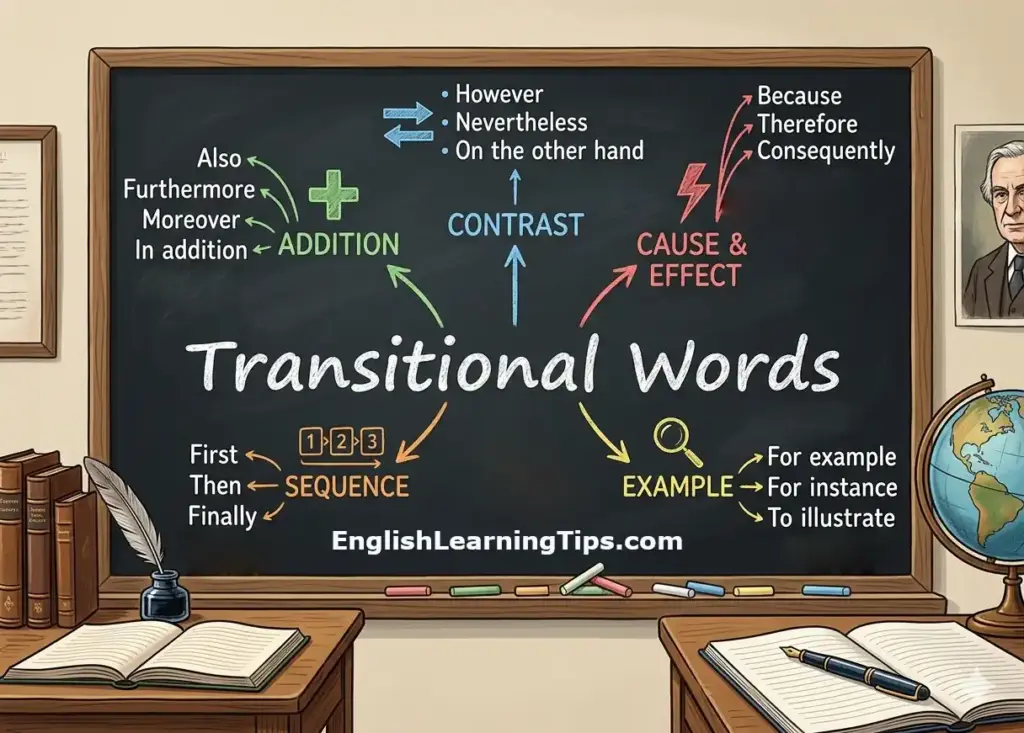
To help you choose the right connector for your context, refer to the table below. Using a variety of these terms prevents your writing from feeling repetitive.
Quick reference: Transition categories
| Function | Common examples | Purpose |
| Addition | Furthermore, Moreover, Additionally | To add information or strengthen a point. |
| Contrast | However, Nevertheless, On the contrary | To show a difference or opposing idea. |
| Cause & effect | Therefore, Consequently, As a result | To show a logical result or reason. |
| Sequence | Subsequently, Meanwhile, Finally | To organize ideas by time or importance. |
| Emphasis | Indeed, Notably, Significantly | To draw attention to a specific point. |
| Illustration | For instance, Specifically, To illustrate | To provide examples for clarity. |
Overcoming common challenges with transitions
To ensure your content remains high-quality and avoids fluff, keep these tips in mind:
- Avoid over-usage: You do not need a transition at the start of every single sentence. Use them when the logical leap between two ideas isn’t immediately obvious.
- Match the tone: Use “moreover” or “subsequently” for formal reports, but stick to “plus” or “then” for casual emails and social media.
- Check for logic: Ensure the word actually fits. For example, don’t use “therefore” unless the second point is a direct result of the first.
- The “comma splice” error: Never use a comma alone to join two sentences with a transition like “therefore.” Always use a semicolon or a period.
- Mismatching logic: Using “consequently” when there is no clear cause-and-effect relationship confuses the reader and hurts your authority.
- The ‘redundancy’ trap (pleonasm): Avoid using transitions that add no extra meaning. If two sentences are already clearly linked, adding “additionally” is just filler.
Frequently asked questions about transitional phrases
Comprehensive appendix of transitional words
1. Addition and agreement
These terms introduce extra information that supports your previous statement.
- Moreover: Emphasizes a more important additional point.
- In addition: Introduces a supporting idea.
- Not only… but also: Creates an emphasis on two related points.
- Likewise / Similarly: Suggests a parallel between two ideas.
2. Contrast and contradiction
Use these to highlight differences or shift direction.
- Nevertheless: Maintains a point despite a previous contrast.
- On the other hand: Presents a different perspective.
- Despite / In spite of: Shows that something is true regardless of an opposing factor.
- Whereas: Directly compares two different situations.
3. Cause, effect, and condition
These show why something happened or the requirements for an outcome.
- Consequently: Highlights a result that follows logically.
- Due to / Owing to: Points to a specific cause (formal).
- Provided that: Specifies a condition that must be met.
- Hence: Indicates a consequence (often used in technical writing).
4. Sequence and time
Organize your thoughts chronologically or by priority.
- Subsequently: Indicates something that follows in time.
- Simultaneously: Shows two events happening at once.
- To begin with: Signals the start of a list or discussion.
- Eventually: Indicates a result after a long period.
5. Conclusion and summary
Signal to your audience that you are wrapping up your argument.
- Ultimately: Points to the most important final conclusion.
- In brief / In short: Provides a quick summary.
- All in all: An informal way to summarize the whole situation.
- To sum up: Concisely reviews the key points discussed.
Conclusion: Master the art of the transition
Transitional words and phrases are far more than just fillers; they are the strategic tools that transform disjointed ideas into a compelling narrative. By using these connectors thoughtfully, you improve your writing’s “flow,” making it easier for both human readers and even search engine algorithms to follow your logic (this is very important in web development). Whether you are aiming for a higher grade on an essay or trying to lead a more persuasive business meeting, mastering these linguistic bridges is one of the fastest ways to elevate your communication skills.
Join the conversation
Which transitional word do you find yourself overusing the most? Are there any specific phrases you struggle to fit into your writing?
Drop a comment below and let’s discuss the best ways to keep your writing fresh and engaging. If you found this guide and our appendix of transitions helpful, please share it with a friend or colleague who is looking to polish their English skills. Your feedback helps us create better resources for the community!
Discover more from English Learning Tips
Subscribe to get the latest posts sent to your email.


