
Common colloquialisms in British English: A guide to UK slang

British English is famously confusing. Beyond the ‘Queen’s English‘ you hear in movies, the UK relies on a shorthand of cheeky slang and centuries-old colloquialisms. Whether you’re trying to figure out if someone is actually angry (‘miffed’) or just calling you a friend (‘mate’), these 20 terms are essential for navigating any UK pub or high street. Let’s break down some common British slang terms reflecting the diverse regional dialects that make up the United Kingdom.
The “bits and bobs” that define British life
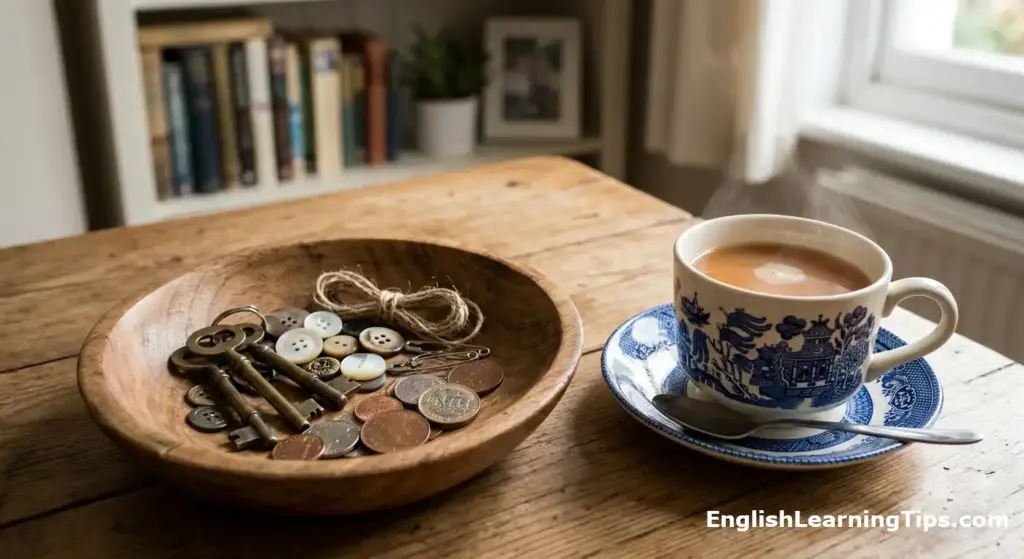
British culture is celebrated for its coziness and appreciation of the mundane. In this snapshot of a typical British home environment, we see a collection of objects that are the essence of the unique phrases you are about to learn.
You’ll find ‘bits and bobs‘ in every British household—usually in a ‘junk drawer‘ or a ceramic bowl by the door. It refers to those small, miscellaneous items like spare keys, loose change (quid), and safety pins that don’t have a home but are too useful to throw away.
Quick reference: British vs. American English colloquialisms
| British term | American equivalent | Meaning |
| Quid | Buck | One pound sterling (£) |
| Knackered | Exhausted / Pooped | Extremely tired |
| Chuffed | Stoked / Thrilled | Very pleased |
| Rubbish | Garbage / Trash | Nonsense or poor quality |
| A cuppa | A brew / Cup of Joe | A cup of tea |
| Nosh | Grub / Food | A meal or snack |
Level up your British English
If you want to dive deeper into UK culture, here are two essentials to get you started:
- Master the lingo: To go beyond the basics, British Slang 101 is a hilarious and comprehensive guide to modern UK expressions.
- Drink like a local: You can’t truly understand “a cuppa” until you’ve tried Yorkshire Tea, the unofficial gold standard for a proper British brew.
20 Essential British phrases you need to know
To truly understand the British “lingo,” you have to look past the literal definitions. Here are the most common colloquialisms used in the UK today.
- Cheers: Perhaps the most versatile word in the UK. While Americans use it for a toast, Brits use it to mean “thank you” or “goodbye.”
- Bloke: A casual term for a man, similar to “guy” or “dude.”
- Lass: A young woman or girl. You will hear this most frequently in northern England and Scotland.
- Gutted: Used when you are extremely disappointed. “I was absolutely gutted when the concert was canceled.”
- Chuffed: The opposite of gutted; it means you are delighted or proud.
- Knackered: A classic term for being “dead tired.”
- Skive off: To skip work or school without a valid reason.
- Dodgy: Something that seems suspicious, unreliable, or poor quality. A “dodgy” sandwich is one you probably shouldn’t eat.
- Quid: This is the informal name for the British pound. Note that “quid” is both singular and plural (e.g., “ten quid”).
- Rubbish: Used to describe something of low quality or to call out a lie. “That’s total rubbish!”
- Taking the mickey: To tease or mock someone in a lighthearted way.
- Gobsmacked: When you are so surprised that your mouth literally hangs open (your “gob”).
- Bits and bobs: Small, miscellaneous items or unfinished tasks.
- Full of beans: To be high-energy and enthusiastic.
- A cuppa: Short for “a cup of tea.” In the UK, a cuppa fixes almost any problem.
- Nosh: A casual word for food or a meal.
- Miffed: To be slightly annoyed or bothered by something.
- Sorted: When a situation is organized, resolved, or agreed upon. “I’ve booked the tickets, so we’re all sorted.”
- Right then: A common way to signal the start of a task or a transition in conversation.
- Fancy: To want something or to have a romantic interest in someone. “Do you fancy a cheeky Nando’s?”
Frequently asked questions about British slang
Conclusion: Why British English continues to charm the world
Mastering these 20 common British colloquialisms is about more than just “fitting in”—it is about understanding the self-deprecating humor and understated warmth of UK culture. Whether you are using “chuffed” to describe your latest win or “knackered” after a long day, these phrases bridge the gap between being a tourist and feeling like a local.
Language is a living thing, and the way we use it in the UK is constantly shifting. From the “ends” of London to the “glens” of Scotland, there is always a new “bit of kit” or a “daft” expression waiting to be discovered.
Join the conversation: What is your favorite British phrase?
Did we miss your favorite bit of British slang? Or perhaps you have a hilarious story about a time you used “pissed” when you meant “pissed off”?
Leave a comment below and let us know which phrase on this list you use the most! If you found this guide “brilliant,” share it with a mate who is planning a trip to the UK or simply loves a good “cuppa.”
Discover more from English Learning Tips
Subscribe to get the latest posts sent to your email.


