
Common colloquialisms in Scottish English: A guide to Scots slang

Scottish English is more than just a unique accent. It’s a vocabulary built on centuries of history, humor, and local grit — very lively colloquialisms. Whether you are navigating the “dear green place” of Glasgow or the historic streets of Edinburgh, hearing a local tell you to “mind the dug” (watch out for the dog) is your first step into a unique linguistic world.
In this guide, we break down 20 essential Scottish expressions, their meanings, and how to use them without looking like a “glaikit” tourist.
Essential Scottish phrases and meanings
To help you master the local lingo, we have organized these terms by how you’ll likely encounter them in daily conversation.
Daily greetings and affirmations
| Term | Meaning | Example sentence |
| Aye | Yes | “Are ye coming tae the pub?” “Aye, I’ll be there.” |
| Ken | To know or understand | “D’ye ken where the bus stop is?” |
| Nae bother | No problem / You’re welcome | “Thanks for the lift.” “Nae bother, pal.” |
| Wee | Small or little | “Would you like a wee dram of whisky?” |
Describing people and personalities
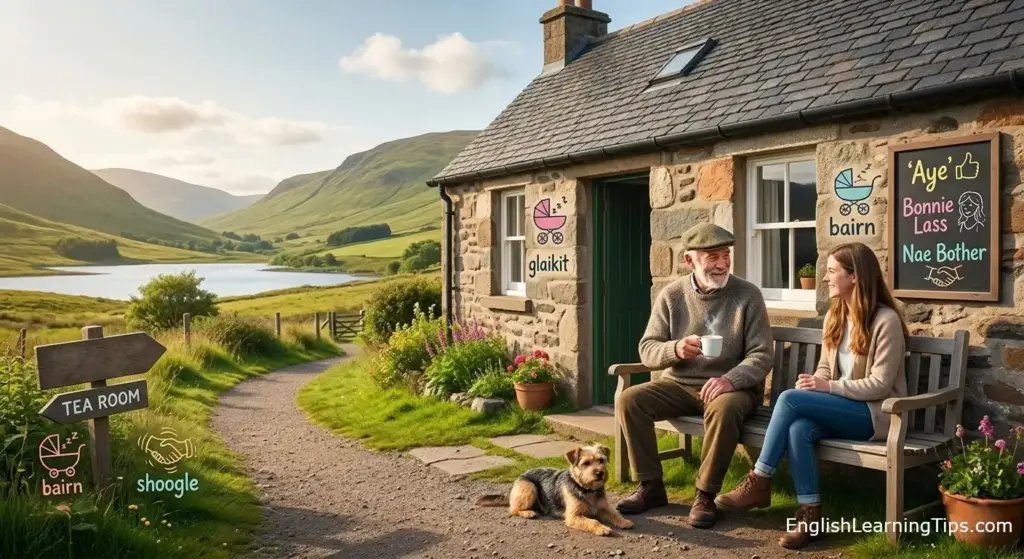
- Bairn: A child or baby. Used widely in the East and North. (“The wee bairn is sleeping.”)
- Bonnie: Beautiful, attractive, or pleasant. (“That’s a bonnie lass you’ve got there.”)
- Glaikit: Foolish, thoughtless, or having a vacant expression. (“Don’t be so glaikit, read the instructions!”)
- Lad / Lass: A young man or woman, respectively.
- Scunner: A feeling of strong dislike or being fed up with someone/something. (“I’ve taken a scunner to this rainy weather.”)
Verbs and actions
- Blether: To chat at length about trivial things.
- Fankle: To tangle or get something into a mess (physical or metaphorical).
- Greet: In Scotland, this doesn’t mean “hello”—it means to cry or weep.
- Haud yer wheesht: A firm but often playful way to say “be quiet” or “shut up.”
- Shoogle: To shake, wobble, or rock unsteadily. (“The table is shoogling.”)
- Skelp: To slap or smack, often used in the context of a telling-off.
Weather and surroundings
- Clarty: Dirty, muddy, or filthy. Essential for hiking in the Highlands.
- Dreich: One of the most famous Scottish words; it describes dull, grey, miserable weather. Often said of “the Haar” (the coastal fog).
- Minging: Disgusting, foul-smelling, or highly unpleasant.
- Yer heid’s full o’ mince: A classic idiom meaning “you are talking absolute nonsense.”
Frequently asked questions about Scottish slang
Expanding your Scottish vocabulary
Learning these 20 colloquialisms is a great start to connecting with the heart of Scottish culture. From the specific “dreich” mist on a Tuesday morning to a friendly “blether” over a cuppa, these words offer a glimpse into a heritage that values humor and directness.
If you are looking to dive deeper into the linguistic landscape, resources like The Scotsman offer extensive lists of up to 50 Scottish slang words to keep your “ken” growing.
Join the conversation: What is your favorite Scottish word?
Language is best when it is shared. We want to hear from you:
- Is there a “wee” Scottish phrase your family always uses that we missed?
- Have you ever had a funny misunderstanding while trying to “ken” what a local was saying?
- Which of these 20 colloquialisms is your absolute favorite?
Drop a comment below and let’s get a “braw” discussion going! If you found this guide helpful, share it with a friend who is planning a trip to Scotland or someone who just loves a good “blether.”
Explore more colloquialisms
- 20 common colloquialisms in American English
- 20 common colloquialisms in British English
- Common colloquialisms in Irish English
Discover more from English Learning Tips
Subscribe to get the latest posts sent to your email.


