

Prepositions for grocery shopping: A guide to supermarket English

Using the right prepositions for grocery shopping is the secret to sounding natural. Whether you’re navigating a massive supermarket or just asking a clerk for help, these small prepositions of place make a huge difference in your clarity.
This guide breaks down the most common prepositions used in stores, organized by how you actually use them while shopping.
Common prepositions of place in the supermarket
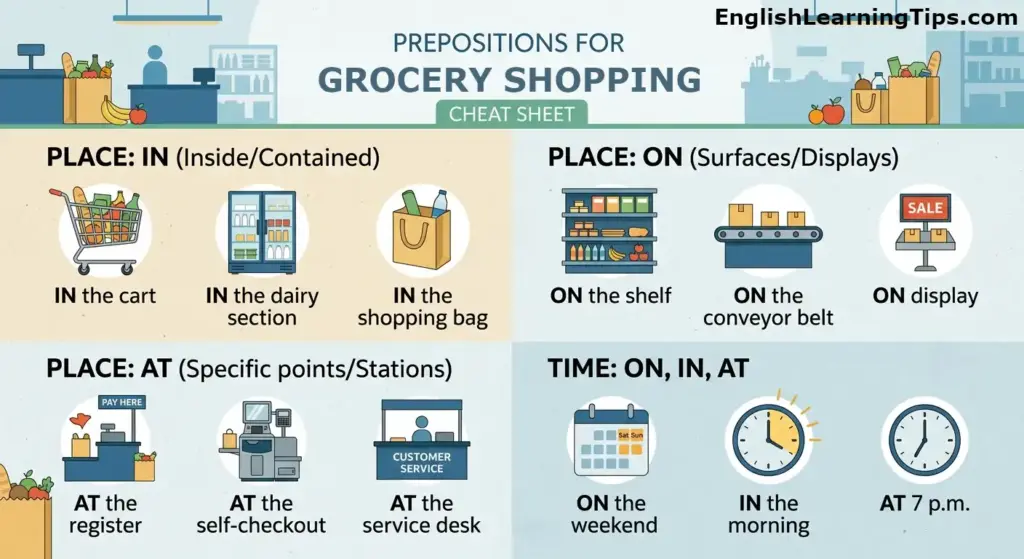
When you are inside a store, you need to describe where items are located. The most common confusion happens between in, on, and at. Here is how to distinguish them:
- In: Use this for sections, aisles, or containers.
- Example: “The milk is in the dairy section.”
- Example: “Put the apples in your cart.”
- On: Use this for surfaces like shelves or the floor.
- Example: “The bread is on the top shelf.”
- Example: “Place your bags on the conveyor belt.”
- At: Use this for specific functional points or the store as a destination.
- Example: “I am at the checkout counter.”
- Example: “We usually shop at Whole Foods.”
Quick reference: Supermarket preposition table
| Preposition | Best use case | Practical shopping example |
| In | Inside a section, aisle, or bag | “The pasta is in aisle 7.” |
| On | On a shelf, floor, or surface | “The cereal is on the middle shelf.” |
| At | A specific station or the store itself | “Pay for your food at the register.” |
| Next to | Side-by-side positioning | “The butter is next to the eggs.” |
| Between | Located in the middle of two items | “The salt is between the pepper and oil.” |
| Behind | Further back or in the rear | “The stockroom is behind the deli.” |
| In front of | Directly ahead or before | “The cart is in front of the sliding doors.” |
Prepositions of time for shopping routines
Talking about when you shop requires a different set of rules. Using these correctly helps you coordinate with friends or explain your schedule.
- On: Used for specific days of the week.
- “I go grocery shopping on Saturdays.”
- In: Used for general times of day or months.
- “It is much quieter if you shop in the morning.”
- At: Used for exact clock times.
- “The supermarket closes at 10 p.m.”
- Before/After: Used for sequencing your errands.
- “I need to stop by the store after work.”
Useful phrases for asking directions
If you can’t find an item, use these prepositional phrases to understand the clerk’s response:
- “Where can I find the…?”
- “It’s in the back, near the pharmacy.”
- “Is there any more…?”
- “There might be some under the display or in the stockroom.”
- “Which aisle is the flour in?”
- “It’s on the right-hand side, between the sugar and the baking chocolate.”
Frequently asked questions about shopping prepositions
Test your knowledge: Grocery store preposition quiz
How well do you know your shopping prepositions? Fill in the blanks below using in, on, at, or next to. (The answers are listed below the exercise—no peeking!)
- I usually go to the grocery store ______ Friday mornings.
- “Excuse me, which aisle is the salsa ______?” “It is ______ aisle 3, ______ the tortilla chips.”
- The organic produce is located ______ the very front of the store.
- Don’t forget to check the expiration date ______ the milk carton before putting it ______ your cart.
- I have four items ______ my shopping list, so I don’t need a large cart.
- “Are you still ______ the store?” “Yes, I am standing ______ the frozen food section.”
(Answers: 1. on; 2. in/on, in, next to; 3. at; 4. on, in; 5. on; 6. at, in)
Conclusion: Mastering your supermarket English
Learning the right prepositions for grocery shopping is more than just a grammar exercise; it is about feeling confident in your daily life. By remembering that you stand at the register, find deals on the shelf, and look for milk in the dairy section, you are well on your way to speaking like a native.
The more you practice these small words in real-world settings, the more natural your English will become. Next time you head to the store, try to describe your actions out loud (or in your head) using the prepositions from our cheat sheet!
Share your shopping experience
Did we miss a tricky phrase? Or maybe you have a “supermarket English” story to share?
- Leave a comment below: What is one preposition that always confuses you when you are shopping?
- Share this guide: If you found this cheat sheet helpful, share it with a friend or a fellow English learner who wants to master their supermarket vocabulary.
Discover more from English Learning Tips
Subscribe to get the latest posts sent to your email.


