

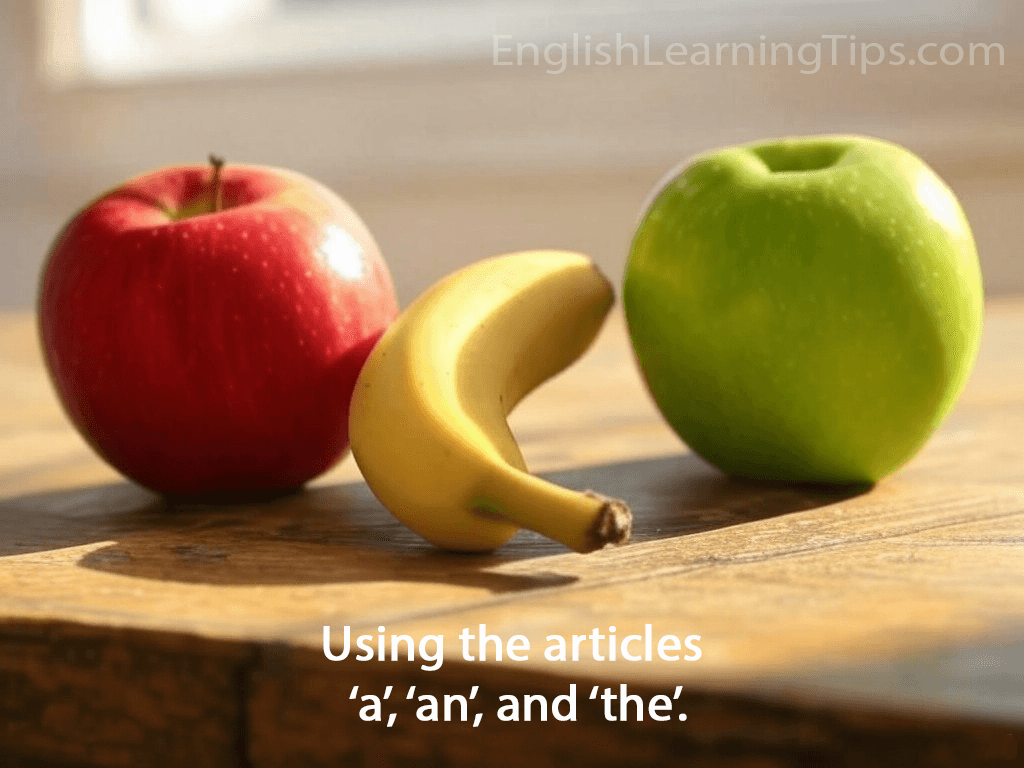
Mastering English articles: A complete guide to a, an, and the

Have you ever wondered why we say “a cat” but “an apple,” or why we say “the moon” instead of just “moon”? These tiny words—a, an, and the—are known as articles. While they seem small, they are essential for clarifying whether you are discussing something specific or general.
This guide breaks down the rules of definite and indefinite articles, provides clear examples, and explains the tricky exceptions that often trip up English learners.
What are articles in English grammar?
Articles are a sub-category of determiners. They function like adjectives because they modify nouns. In English, there are two types:
- Indefinite articles: A and an (used for non-specific things).
- Definite article: The (used for specific things).
When to use indefinite articles: A and an
We use “a” and “an” when we are talking about a singular, countable noun in a general sense. You aren’t referring to a specific item, but any one of its kind.
The “A vs. An” rule summary
- Use “A” before words that start with a consonant sound: a car, a dog, a unit.
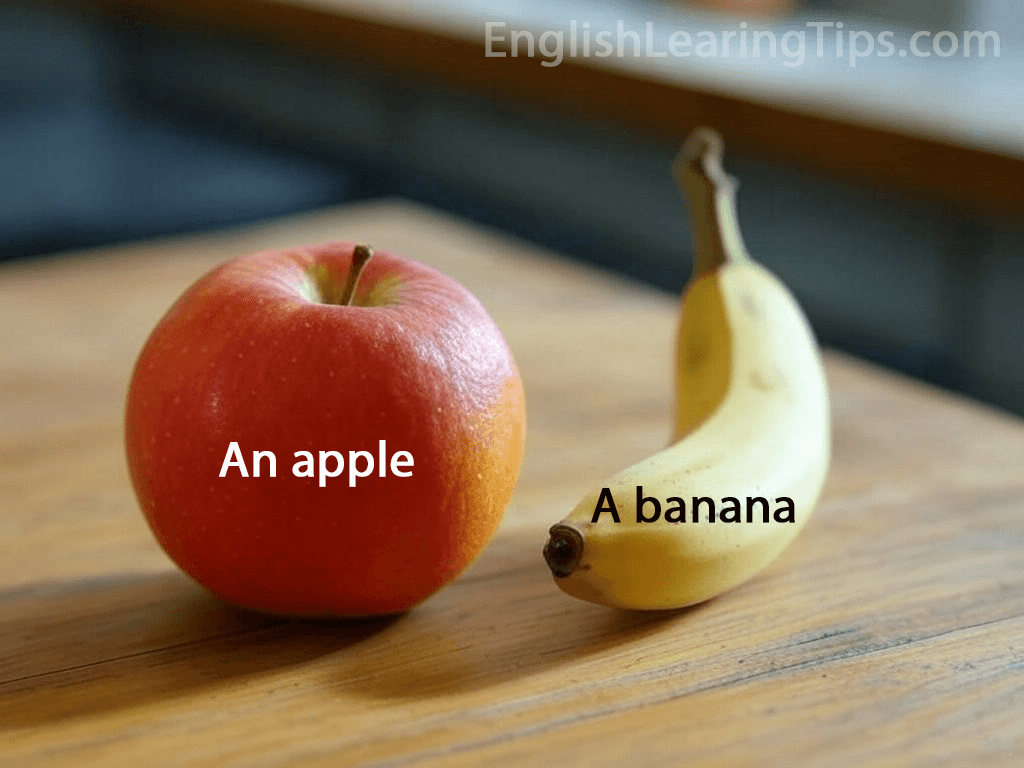
- Use “An” before words that start with a vowel sound: an apple, an egg, an hour.
The golden rule: Sound over spelling
The most common mistake is choosing “a” or “an” based on the first letter of the word. The choice between ‘a’ and ‘an’ is phonetic, meaning it’s based on the sound that follows.
- Use “a”: Before words starting with a consonant sound.
- A banana (b-sound)
- A university (Note: Starts with a “y” sound, which is a consonant).
- Use “an”: Before words starting with a vowel sound.
- An apple (a-sound)
- An honor (Note: The “h” is silent, so it starts with an “o” sound).
- An MBA (Note: The letter “M” is pronounced “em,” starting with a vowel sound).
When to use the definite article: The
“The” is used when the identity of the noun is known to the reader or listener. This applies to singular, plural, and uncountable nouns.

1. Specific or previously mentioned items
Use “the” when you have already talked about the object or when it is obvious which one you mean.
- Example: “I saw a dog. The dog was wearing a sweater.” (The second mention makes it specific).
2. Unique objects
When there is only one of something in existence.
- Example: The sun, the moon, the internet.
3. Superlatives and ordinals
Always use “the” with “tallest,” “best,” “first,” or “last.”
- Example: “He is the tallest player on the team.”
4. General categories or species
When a singular noun represents an entire group.
- Example: “The giraffe is the tallest land animal.” (Meaning the species in general).
5. Articles with geographic names
While most countries and cities do not use an article, certain geographic features almost always require the. This is a common area of confusion for English learners.
- Rivers, oceans, and seas: Use the before the names of water bodies.
- Examples: The Nile, the Atlantic Ocean, the Mediterranean Sea.
- Mountain ranges: Use the for a group of mountains, but no article for a single peak.
- Examples: The Andes (range) vs. Mount Everest (single peak).
- Island groups: Use the for chains of islands.
- Examples: The Bahamas, the Canary Islands.
6. Articles with “school,” “work,” and “bed”
A tricky rule in English is the “Purpose vs. Place” rule. We often omit the article when we are talking about the purpose of a building rather than the building itself.
- No article (The Purpose): We say “go to bed” (to sleep), “go to school” (to learn), or “go to work” (to do your job).
- With “The” (The Building): We use the when referring to the physical location or a specific object.
- Example: “I walked to the school to pick up my keys.” (You aren’t there as a student; you are visiting the building).
- Example: “The cat is sitting on the bed.” (Referring to the piece of furniture).
Comparison table: A vs. An vs. The
| Article | Type | Noun Type | Example |
| A | Indefinite | Singular / Consonant sound | A European vacation |
| An | Indefinite | Singular / Vowel sound | An hour later |
| The | Definite | Specific / Singular or plural | The books on my desk |
| Zero article | N/A | General / Plural or uncountable | Dogs are loyal pets |
The “zero article”: When to use nothing at all
Sometimes, the best article is no article at all. This is common in the following scenarios:
- General plural nouns: “I love cats.” (Not “The cats,” unless referring to specific ones).
- Uncountable nouns: “Water is essential for life.”
- Languages and nationalities: “She speaks Spanish.”
- Most proper nouns: “She lives in Paris,” or “He climbed Mount Everest.”
Pro Tip: Article usage can change based on regional dialects. For example, in the US, people say “go to the hospital,” while in the UK, they say “go to hospital.”
Frequently asked questions about articles
Outside resources
While the rules we’ve covered apply to most situations, there are nuanced cases for advanced writers. If you are writing for an academic paper, I highly recommend checking out the Purdue OWL guide on articles for professional-level precision.
For those interested in the differences between UK and US styles, the British Council’s article rules offer excellent regional insights.”
Take the quiz!
Test your knowledge: The articles quiz
Think you’ve mastered a, an, and the? Challenge yourself with our 20-question practice test.
Part 1: Multiple choice
- I am going to buy ____ new laptop today.
A) a | B) an | C) the - He is ____ honest man.
A) a | B) an | C) the - ____ moon looks beautiful tonight.
A) A | B) An | C) The - She wants to be ____ astronaut.
A) a | B) an | C) the - I saw ____ movie you recommended; it was great!
A) a | B) an | C) the - Do you have ____ umbrella I could borrow?
A) a | B) an | C) the - Paris is ____ capital of France.
A) a | B) an | C) the - I waited for ____ hour at the station.
A) a | B) an | C) the - ____ elephants are my favorite animals.
A) The | B) A | C) (No article) - He is ____ best student in the class.
A) a | B) an | C) the
Part 2: Fill in the blanks
Type “a”, “an”, “the”, or “X” if no article is needed.
- My sister is studying at ____ university in Ohio.
- Can you pass me ____ salt, please?
- I love listening to ____ music while I work.
- It took ____ year to finish the project.
- ____ Nile is the longest river in the world.
- I have ____ idea for a new business.
- ____ happiness is more important than money.
- We are going to ____ United Kingdom next summer.
- She is wearing ____ uniform for school.
- There is ____ fly in my soup!
Click to reveal the answer key
Video: 6 rules of articles a, an, the
Conclusion: Mastering the nuances of English articles
English articles might be small, but they carry significant weight in how we communicate clarity and specificity. Whether you are choosing between “a” and “an” based on phonetic sounds or deciding if a geographic location requires “the,” the key is to focus on the context of your sentence.
Remember the golden rule: it’s about the sound, not the letter. By mastering these simple determiners, you’ll significantly improve your fluency and writing precision.
Join the conversation!
Even for native speakers, English articles can be surprisingly tricky—especially when it comes to regional differences like “in hospital” vs. “in the hospital.”
- How did you do on the quiz? Did any of the “Zero Article” questions catch you off guard?
- What is one article rule that always confuses you?
- Are there any “exception” words you’ve found that don’t seem to follow the rules?
Discover more from English Learning Tips
Subscribe to get the latest posts sent to your email.


