

Understanding landfills — Video-based esl lesson

In modern society, the act of throwing something away is a simple daily habit, yet the systems managing that waste represent an extraordinary feat of engineering and environmental planning. This lesson explores the lifecycle of waste, moving beyond the household trash bin to examine the complex infrastructure of the modern sanitary landfill.
Designed for intermediate to advanced learners, this curriculum bridges the gap between technical vocabulary and critical thinking. Students will investigate how engineering principles—such as compaction, lining systems, and leachate management—work in tandem to mitigate environmental impact. By balancing technical knowledge with real-world discourse on sustainability, sanitation, and municipal responsibility, this lesson empowers students to analyze waste management not just as a civic utility, but as a crucial pillar of environmental stewardship.
Level: Intermediate to Advanced (B1-B2)Duration: 60 minutes
Objective: Students will learn about landfill engineering, environmental impacts, and waste management while expanding their vocabulary and practicing listening, reading, speaking, and writing skills.Materials:
- Transcript of the landfill video
- Audio/video clip of the landfill presentation (optional)
- Handouts with vocabulary lists and comprehension questions
- Whiteboard or digital board for brainstorming
- Access to a dictionary (online or physical)
Warm-up (10 minutes)
Activity: Brainstorm and Discuss
- Objective: Activate prior knowledge and introduce the topic.
- Instructions:
- Write the word “landfill” on the board and ask students: “What do you think happens to the trash you throw away?”
- Elicit responses and write key words (e.g., garbage, waste, recycling) on the board.
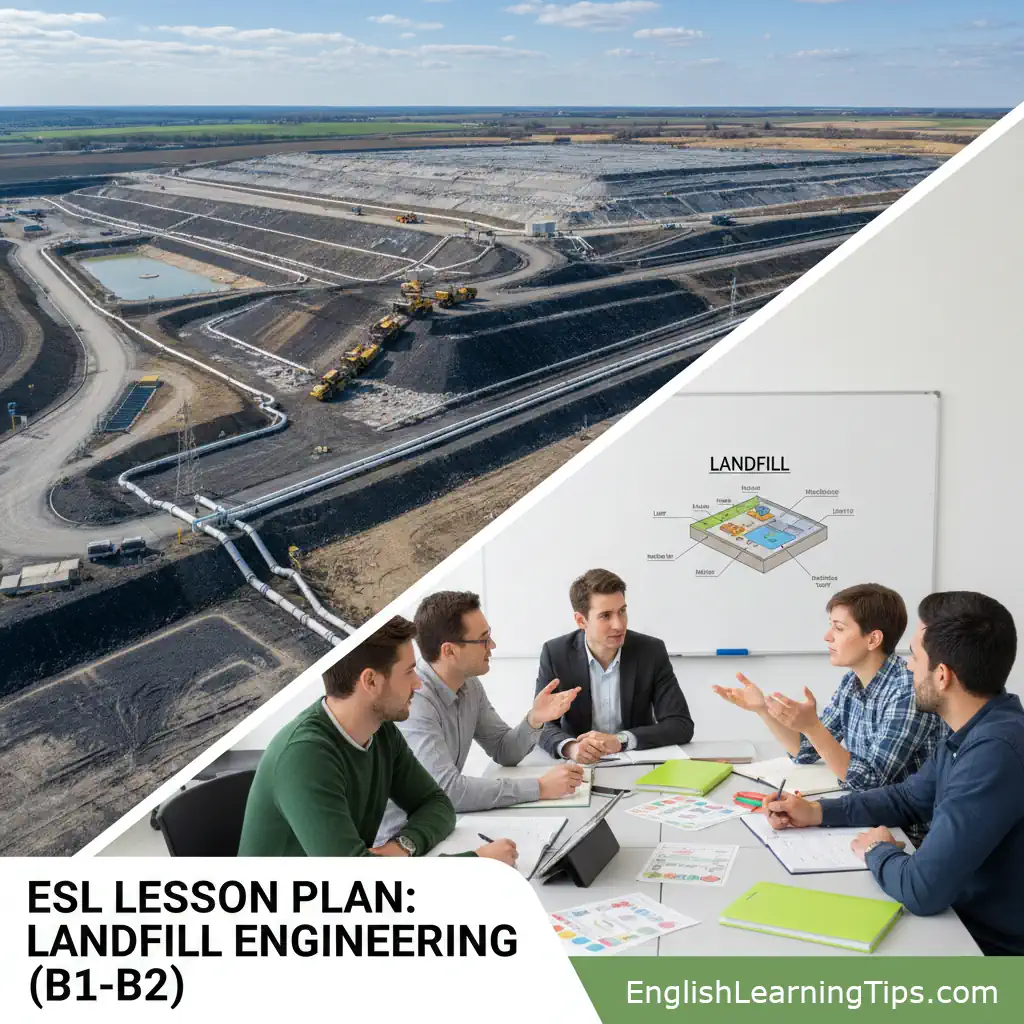
- Show a picture of a landfill (if available) and ask: “What problems might a landfill cause?” Guide students to think about environmental and health issues.
- Goal: Engage students and connect their experiences to the lesson topic.
Vocabulary introduction (15 minutes)
Activity: Vocabulary Matching and Contextual Use
- Objective: Introduce and practice key vocabulary from the transcript and related terms.
- Instructions:
- Provide a handout with two lists: 10 vocabulary words from the transcript and 10 additional related words for expansion. Include definitions and example sentences.
- Students match each word to its definition in pairs.
- Discuss the words as a class, asking students to create their own sentences using at least 5 words.
Vocabulary words from the video
- Landfill (n): A place where waste is buried under the ground.
- Example: The Puente Hills Landfill was one of the largest in the U.S.
- Trash (n): Waste material that is thrown away.
- Example: Trash from homes is collected and sent to landfills.
- Waste (n): Unwanted or unusable materials.
- Example: Municipal solid waste includes household garbage.
- Leachate (n): Liquid that drains from a landfill, often contaminated.
- Example: Leachate collection systems prevent groundwater pollution.
- Compaction (n): The process of making something denser by pressing it. (A “trash compactor” is what actually smashes/smushes the trash.)
- Example: Landfills use compaction to fit more trash in less space.
- Liner (n): A protective layer, often plastic, to prevent leaks in a landfill.
- Example: A plastic liner keeps leachate from contaminating soil.
- Municipal (adj): Related to a city or local government.
- Example: Municipal solid waste is managed by city authorities.
- Environmental (adj): Relating to the natural world and its protection.
- Example: Landfills are designed to minimize environmental impacts.
- Sanitation (n): Systems for keeping places clean and healthy.
- Example: Sanitation professionals manage waste to protect public health.
- Decompose (v): To break down or decay naturally.
- Example: Organic waste decomposes in landfills, producing gases.
Vocabulary for extension
- Recycling (n): The process of converting waste into reusable material.
- Example: Recycling reduces the amount of waste sent to landfills.
- Incineration (n): Burning waste to dispose of it.
- Example: Some countries use incineration instead of landfills.
- Contamination (n): The act of making something impure or harmful.
- Example: Leachate can cause contamination of groundwater.
- Sustainability (n): The ability to maintain or preserve something, especially the environment.
- Example: Sustainable waste management reduces environmental harm.
- Biodegradable (adj): Capable of being broken down by natural processes.
- Example: Biodegradable materials decompose faster than plastics.
- Groundwater (n): Water held underground in soil or rock.
- Example: Landfills must protect groundwater from pollution.
- Methane (n): A gas produced by decomposing waste, harmful to the environment.
- Example: Methane from landfills can be used to generate electricity.
- Erosion (n): The process of soil or rock being worn away by wind or water.
- Example: Grass is planted on landfills to prevent erosion.
- Infrastructure (n): The basic systems and structures needed for a process.
- Example: Landfills require infrastructure like liners and pipes.
- Disposal (n): The act of getting rid of something.
- Example: Proper disposal of waste protects the environment.
Grammar spotlight: Expressing purpose and consequence
To help students analyze the technical and environmental aspects of landfills, this section focuses on the grammatical structures used to explain the why (purpose) and the result (consequence) of engineering decisions.
Expressing purpose with “to” and “in order to”
When discussing engineering, students often need to explain why specific systems are installed. Using the infinitive of purpose is the most natural way to link a design feature to its function.
- Structure: [Action] + [in order] + to + [verb].
- Examples from the lesson:
- “Landfills use compaction to fit more trash in less space.”
- “A plastic liner is installed in order to prevent leachate from contaminating the soil.”
Expressing consequence with “so (that)” and “as a result”
Because landfills involve complex systems where one action impacts another, students should practice connecting cause and effect.
- Structure for “so that”: [Action] + so (that) + [subject] + [verb].
- Example: “Engineers design sophisticated drainage systems so that hazardous liquids can be collected safely.”
- Structure for “as a result”: [Cause]. As a result, [effect].
- Example: “Waste is not sorted properly. As a result, the landfill reaches capacity much faster than expected.”
Listening/reading comprehension (15 minutes)
Activity: Guided Listening/Reading and Questions
- Objective: Develop listening or reading comprehension skills using the transcript.
- Instructions:
- Play the audio/video (0:00–2:16) or have students read the corresponding transcript section silently.
- Provide a handout with 5 comprehension questions:
- What is the Puente Hills Landfill, and when did it close?
- What is municipal solid waste?
- Why is choosing a landfill site described as a “giant geometry problem”?
- What are some environmental concerns mentioned about landfills?
- How have landfills changed since the 1950s?
- Students answer in pairs, then discuss answers as a class.
- Goal: Ensure students understand key concepts and vocabulary in context.
Speaking activity (10 minutes)
Activity: Group Discussion
- Objective: Practice speaking and using new vocabulary in context.
- Instructions:
- Divide students into small groups and assign one question per group:
- What are the benefits and challenges of using landfills for waste management?
- How can we reduce the amount of waste sent to landfills?
- Should landfills be turned into parks after closure? Why or why not?
- Each group discusses their question for 5 minutes, using at least 5 vocabulary words.
- One student from each group summarizes their discussion to the class.
- Divide students into small groups and assign one question per group:
- Goal: Encourage fluency and critical thinking while reinforcing vocabulary.
Writing activity (10 minutes)
Activity: Short Paragraph Writing
- Objective: Practice writing and applying new vocabulary.
- Instructions:
- Ask students to write a short paragraph (5–7 sentences) answering the question: “What is one way we can improve waste management in our city?”
- Require students to use at least 5 vocabulary words from the lesson.
- Collect and provide feedback on vocabulary use and grammar.
- Goal: Reinforce vocabulary and develop writing skills.
Wrap-up (5 minutes)
Activity: Vocabulary Review and Reflection
- Objective: Consolidate learning and assess understanding.
- Instructions:
- Play a quick game: Call out a vocabulary word, and students shout out a synonym, definition, or example sentence.
- Ask: “What is one thing you learned about landfills today?”
- Assign homework: Research one local waste management practice (e.g., recycling, landfill use) and write 3–5 sentences about it, using 3 vocabulary words.
- Goal: Review key terms and reflect on the lesson.
Assessment
- Formative: Monitor participation in discussions and accuracy in vocabulary use during activities.
- Summative: Evaluate the writing activity for correct vocabulary use, grammar, and coherence.
- Homework: Check for understanding and application of vocabulary in the research task.
Notes for teachers
- Adjust the complexity of questions or vocabulary based on student level.
- If technology is available, show short clips of the video to enhance engagement.
- Encourage students to connect the topic to their own experiences with waste management in their communities.
Discover more from English Learning Tips
Subscribe to get the latest posts sent to your email.


