

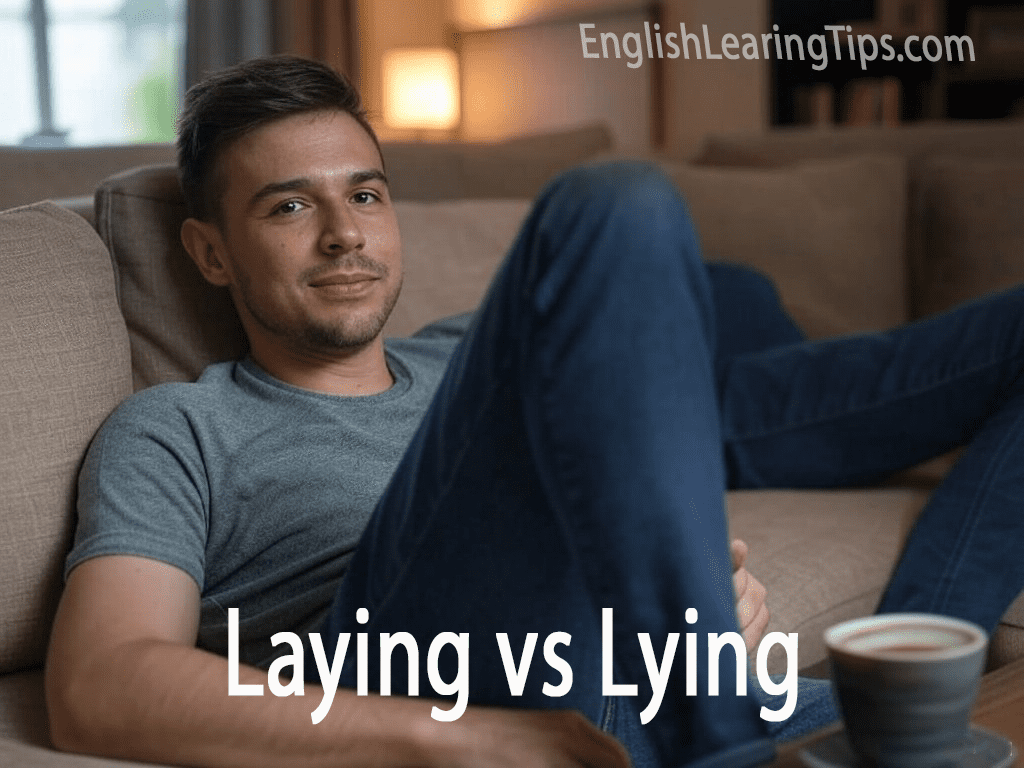
Laying vs. lying: The simple guide to getting it right

Have you ever paused mid-sentence, wondering if you should be laying or lying down for a nap? You aren’t alone. I’ve seen seasoned editors pause for a full ten seconds before typing ‘lay’ or ‘lie.’ It’s the ultimate English language glitch. While they both describe positioning, their grammatical rules are distinct.
The confusion usually stems from the fact that the past tense of “lie” is “lay.” However, once you understand the “direct object” rule, you will never mix them up again.
The 2-second rule:
- Lay requires an Object (You lay a book).
- Lie requires Rest (You lie down).
Stuck on a deadline? Keep a copy of The Blue Book of Grammar and Punctuation on your desk for a 5-second answer to every “lay vs. lie” disaster.
What is the difference between laying and lying?
The fundamental difference lies in action versus rest.
- Lying is something you do yourself (or an object does on its own). It means to recline or remain in a flat position.
- Laying is an action you perform on something else. It means to place or set an object down.
The direct object test
If you can ask the question “What are you [word]ing?” and have an answer, use laying.
- Example: “I am laying (what?) the keys on the counter.” (Correct)
- Example: “I am lying (what?) on the sofa.” (There is no object; you are the one reclining. Correct)
Conjugation chart: Lie vs. lay
One reason these words are difficult is their irregular verb forms. Use this table as a quick reference guide to ensure you are using the correct tense.
| Tense | Lie (to recline) | Lay (to place) |
| Present | I lie down. | I lay the book down. |
| Past | I lay down yesterday. | I laid the book down. |
| Past participle | I have lain there before. | I have laid the book there. |
| Present participle | I am lying down. | I am laying the book down. |
How to remember the difference: Mnemonics
If you don’t want to memorize a table, try these simple memory tricks:
- P-L-A-Y for Lay: You place something when you lay it. Both words have an “a.”
- R-E-C-L-I-N-E for Lie: You recline when you lie down. Both words have an “i.”
- The “Chickens” Rule: Chickens lay eggs (the egg is the object). People lie down (no object).
Pro Tip: If you’re homeschooling or decorating an office, this Commonly Confused Words Poster Set is a great visual reminder so you never have to Google this again. Also, see our article on words we commonly confuse.
Common phrases and idioms
Sometimes the rules feel blurry because of common English idioms. Here is how to handle them:
- Lie low: To stay out of sight (no object).
- Lay of the land: Though often misspoken as “lie of the land,” “lay” is the standard American English usage for a horizontal arrangement or task.
- Lay it on me: To tell someone news (the news is the object).
Note: If these rules make you want to “lie down” in frustration, you might as well do it in style. Check out these shirts, like the “I’m Silently Correcting Your Grammar” T-shirt—the perfect addition for the resident word-nerd.
Frequently asked questions about laying and lying
Videos to help you learn
Mastering the lay vs. lie challenge
Distinguishing between laying and lying is a hallmark of polished writing, but it is also one of the most difficult rules to master due to the overlapping past tense forms. To keep it simple, always ask yourself: “Is there a direct object?” If you are placing something down, you are laying it. If you are resting your own body, you are lying down.
While the “past tense of lie is lay” rule might feel like a linguistic trap, using these words correctly will improve your clarity and help you stand out in professional and academic settings. Bottom line: If you’re moving an object, use lay. If you’re moving yourself, use lie.
Join the grammar discussion
Even the best writers have a “nemesis” word that they always have to double-check. Is lay vs. lie your biggest grammar hurdle, or is there another pair—like effect vs. affect—that always trips you up?
Drop a comment below and let us know:
- What is one trick you use to remember the difference?
- Are there any song lyrics or famous quotes that drive you crazy because they use the wrong form?
We respond to every comment, so let’s settle those grammar debates together!
Discover more from English Learning Tips
Subscribe to get the latest posts sent to your email.


