

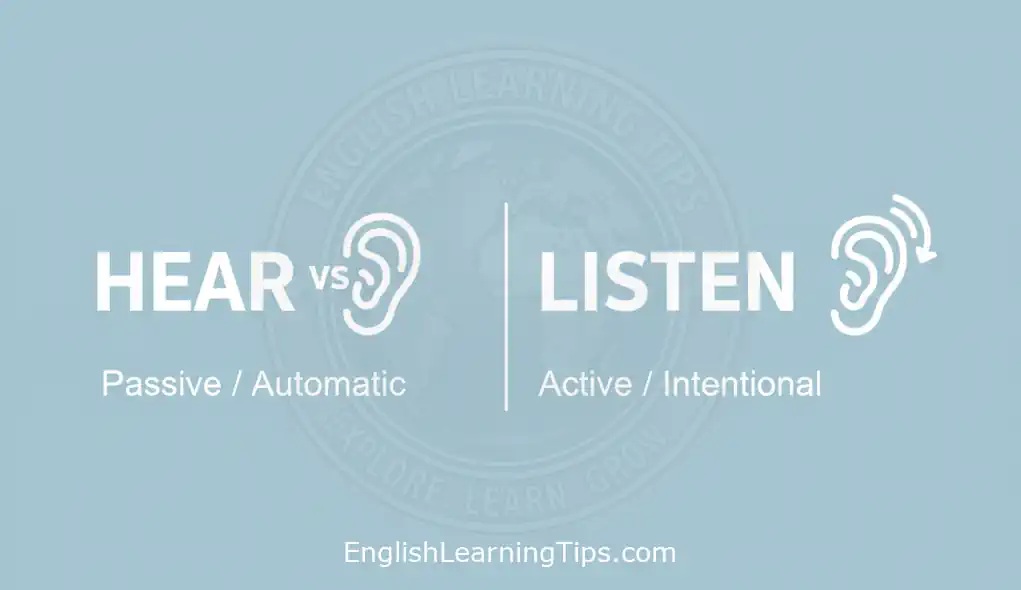
Hear vs. listen: What is the difference?

Just like see and look, the difference between hear and listen comes down to intent. One happens automatically, while the other requires you to pay attention. Understanding this distinction is a major step toward English fluency.
The quick rule: Passive vs. active
- Hear: Sound enters your ears naturally (Passive/Perception).
- Listen: You make a conscious effort to focus on a sound (Active/Direction).
When to use hear: Natural perception
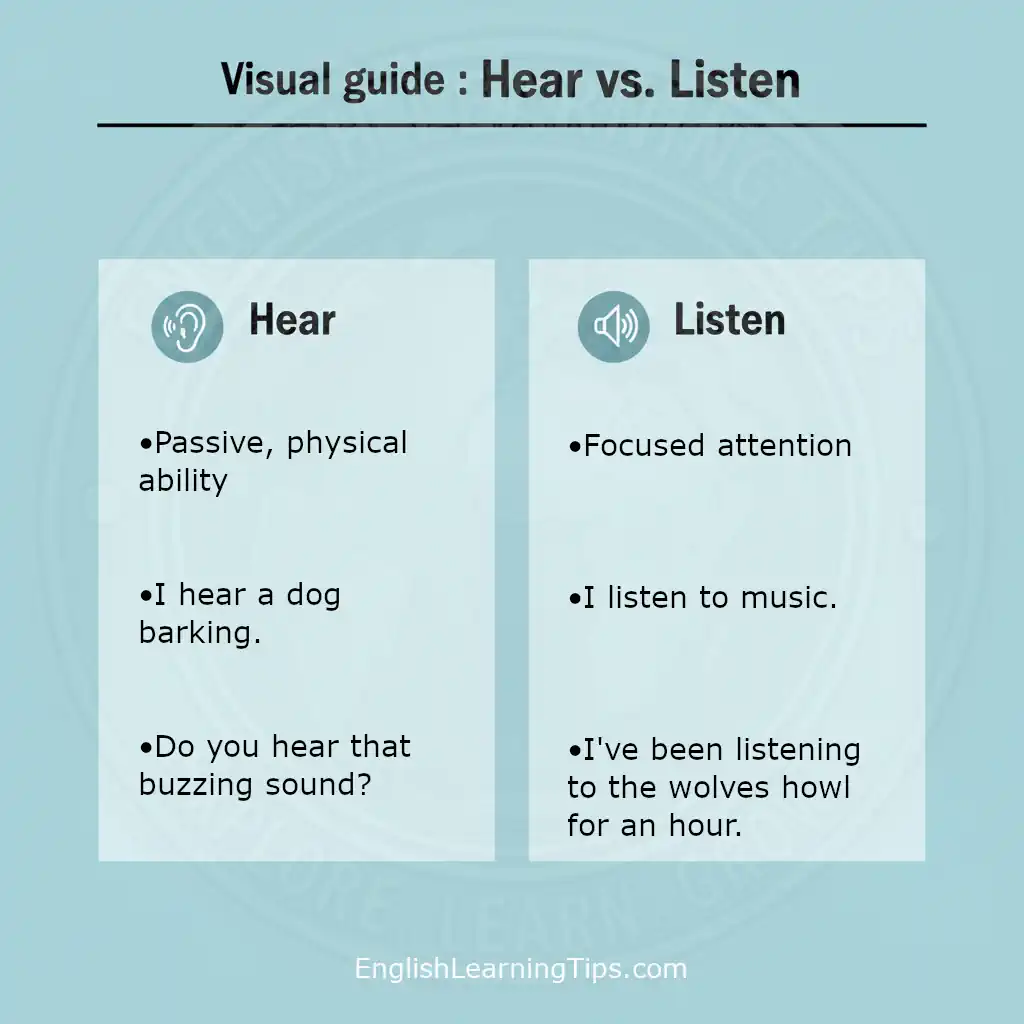
Hear is a passive verb. It is something your ears do automatically, whether you want them to or not. It refers to the physical ability to perceive sound.
- Usage tip: Use “hear” for sudden noises or background sounds you didn’t choose to notice.
- Example: “Did you hear that loud bang outside?”
- Example: “I can hear the neighbors talking through the wall.”
When to use listen: Focused attention
Listen is an active verb. It means you are paying attention and trying to understand the sound. Because it is an action directed toward something, it is almost always followed by the preposition “to” when there is an object.
- Usage tip: If you are focusing on the meaning of the sound (like music or a speech), use “listen.”
- Example: “I like to listen to podcasts during my commute.”
- Example: “Listen carefully to the instructions.”
To truly master listening, you need to block out the world. Many of our students use noise-canceling headphones to focus entirely on English podcasts without being distracted by background noise.
Comparison table: Hear vs. listen
| Verb | Action type | Focus | Common example |
| Hear | Passive | Perception | “I hear the rain.” |
| Listen | Active | Intent/Attention | “Listen to the music.” |
Common mistakes and exceptions
1. “Listen” needs “to”
A common error is saying “Listen me.” In English, if you are listening to a person or thing, you must include “to.”
- Incorrect: “Listen the teacher.”
- Correct: “Listen to the teacher.”
2. Hear vs. listen in a conversation
You can hear someone talking without listening to what they are actually saying.
- Example: “I could hear him speaking, but I wasn’t listening to his words because I was distracted.”
Active and passive verbs vs active and passive voice
Sometimes students get the two confused because both use the terms “active” and “passive,” but they describe two completely different grammatical concepts.
Active vs. passive verbs (Meaning and intent)
This refers to the nature of the action itself. It describes whether the subject is making a conscious effort or if the experience is happening to them automatically.
- Active verbs: Require willpower, physical movement, or mental focus.
- Examples: Run, study, watch, listen.
- Sentence: “I listened to the song.” (I chose to focus).
- Passive verbs (Stative): Describe a state of being or an automatic sensory experience.
- Examples: Be, hear, see, know.
- Sentence: “I heard the song.” (The sound just reached my ears).
Active vs. passive voice (Sentence structure)
This refers to who is doing the action and who is receiving it. It is about the “Word Order” of your sentence.
Active voice
The subject performs the action. It is direct and clear.
- Formula: Subject + Verb + Object
- Example: “The chef (subject) prepared (verb) the meal (object).”
Passive voice
The object becomes the subject. The person doing the action is either at the end of the sentence or missing entirely.
- Formula: Object + Be-Verb + Past Participle (+ by Subject)
- Example: “The meal (subject) was prepared (verb) by the chef.”
Learn more with our guide on active and passive voice.
Frequently asked questions about hear and listen
Video: Listen to this one-minute explanation of hear vs listen
If you want a physical reference for tricky verbs like these, we highly recommend English Grammar in Use. It’s one of the best tools for self-study and covers vision and sound verbs in great detail.
Conclusion: Use your senses with precision
The distinction between hear and listen is more than just a grammar rule; it is about how you describe your connection to the world around you. Hearing is a physical gift that happens automatically, while listening is a mental skill that you choose to practice.
By mastering the “listen to” rule and understanding the passive nature of “hear,” you are well on your way to speaking English with the nuance and precision of a native.
Join the conversation
We love hearing (and listening to!) our readers. Sensory verbs can be one of the trickiest parts of learning English, so let’s help each other out.
- Keep learning: Now that you have mastered the sounds, why not check out our guide on look, see, and watch to perfect your vision verbs, too?
- Leave a comment: Is there a specific sound or situation where you still find these verbs confusing? Tell us below, and we’ll give you a hand!
- Share the guide: Do you have a study buddy or a student who always says “Listen me”? Send them this guide to help them master the “listen to” rule once and for all.
Discover more from English Learning Tips
Subscribe to get the latest posts sent to your email.


