

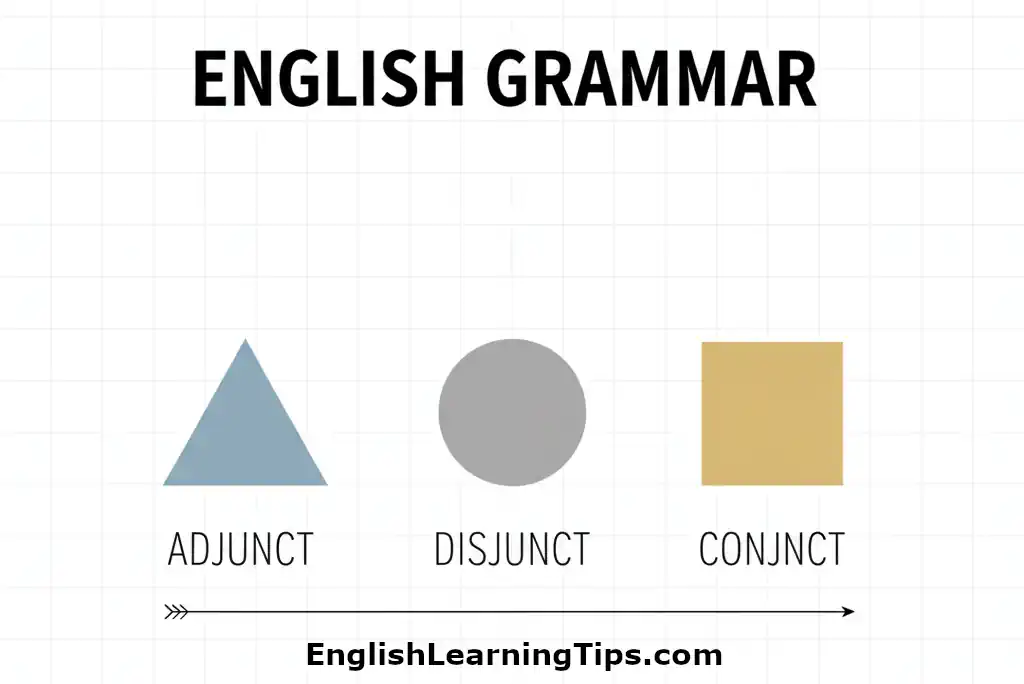
Adverbials in English grammar: A guide to adjuncts, disjuncts, and conjuncts

Understanding how to classify adverbials is a foundational skill for mastering English syntax and punctuation. While the term “adverb” is common, many writers struggle to distinguish between the three functional roles adverbials play: adjuncts, disjuncts, and conjuncts.
By categorizing these correctly, you can dramatically improve your writing flow, academic precision, and use of commas.
What is an adverbial?
An adverbial is a word, phrase, or clause that functions as an adverb. Unlike adjectives, which modify nouns, adverbials modify verbs, adjectives, other adverbs, or entire sentences. They provide context by answering questions such as:
- How? (Manner)
- When? (Time)
- Where? (Place)
- Why? (Reason)
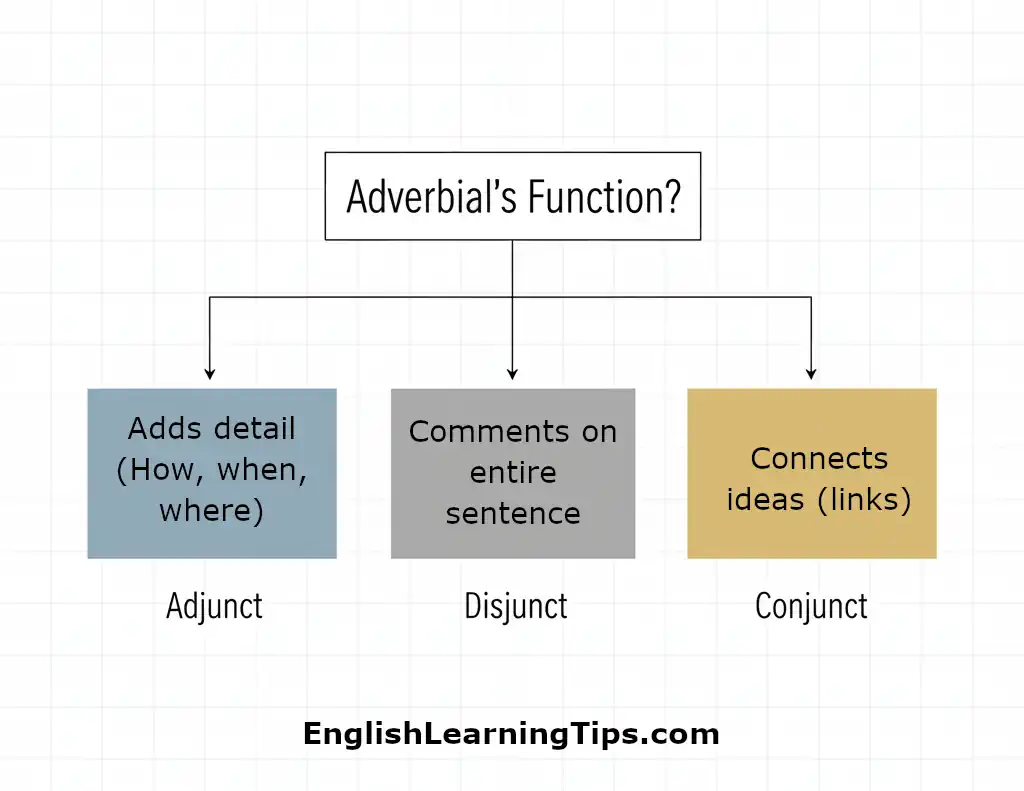
An adverbial is a functional part of a sentence that adds detail to a verb or clause; it can be classified as an adjunct (detail), a disjunct (opinion), or a conjunct (connector).
Adjuncts: Integrated adverbials for circumstantial detail
Adjuncts are “integrated” adverbials. This means they are a core part of the clause structure. If you remove an adjunct, the sentence remains grammatically sound, but it loses essential information about the action.
How to spot an adjunct
- Integration: They are part of the verb phrase.
- Flexibility: They can often move positions (e.g., “She sang beautifully” vs. “Beautifully, she sang”).
- Questionability: You can identify them by asking How, When, or Where.
Examples:
- Time: They arrived at midnight.
- Manner: She ran quickly to the store.
- Place: The meeting is in the conference room.
Disjuncts: Peripheral adverbials for speaker attitude
Disjuncts, often called “sentence adverbs,” are peripheral—they sit outside the core meaning of the sentence. They do not modify the verb; instead, they comment on the entire proposition or the way the speaker is communicating.
Categorizing disjuncts
- Content disjuncts: Express the speaker’s judgment or evaluation (e.g., Fortunately, Obviously, Surprisingly).
- Style disjuncts: Comment on the speaker’s mode of expression (e.g., Honestly, Briefly, Strictly speaking).
Examples:
- Fortunately, nobody was injured in the accident.
- Strictly speaking, that answer is incorrect.
Conjuncts: Logical linking adverbials
Conjuncts (or conjunctive adverbs) function as bridges between ideas. They do not modify the verb or provide an opinion; they create cohesion by showing a logical relationship between two independent clauses or sentences.
Common conjuncts by logical category
| Category | Common examples |
| Addition | Furthermore, moreover, also, besides |
| Contrast | However, nevertheless, conversely, yet |
| Result | Therefore, consequently, thus, so |
| Sequence | First, next, meanwhile, finally |
Comparison table: Adjuncts vs. disjuncts vs. conjuncts
If you’re still unsure which is which, this breakdown should clear things up.
| Feature | Adjunct | Disjunct | Conjunct |
| Primary role | Modifies action | Comments on sentence | Links ideas |
| Grammatical status | Integrated | Peripheral | Peripheral |
| Effect of removal | Loses detail | Loses tone/judgment | Loses logical flow |
| Can be questioned? | Yes | No | No |
Common mistakes and punctuation tips
A frequent source of grammatical errors is failing to punctuate these categories correctly.
- Disjuncts and conjuncts usually require a comma when placed at the beginning of a sentence.
- Conjuncts linking two independent clauses typically require a semicolon before them and a comma after them (e.g., “The plan was risky; however, it succeeded”).
Frequently asked questions (FAQs)
Adverbial identification quiz
For each sentence, identify the bolded word or phrase as an adjunct, a disjunct, or a conjunct.
- He spoke slowly during the presentation.
- Frankly, I think we should start over.
- The project was difficult; nevertheless, we completed it on time.
- She sat in the garden all afternoon.
- Surprisingly, the store was closed on a Saturday.
- The ingredients were fresh; furthermore, the price was reasonable.
- I have finished my work before the deadline.
- To be honest, I have never enjoyed hiking.
- They arrived by bus.
- The water was rising; consequently, we evacuated the building.
Taking notes on complex sentence structures is easier when you can map them out visually. I recommend using Pilot FriXion Erasable Pens for color-coding your adjuncts and disjuncts without the mess of white-out.
- 1. Adjunct: Describes the manner of speaking; it is integrated into the verb phrase.
- 2. Disjunct: Expresses the speaker’s personal attitude or honest opinion.
- 3. Conjunct: Links two independent clauses and establishes a relationship of contrast.
- 4. Adjunct: Specifies the location (place) of the action.
- 5. Disjunct: Comments on the proposition (the event of the store being closed).
- 6. Conjunct: Connects two ideas to show an additive relationship.
- 7. Adjunct: Provides circumstantial detail regarding time.
- 8. Disjunct: Acts as a style disjunct, framing the speaker’s mode of expression.
- 9. Adjunct: Explains the means (how) they arrived.
- 10. Conjunct: Connects the cause to the result across two independent sentences.
Mastering the nuance: A final word
Distinguishing between adjuncts, disjuncts, and conjuncts is more than just an academic exercise—it is the key to controlling the “voice” of your writing. Adjuncts provide the essential details, disjuncts add your personal flair and perspective, and conjuncts build the logical bridges that keep your readers engaged from the first sentence to the last. By mastering these three adverbial roles, you move beyond basic sentence construction and into the realm of professional, cohesive, and impactful writing.
Understanding the mechanics of conjuncts is only half the battle; the other half is style. To see these adverbials used with professional precision, check out William Zinsser’s On Writing Well.
Join the conversation
How do you handle complex sentence structure? Do you have a favorite conjunct that you use to transition between ideas, or do you find yourself struggling with disjunct punctuation?
Share your thoughts in the comments below. If you found this guide helpful for your writing or study, please share it with a colleague or student who is looking to sharpen their grasp of English grammar. Together, we can make complex syntax simple.
Discover more from English Learning Tips
Subscribe to get the latest posts sent to your email.


