
Dependent and independent clauses: The essential guide to sentence structure

Understanding the difference between dependent and independent clauses is the foundation of clear, professional writing. These grammatical building blocks determine whether a group of words functions as a complete sentence or remains an incomplete thought. By mastering these structures, you can avoid common errors like fragments and run-on sentences while improving your overall writing flow.
Clause structure at a glance
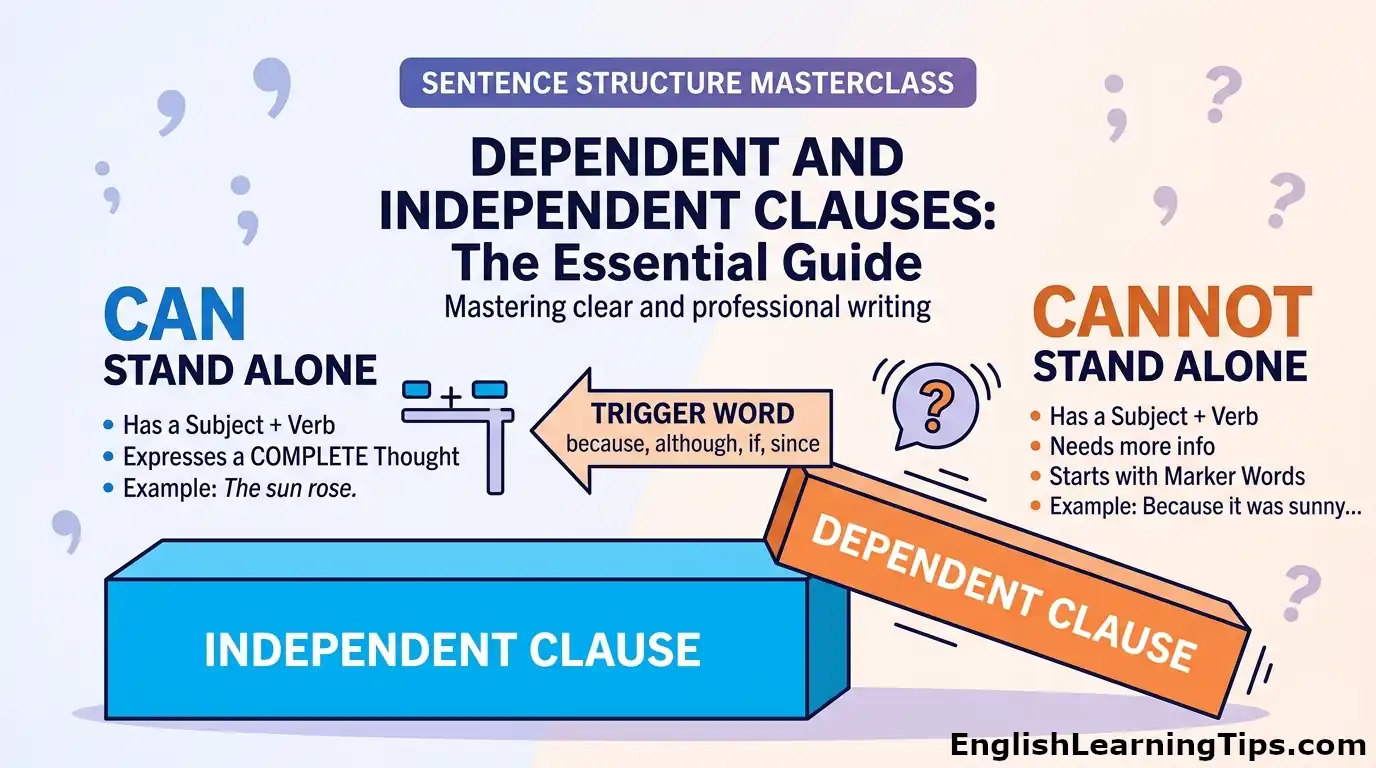
To help visualize how these pieces fit together, think of them as building blocks:
The fundamental difference
The simplest way to distinguish the two is the “Independence Test”:
- Independent clause: Can stand alone. (e.g., I ate the sandwich.)
- Dependent clause: Cannot stand alone; it “hangs.” (e.g., Because I was hungry…)
What is an independent clause?
An independent clause is a group of words that contains a subject and a verb and expresses a complete thought. Because it makes sense on its own, it can stand alone as a simple sentence.
Key characteristics of independent clauses:
- Subject: The person, place, or thing performing the action.
- Verb: The action or state of being.
- Completeness: It does not leave the reader waiting for more information to understand the core message.
Independent clause examples:
- The sun rose over the mountains.
- She practiced the piano for two hours.
- Technology evolves rapidly.
What is a dependent clause?
A dependent clause (also known as a subordinate clause) also contains a subject and a verb, but it cannot stand alone. It begins with a “trigger word”—either a subordinating conjunction or a relative pronoun—that makes the clause rely on an independent clause to complete its meaning.
Common subordinating conjunctions and relative pronouns:
- Conjunctions: Although, because, if, since, unless, while, whenever.
- Relative pronouns: Who, which, that, whom, whose.
Dependent clause examples:
- Because the storm intensified… (Leaves the reader asking: What happened?)
- If you finish your chores… (Leaves the reader asking: Then what?)
- Which was sitting on the table… (Leaves the reader asking: What was?)
Independent vs. dependent clauses: A side-by-side comparison
This table breaks down the technical differences to help you identify each clause type quickly.
| Feature | Independent clause | Dependent clause |
| Can stand alone? | Yes | No |
| Expresses complete thought? | Yes | No (Incomplete) |
| Has a subject and verb? | Yes | Yes |
| Starts with a marker word? | No (Usually) | Yes (Subordinating conjunction) |
| Grammatical status | Full sentence | Sentence fragment |
How to combine clauses for better sentence variety
To create complex sentences, you must connect these clauses using proper punctuation. There are two primary patterns for combining a dependent and an independent clause:
1. Dependent clause first (The comma rule)
When a sentence starts with a dependent clause, you must use a comma to separate it from the independent clause.
- Pattern: Dependent Clause + Comma + Independent Clause.
- Example: Since it is raining outside, we should stay indoors.
2. Independent clause first
When the independent clause comes first, a comma is usually unnecessary.
- Pattern: Independent Clause + Dependent Clause.
- Example: We should stay indoors since it is raining outside.
Common grammar mistakes: Fragments, run-ons, and comma splices
Misunderstanding how clauses interact leads to the three most common writing errors:
- Sentence fragments: This happens when a dependent clause is left alone.
- Incorrect: Because I was late.
- Fix: I missed the meeting because I was late.
- Run-on sentences: This occurs when two independent clauses are joined without any punctuation.
- Incorrect: The cake is delicious I want another slice.
- Fix: The cake is delicious**;** I want another slice.
- Comma splices: This happens when you join two independent clauses with only a comma.
- Incorrect: The sun is hot, I need water.
- Fix: The sun is hot**, and** I need water. (Or use a semicolon).
If you want to move beyond the basics, The Blue Book of Grammar and Punctuation offers excellent practice exercises specifically for clause structures and comma usage.
Frequently asked questions about clauses
Video: Independent and dependent clauses in English grammar
Refine your writing: Share your thoughts
Now that you have the tools to identify and combine independent and dependent clauses, we want to hear from you. Was there a specific subordinating conjunction that used to trip you up? Or perhaps you have a “grammar pet peeve” involving comma splices that you see everywhere?
Drop a comment below with your toughest grammar questions or share a tip that helped you finally master sentence structure. If you found this guide helpful, share it with a fellow writer or student—helping others clarify their communication is the best way to strengthen your own skills!
Discover more from English Learning Tips
Subscribe to get the latest posts sent to your email.


