


Hedging in English grammar: A guide to cautious language

Hedging is the use of tentative, cautious language to soften statements, express uncertainty, or avoid absolute claims. In English, this is achieved through specific words and phrases known as hedging devices. While often used in daily conversation to be polite, hedging is essential in academic, scientific, and professional writing to build credibility and ensure accuracy.
What is hedging in linguistics?
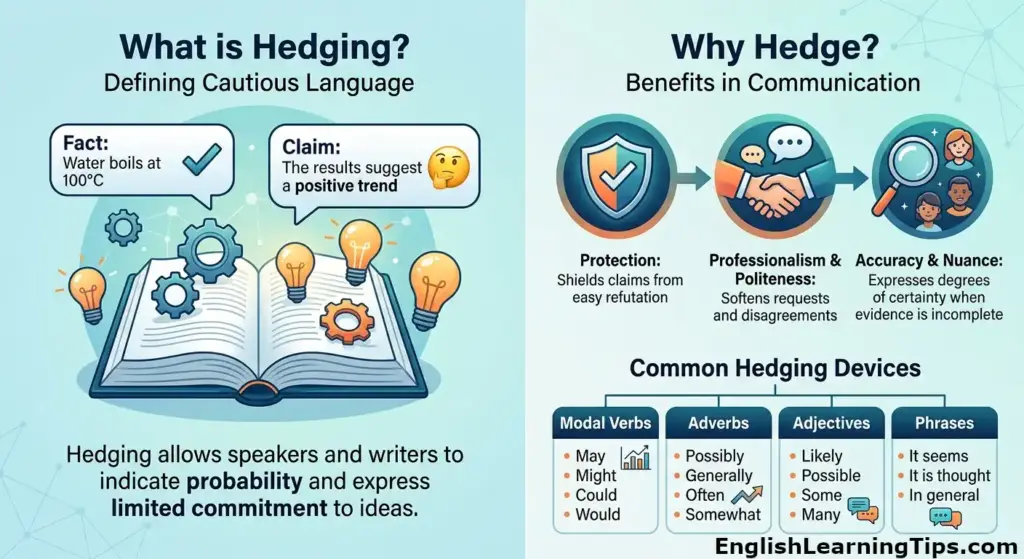
At its core, hedging allows speakers and writers to indicate probability or limited commitment to an idea rather than presenting it as an indisputable fact. Linguists define a hedge as any word or phrase that introduces ambiguity or acknowledges that a claim may be subject to further evidence.
By using these techniques, you distinguish between established facts and claims that rely on current, potentially limited data. Overusing absolute language—such as “always,” “prove,” or “definitely”—can make your writing seem dogmatic and leave you vulnerable to criticism.
Why use hedging in English?
Mastering the art of cautious language helps you navigate complex communication. Key benefits include:
- Accuracy: Expresses degrees of certainty when evidence is incomplete.
- Professionalism: Protects claims from easy refutation in academic papers.
- Politeness: Softens requests, suggestions, or disagreements in spoken English.
- Nuance: Acknowledges that alternative viewpoints or exceptions may exist.
Common hedging devices and examples
Hedging devices are categorized by the part of speech or structure used to introduce tentativeness. Use the table below to improve your writing clarity.
| Category | Hedging devices | Example of hedged sentence |
| Modal verbs | May, might, could, would | The findings might vary across cultures. |
| Reporting verbs | Seem, appear, tend, suggest | Results seem to support the theory. |
| Adverbs | Possibly, generally, often, somewhat | This approach generally works well. |
| Adjectives | Likely, possible, some, many | Some evidence points to a link. |
| Nouns/phrases | Possibility, tendency, to some extent | There is a tendency for prices to rise. |
Hedging in academic writing vs. everyday conversation
The application of hedging changes based on your audience. Understanding this distinction is key to professional writing.
Academic and professional contexts
In academic papers, the goal is objectivity. You should hedge your claims to reflect the strength of your evidence.
- Use: “The results indicate a possible correlation.”
- Avoid: “The results prove causation” (unless you have absolute, universal proof).
Everyday spoken English
In social settings, hedging acts as a social lubricant. It reduces the “face-threatening” nature of an interaction.
- Softening a request: “Could you perhaps pass the salt?”
- Softening a disagreement: “I might be wrong, but I think the meeting starts at 2 p.m.”
Best practices for effective hedging
To strike the right balance between confidence and caution, follow these tips:
- Match the device to the evidence: Use stronger hedging (e.g., “might”) for preliminary findings and lighter hedging (e.g., “likely”) for well-supported claims.
- Avoid over-hedging: Using too many hedges in one sentence—e.g., “It seems likely that it may be possible that…”—can make your writing sound indecisive or weak.
- Read aloud: If your writing feels overly vague, simplify your sentence structure.
- Target absolute facts: Never hedge statements of established fact, such as “Water boils at 100°C.”
If you struggle to differentiate between a hedge and a filler, Practical English Usage is an essential desk companion.
Frequently asked questions (FAQs)
Video: Heading language – Academic writing
Mastering the balance: Confidence through clarity
Hedging is far more than just a grammatical nuance; it is a vital skill for anyone looking to communicate with both authority and intellectual honesty. By using cautious language strategically, you can protect your work from unnecessary criticism, build professional credibility, and navigate complex social interactions with ease. Whether you are drafting a thesis or sending a high-stakes business email, remember that the most effective writers know exactly when to hedge—and exactly when to lead with confidence.
Level up your workspace with a High-Quality Ergonomic Keyboard for those long thesis sessions.
Join the conversation: How do you hedge?
We want to hear from you. Have you ever struggled with the line between sounding too hesitant and appearing overly dogmatic? Or perhaps you have a favorite “hedging device” you rely on in your professional writing?
Share your thoughts in the comments below. If you found this guide helpful for mastering your academic or professional tone, please share this article with your colleagues or fellow writers who might be looking to level up their communication skills.
Discover more from English Learning Tips
Subscribe to get the latest posts sent to your email.


