

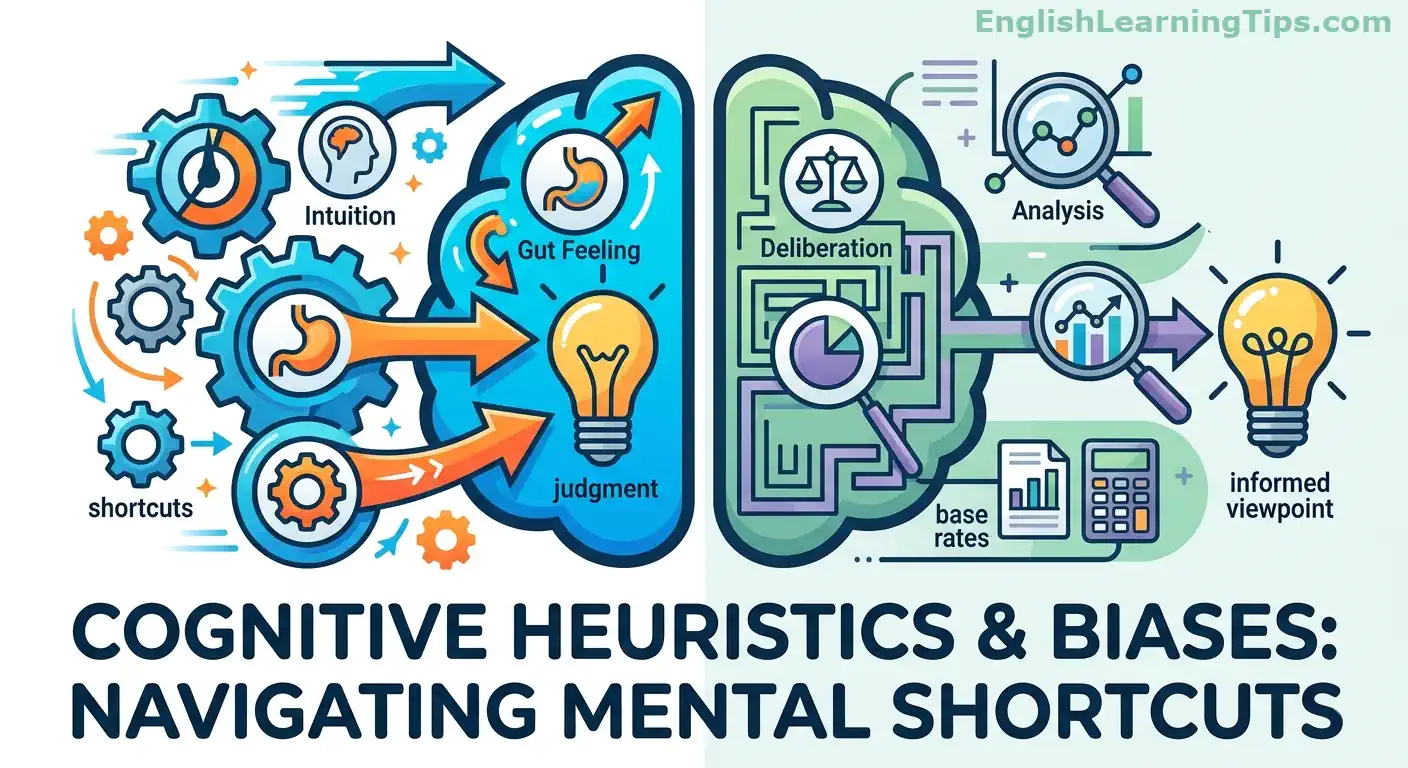
Cognitive Heuristics and Biases: A Comprehensive ESL Lesson Plan

Navigating the complexities of human decision-making requires an understanding of how our brains process information under pressure. This lesson plan explores the fascinating world of cognitive heuristics and biases, providing students with the linguistic tools to discuss mental shortcuts and logical fallacies.
By analyzing the “rules of thumb” we use daily, learners will improve their critical thinking skills while mastering advanced vocabulary related to psychology and reasoning. This session is designed to bridge the gap between intuitive “gut feelings” and objective, data-driven analysis, making it an essential resource for students looking to refine their professional and academic English.
Lesson plan: Mastering cognitive heuristics and avoiding biases in judgment
Level: Intermediate to Advanced (B2-C1)
Time: 45 minutes
Topic: Heuristics, cognitive biases, and critical thinking skills
Objectives: Students will understand the definition of cognitive heuristics, identify common biases like the availability and representativeness heuristics, and practice strategies for more objective decision-making.
Background
Heuristics are mental shortcuts that humans use to make quick decisions and judgments without needing to deliberate exhaustively over every piece of information. They act as “rules of thumb” developed from past experiences, allowing us to navigate a complex world efficiently. Without these cognitive tools, the sheer volume of choices we face daily—from what to wear to what to eat—would become mentally paralyzing and exhausting.
However, these shortcuts are not always accurate. Because they prioritize speed over deep analysis, they frequently lead to predictable errors in reasoning, known as cognitive biases. Whether it is overestimating the prevalence of violence due to media coverage (the availability heuristic) or misinterpreting medical test results (the representativeness heuristic), relying too heavily on intuition can result in faulty conclusions. Recognizing these fallibilities is essential for developing stronger critical thinking and more informed viewpoints.
To explore the foundation of these concepts further, Daniel Kahneman’s ‘Thinking, Fast and Slow’ is an essential read for anyone interested in why we make the choices we do.
Basic vocabulary
Introduce essential words related to cognitive psychology and decision-making.
Vocabulary list
| Word | Part of Speech | Definition | Example Sentence |
| Heuristic | Noun (adj: heuristic) | A mental shortcut or rule of thumb for problem-solving. | We use heuristics to make quick decisions every day. |
| Cognitive | Adjective (adv: cognitively) | Relating to the mental processes of thinking and understanding. | He is studying the cognitive development of children. |
| Deliberate | Verb (noun: deliberation) | To think carefully or consider something at length. | The committee needed time to deliberate on the new policy. |
| Shortcut | Noun | A quicker way to do something. | Taking this route is a shortcut to the city center. |
| Availability | Noun (adj: available) | The quality of being easily reached or accessed. | The availability of information online changes how we learn. |
| Representative | Adjective (verb: represent) | Typical of a particular class or group. | That sample is representative of the whole population. |
| Prevalence | Noun (adj: prevalent) | The fact or state of being widespread. | The prevalence of smartphone use is very high globally. |
| Fallibility | Noun (adj: fallible) | The tendency to make mistakes or be wrong. | Acknowledging human fallibility is the first step to learning. |
| Intuition | Noun (adj: intuitive) | The ability to understand something instinctively. | My intuition told me that something was wrong. |
| Judgment | Noun (verb: judge) | The ability to make considered decisions or come to conclusions. | It is important to use good judgment in business deals. |
Vocabulary for extension
- Bias (noun/verb, biased – adj): An inclination or prejudice for or against one person or thing.
- Reasoning (noun/verb, reasonable – adj): The action of thinking about something in a logical way.
- Inaccurate (adjective, accuracy – noun): Not correct or precise.
- Perspective (noun): A particular attitude toward or way of regarding something.
- Assumption (noun, assume – verb): A thing that is accepted as true without proof.
- Informed (adjective, inform – verb): Having or showing knowledge of a particular subject.
- Uncertainty (noun, uncertain – adj): The state of being unsure.
- Objective (adjective, objectiveness – noun): Not influenced by personal feelings.
- Subconscious (adjective, subconsciously – adv): Part of the mind of which one is not fully aware.
- Analysis (noun, analyze – verb): Detailed examination of the elements or structure of something.
Teaching tips
- Use visual flowcharts to show how a shortcut leads to a decision vs. a “long-cut” approach.
- Encourage students to use the new vocabulary in sentences related to their own personal decision-making experiences.
Grammar spotlight: Conditionals and modals of deduction
When discussing heuristics, we often talk about hypothetical outcomes and logical deductions (deductive reasoning) based on limited evidence.
The first conditional (Real possibilities)
Use this to describe the direct result of using a mental shortcut.
- Rule: If + present simple, will + base verb.
- Example: If we rely only on the news, we will assume the world is more dangerous than it is.
The second conditional (Hypothetical scenarios)
Use this to reflect on how our thinking might change if we weren’t biased.
- Rule: If + past simple, would + base verb.
- Example: If people understood statistics better, they would make fewer errors in judgment.
For a deeper look at conditionals, see our guide, Mastering conditionals in English: A comprehensive guide to “if” sentences.
Modals of deduction (Degrees of certainty)
We use these to express how sure we are about a conclusion when we don’t have all the facts.
- Must / Can’t (High certainty): “The patient must have the disease” (Positive) or “The result can’t be right” (Negative).
- Might / Could (Possibility): “Our heuristics might lead us to faulty conclusions.”
Related: Adverbs of certainty: A complete guide to expressing confidence in English
Useful phrases
Key phrases
- “It is a rule of thumb.”
- “I’m relying on my intuition.”
- “That’s a common cognitive shortcut.”
- “Let’s look at the statistics rather than just my gut feeling.”
- “We often mistake a single case for the norm.”
Teaching tips
- Role-play scenarios where a student must persuade another to move past a “gut feeling” using data.
Example conversations
Conversation 1: Basic description
Student A: I always use the same brand of coffee because I know it tastes good.
Student B: Isn’t that just a shortcut because you don’t want to try something new?
Student A: Maybe, but it saves me time every morning.
Student B: That is a classic example of a heuristic in action.
Conversation 2: Adding details
Student A: I saw a lot of news about accidents today, so I think driving is getting more dangerous.
Student B: That is likely the availability heuristic at work.
Student A: What do you mean by that?
Student B: Because you see the stories often, you assume they happen more frequently than they actually do.
Conversation 3: More advanced
Student A: How can we avoid falling for the representativeness heuristic when looking at data?
Student B: We have to force ourselves to look at the base rates, not just the individual case.
Student A: That is difficult, especially when our political identity is involved.
Student B: True, but acknowledging our fallibility is the only way to get to an informed viewpoint.
Teaching tips
- Ensure students focus on the function of the conversation rather than memorizing lines. Encourage natural pauses and hesitation fillers (e.g., “Well,” “I guess”).
Teaching strategy
Use the Inquiry-Based Learning approach. Pose the “rare disease” problem from the transcript to the class before explaining the bias. Let them debate the answer, then use the statistics to reveal the “bias” in their thinking.
Visualizing these processes is easier with the right tools. Using a large magnetic dry-erase board allows teachers to map out decision trees in real-time, helping students see where a heuristic branches off from logical reasoning.
Here’s a 45-minute lesson plan
Step 1: Warm-up (5 minutes)
Ask students: “What is a decision you made today without thinking?” (e.g., coffee, clothes). Introduce the term “Rule of Thumb.”
Step 2: Vocabulary introduction (10 minutes)
Review the vocabulary chart. Briefly explain “Cognitive Bias.”
Step 3: Phrase practice (10 minutes)
Students practice the “Useful Phrases” in pairs, creating short scenarios for each.
Step 4: Conversation practice (15 minutes)
Pair students to role-play the “Example Conversations.” Swap roles halfway through.
Step 5: Wrap-up and personalization (5 minutes)
Ask students to share one example of a heuristic they realized they use frequently.
Discussion questions
- Question: Why do humans use shortcuts instead of thinking deeply about every decision?
- Answer: Because deep thinking is mentally taxing, we need shortcuts to function efficiently in daily life.
- Question: What is the “availability heuristic”?
- Answer: Assuming something is more common simply because we can recall examples of it easily.
- Question: How does political identity affect our reasoning?
- Answer: It causes us to rely on existing beliefs rather than seeking objective, new information.
- Question: Is it possible to completely eliminate biases?
- Answer: No, but we can learn to recognize them and slow down our thinking.
- Question: Why is it important to listen to opinions we disagree with?
- Answer: It helps us challenge our own biased intuitions and view the world more objectively.
Additional tips
- Cultural sensitivity: Be aware that some cultures prioritize intuition more than others; discuss how “rationality” is defined differently in various contexts.
- Visual aids: Use diagrams to show the difference between “System 1” (fast) and “System 2” (slow) thinking.
- Adapt for level: For lower levels, focus on the “shortcuts” definition; for higher levels, focus on the statistical/logical fallacies.
- Technology: Use online polls (like Mentimeter) to show how the class as a whole might fall for the same bias simultaneously.
Common mistakes to address
- Grammar: Confusing “fallible” (the person) with “fallacy” (the error).
- Word choice: Using “instinct” and “heuristic” interchangeably; remind them that heuristics are learned, while instincts are often biological.
Example activity
“The Bias Detective”
Give students a list of common headlines or “gut feeling” statements. In small groups, they must identify which heuristic might be influencing that statement and try to find a “logical check” to counter it.
For more real-world scenarios to use in class, Rolf Dobelli’s ‘The Art of Thinking Clearly’ offers dozens of short examples of common cognitive errors that make perfect case studies for students.
Homework or follow-up
- Writing: Write a 200-word paragraph describing a time you realized your intuition was wrong because of a bias.
- Speaking: Record a 2-minute audio explanation of the “representativeness heuristic” to a friend.
- Research: Find one article about a “nudge” (a way to help people make better decisions) and explain how it combats a specific heuristic.
FAQs
Conclusion
Understanding how our brains use shortcuts is the first step toward clearer, more objective thinking. While heuristics are necessary for navigating a complex world, recognizing our cognitive biases allows us to make better-informed decisions. Which mental shortcut do you find yourself relying on the most? Share your thoughts in the comments below, and don’t forget to share this post with someone who loves exploring the science of human behavior!
Join the conversation: How do you think?
We want to hear from you! Which of these cognitive shortcuts do you find yourself using most often in your daily life? Have you ever had a “gut feeling” that turned out to be a complete logical fallacy?
Leave a comment below with your experiences or any questions you have about improving your decision-making process. If you found this lesson plan helpful, please share it with your colleagues, students, or friends on social media to help others navigate their own cognitive biases!
Discover more from English Learning Tips
Subscribe to get the latest posts sent to your email.


