

How to create a habit: An ESL lesson plan on the cue-habit-reward loop

Building a better life starts with the small actions we repeat every day. In this ESL lesson plan on habit formation, students will explore the psychological “cue-habit-reward” loop to understand how routines are built and broken. By integrating English vocabulary for personal development with practical goal-setting strategies, this lesson helps learners improve their fluency while gaining tools for success in health, wealth, and happiness.
Lesson plan: Mastering the habit loop for personal growth
Level: Intermediate (B1-B2)
Time: 60 minutes
Topic: Habit formation and psychology
Objectives: Students will be able to define the three parts of a habit loop, use conditional “if-then” statements to describe goals, and discuss personal routines using new vocabulary.
Video: How to Create a Habit that Sticks – The Habit Loop
Background
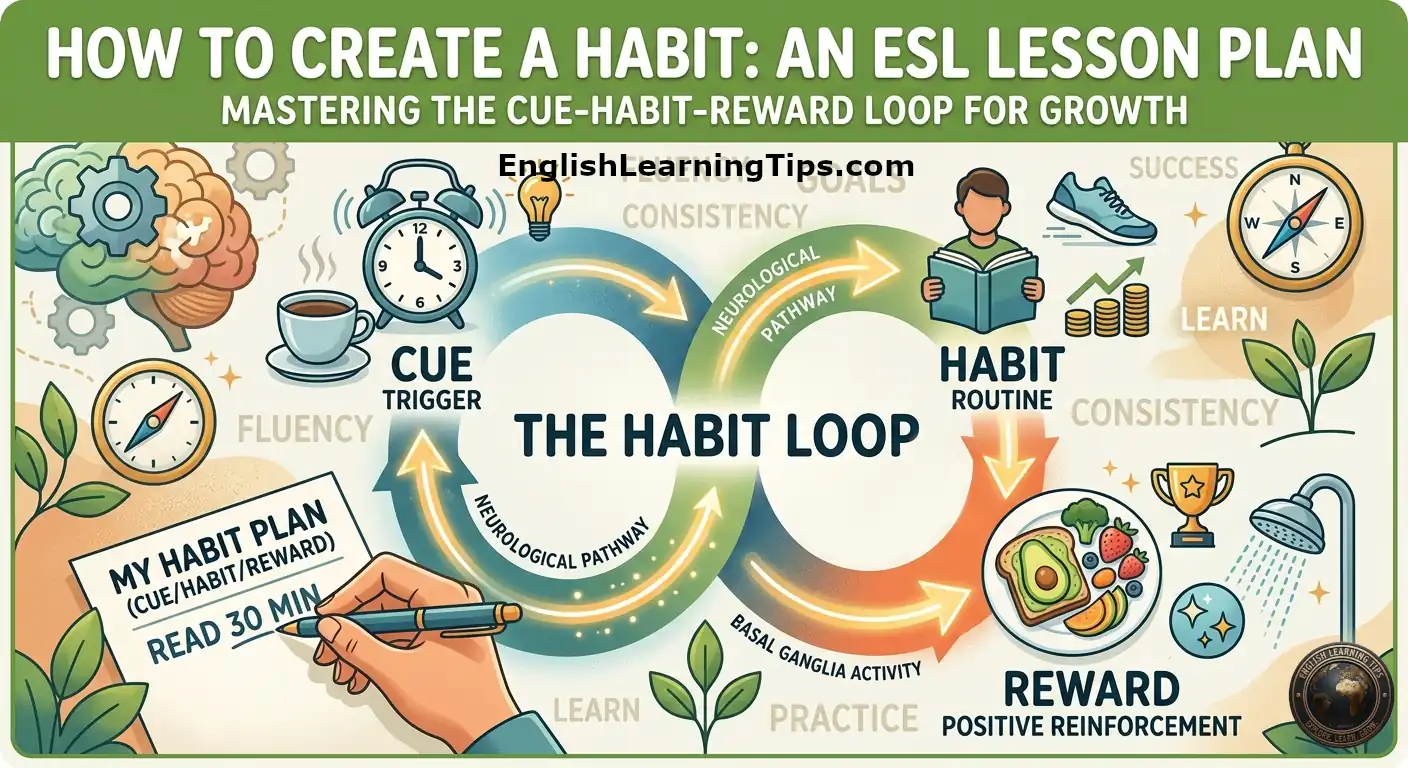
Habit formation is a neurological process that allows our brains to save energy by turning frequent behaviors into automatic routines. According to psychological research, most habits follow a specific loop consisting of a trigger, the behavior itself, and a positive reinforcement. By identifying these components, individuals can intentionally design new routines or replace unproductive ones.
In this lesson, we look at the “cue, habit, and reward” system. This method is used by successful athletes, entrepreneurs, and even advertisers to create lasting change. Whether you are trying to improve your health, wealth, or relationships, understanding the science behind your actions is the first step toward mastery. Let’s talk about breaking bad habits and forming new ones.
According to The Power of Habit and other modern psychological research, most habits follow a specific loop consisting of a trigger, the behavior itself, and a positive reinforcement.
Basic vocabulary
Introduce essential words related to habit development and behavioral psychology.
Vocabulary list
- Cue (noun)
- Conjugations: Cues (n. pl), Cue (v)
- Definition: A signal or trigger that starts a behavior.
- Example sentence: My morning alarm is the cue for me to start my workout.
- Reward (noun)
- Conjugations: Reward (v), Rewarding (adjective)
- Definition: A positive result or feeling after an action.
- Example sentence: Eating a healthy breakfast is my reward for running.
- Implement (verb)
- Conjugations: Implementation (n), Implemented (v. past)
- Definition: To put a plan or system into action.
- Example sentence: I want to implement a new reading habit this month.
- Iteration (noun)
- Conjugations: Iterate (v), Iterative (adj)
- Definition: The repetition of a process.
- Example sentence: Each iteration of the habit makes it stronger.
- Reinforcement (noun)
- Conjugations: Reinforce (v), Reinforced (adj)
- Definition: Something that strengthens a behavior.
- Example sentence: Positive reinforcement helps children learn new skills.
- Mindful (adjective)
- Conjugations: Mindfully (adv), Mindfulness (n)
- Definition: Being conscious or aware of something.
- Example sentence: You should be mindful of how you spend your free time.
- Consistency (noun)
- Conjugations: Consistent (adj), Consistently (adv)
- Definition: The quality of always acting in the same way.
- Example sentence: Consistency is the most important part of any routine.
- Satisfactory (adjective)
- Conjugations: Satisfaction (n), Satisfy (v)
- Definition: Fulfilling a need or requirement.
- Example sentence: A satisfactory reward keeps you motivated to continue.
- Incorporate (verb)
- Conjugations: Incorporation (n), Incorporated (adj)
- Definition: To include something as part of a whole.
- Example sentence: Try to incorporate more vegetables into your diet.
- Structure (noun)
- Conjugations: Structural (adj), Restructure (v)
- Definition: The way parts are arranged or organized.
- Example sentence: The structure of the brain affects how we learn habits.
Vocabulary for extension
- Automaticity (Noun): The ability to do things without occupying the mind with the low-level details. Note: Using a habit-tracking journal can help speed up this process by providing visual cues.
- Trigger (Verb/Noun): To cause an event or situation to happen or exist.
- Routine (Noun): A sequence of actions regularly followed.
- Dopamine (Noun): A chemical in the brain associated with pleasure and reward.
- Neurology (Noun): The study of the anatomy and functions of nerves and the nervous system.
- Incentive (Noun): A thing that motivates or encourages one to do something.
- Replace (Verb): To take the place of something else.
- Eliminate (Verb): To completely remove or get rid of something.
- Willpower (Noun): Control exerted to do something or restrain impulses.
- Formation (Noun): The action of forming or the process of being formed.
Teaching tips
- Use a “concept check” by asking students to identify the cue, habit, and reward in a common activity like brushing teeth.
- Encourage students to create “word maps” showing how the verb form of a word (e.g., satisfy) changes into an adjective (satisfactory).
Grammar
The lesson focuses on first conditional statements and if-then structures for goal setting.
- Structure: If + [Present Simple], then + [Future Simple].
- Example: “If I wake up early, then I will read for thirty minutes.”
- Usage: We use this to describe the “cue” (if) and the resulting “reward” or “outcome” (then).
Useful phrases
Key phrases
- To get rid of a habit: To stop doing something regularly.
- From the ground up: Starting from the very beginning.
- To swap out: To exchange one thing for another.
- Positive reinforcement: Encouraging a behavior by providing a reward.
- To fall back into: To return to an old, usually bad, habit.
Teaching tips
- Have students practice “To swap out” by giving them a list of bad habits and asking what they would replace them with (e.g., “I will swap out soda for sparkling water”).
Example conversations
Conversation 1: Basic description
Teacher: Can you explain how you start your morning?
Student: My alarm is the cue that tells me to get out of bed.
Teacher: And what is the habit you are trying to build?
Student: I am trying to drink a glass of water immediately after I wake up.
Conversation 2: Adding details
Friend A: I’ve been trying to go to the gym, but I keep forgetting.
Friend B: You need a better cue to trigger the behavior.
Friend A: Maybe I should put my gym shoes right next to the door.
Friend B: Exactly, and then give yourself a small reward after you finish.
Conversation 3: More advanced
Manager: How are you planning to implement the new software training?
Employee: We will use an if-then statement to guide the staff’s routine.
Manager: That sounds like a solid strategy for consistency.
Employee: If they complete the daily module, then they get an extra break.
Teaching tips
- Ask students to perform these dialogues in pairs and then “remix” them using their own personal habits.
Teaching strategy
Use the Task-Based Learning (TBL) approach. Give students the task of “designing a better human.” They must work in groups to create a 24-hour schedule for a fictional person using the cue-habit-reward system for every major activity.
Here’s a 45-minute lesson plan
Step 1: Warm-up (5 minutes)
- Ask students: “What is one thing you do every single day without thinking?”
- List these on the board and introduce the concept of “automaticity.”
Step 2: Vocabulary introduction (10 minutes)
- Distribute the vocabulary chart.
- Practice pronunciation of “Basal Ganglia” and “Reinforcement.”
Step 3: Phrase practice (10 minutes)
- Students write three “If-Then” statements regarding their English learning goals.
Step 4: Conversation practice (15 minutes)
- Students pair up to role-play the example conversations, then create their own about a habit they want to “swap out.”
Step 5: Wrap-up and personalization (5 minutes)
- Each student shares one “cue” they will use tomorrow morning.
Discussion questions
- Question: Why is it harder to break a bad habit than to start a new one?
- Answer: Bad habits are often deeply wired into the basal ganglia, and the reward is usually instant.
- Question: What is a “cue” you use every day?
- Answer: Answers vary, but common cues include alarms, mealtimes, or arriving at work.
- Question: Can a reward be psychological, or does it have to be physical?
- Answer: It can be both; the feeling of pride or being “sparkly clean” is a powerful psychological reward.
- Question: How does an if-then statement help with discipline?
- Answer: It removes the need to make a decision in the moment, making the action more automatic.
- Question: What part of the brain handles habits?
- Answer: The basal ganglia.
Additional tips
- Cultural sensitivity: Be aware that “rewards” (like food or leisure) vary by culture; encourage students to share culturally specific rewards.
- Visual aids: Use a circular diagram to show the loop of cue, habit, and reward.
- Adapt for level: For lower levels, focus on “Every day I…” For higher levels, focus on “If I were to…”
- Technology: Use habit-tracking apps (like Habitica or Streaks) as a real-world example of reinforcement.
Common mistakes to address
- Grammar: Using “will” in the “if” clause (Correct: If I wake up. Incorrect: If I will wake up).
- Word choice: Confusing “habit” with “hobby.” A hobby is for fun; a habit is an automatic routine.
Example activity
The habit map: Students fold a piece of paper into three columns labeled “Cue,” “Habit,” and “Reward.” They must map out their current English study routine and then create a “New and Improved” map to share with the class.
Homework or follow-up
- Writing: Write a 200-word paragraph about a habit you successfully changed in the past.
- Speaking: Record a 1-minute voice memo explaining your “if-then” plan for the week.
- Research: Look up the “Basal Ganglia” and find one fun fact about how it works.
Faqs
Conclusion: Start building your future today
Understanding the psychology of habits is a game-changer for anyone learning a new language. By mastering the cue-habit-reward loop, you can make your English practice as automatic as brushing your teeth.
What is one habit you are planning to implement this week? Let us know in the comments below, and share this article with a friend who wants to reach their goals!
Discover more from English Learning Tips
Subscribe to get the latest posts sent to your email.


