
Doomsday Clock English lesson: ESL vocabulary for news and global risks

Understanding news headlines regarding global events can be a challenge for English learners. This lesson focuses on the Doomsday Clock, a symbolic measure of global risk, to help you master advanced adjectives and metaphors used in international journalism. By the end of this session, you will be able to discuss complex topics like climate change and nuclear risk with confidence.
Lesson plan: Timely talk: Navigating news of the Doomsday Clock
Level: Intermediate to Advanced (B2-C1)
Time: 60 minutes
Topic: The Doomsday Clock and global risk vocabulary
Objectives: To understand and apply news-related vocabulary, master metaphors for urgency, and engage in discussions about global challenges.
Background
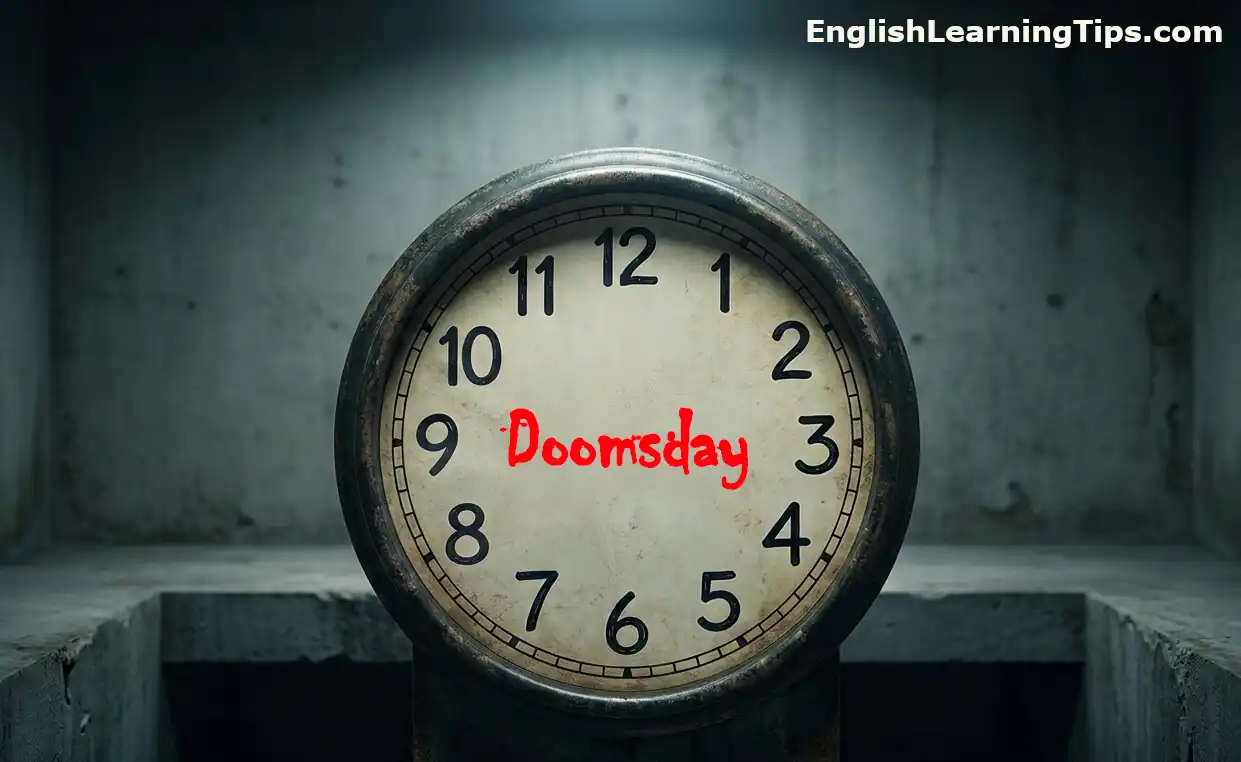
The Doomsday Clock is a symbolic timepiece maintained since 1947 by the Bulletin of the Atomic Scientists. Originally created to represent the threat of nuclear weapons during the Cold War, the clock now factors in modern risks such as anthropogenic climate change, disruptive technologies, and artificial intelligence. “Midnight” on this clock represents a metaphorical point of global catastrophe or the end of humanity.
In recent years, the clock has moved closer to midnight than ever before. Currently set at 90 seconds to midnight (as of the latest 2024 update), the experts behind the project—including several Nobel Laureates—use it as a “stark” warning to world leaders. The goal of the clock is not to predict the future, but to spur action and remind the public that when it comes to saving the planet, every second counts.
Basic vocabulary
Introducing essential words related to global news and metaphorical warnings is key to understanding the gravity of these reports.
Vocabulary list
| Word | Part of speech | Conjugations | Definition | Example sentence |
| Stark | Adjective | Starkly (adv), starkness (n) | Very clear, obvious, or unpleasantly sharp. | The report offered a stark warning about the effects of pollution. |
| Apocalypse | Noun | Apocalyptic (adj), apocalyptically (adv) | A very serious event causing total destruction. | Many movies depict a post-apocalypse world where resources are scarce. |
| Disaster | Noun | Disastrous (adj), disastrously (adv) | A sudden event that causes great damage or loss. | The flood was a natural disaster that displaced thousands. |
| Warn | Verb | Warning (n/adj), warned (past) | To inform someone of a possible problem or danger. | Experts warn that we must reduce carbon emissions immediately. |
| Humanity | Noun | Human (adj/n), humanize (v) | The human race as a whole. | The future of humanity depends on global cooperation. |
| Destroy | Verb | Destruction (n), destructive (adj) | To damage something so badly that it cannot be used. | A nuclear conflict would destroy major cities instantly. |
| Threat | Noun | Threaten (v), threatening (adj) | A suggestion that something unpleasant will happen. | Climate change is a major threat to coastal communities. |
| Update | Verb | Update (n), updated (adj) | To make something more modern or include new info. | The scientists update the clock’s time every year. |
| Conflict | Noun | Conflict (v), conflicting (adj) | A serious disagreement or argument. | Armed conflict in the region has caused the clock to move forward. |
| Risk | Noun | Risky (adj), risk (v) | The possibility of something bad happening. | There is a high risk of economic instability during war. |
Vocabulary for extension
- Doomsday (noun): The end of the world; a time of final judgment or total destruction.
- Predict (verb/noun: prediction/adj: predictable): To say that an event will happen in the future.
- Metaphor (noun/adj: metaphorical/adv: metaphorically): A figure of speech used to represent something else.
- Bulletin (noun): A short official statement or broadcast summary of news.
- Atomic (adjective/noun: atom): Relating to the energy produced by splitting atoms.
- Artificial (adjective/adv: artificially): Made or produced by human beings rather than occurring naturally.
- Intelligence (noun/adj: intelligent): The ability to acquire and apply knowledge and skills.
- Drastic (adjective/adv: drastically): Likely to have a strong or far-reaching effect; extreme.
- Reduction (noun/verb: reduce/adj: reducible): The action of making something smaller or less in amount.
- Indicator (noun/verb: indicate/adj: indicative): A sign or signal that shows the condition or existence of something.
Teaching tips
- Visualizing metaphors: Use a physical or drawn clock to show how “seconds to midnight” creates a sense of urgency.
- Word families: Encourage students to build the table further by finding more synonyms for “disaster” (e.g., catastrophe, calamity).
Grammar spotlight: Advanced structures for global risks
To discuss the Doomsday Clock and international news effectively, students need to move beyond simple tenses. This spotlight focuses on three sophisticated structures used to express urgency, historical trends, and hypothetical scenarios.
The double comparative for cause and effect
In journalism, we often want to show that as one thing increases, another thing changes as a result. The double comparative is the perfect tool for this. It creates a sense of momentum or escalating risk.
The structure:
The + comparative adjective + clause, the + comparative adjective + clause
- Example: “The closer the clock moves to midnight, the more urgent the global response becomes.”
- Example: “The higher the risk of nuclear conflict, the starkest the warning from the Bulletin.”
Teacher tip: Remind students that even though “the” is usually for superlatives, here it is used with the comparative (e.g., closer, faster, more dangerous) to show a proportional relationship.
Present perfect for current relevance
We use the present perfect (has/have + past participle) to talk about actions that happened at an unspecified time in the past but have a direct impact on the “now.” In the context of the Doomsday Clock, this connects historical decisions to our current level of risk.
- Recent change: “The scientists have moved the hands of the clock forward.” (The result is that we are currently in more danger.)
- Ongoing threat: “Climate change has become a primary factor in the clock’s setting.” (It started in the past and is still a factor today.)
Contrast with past simple:
- Past simple: “The clock moved to 17 minutes in 1991.” (A finished action in a specific year.)
- Present perfect: “The clock has moved closer to midnight recently.” (An action with current significance.)
The second conditional for hypothetical solutions
When discussing global “threats,” we often talk about what could happen if world leaders changed their behavior. Because these changes are often difficult or unlikely, we use the second conditional to discuss “unreal” or “hypothetical” present/future situations.
The structure:
If + past simple, would + base verb
- Example: “If world leaders reduced carbon emissions today, scientists would move the clock back.”
- Example: “If humanity banned autonomous weapons, the ‘apocalypse’ would feel less imminent.”
Common errors to avoid
- Articles with “humanity”: Do not use “the” when referring to the human race as a whole.
- Incorrect: The humanity is at risk.
- Correct: Humanity is at risk.
- Stark vs. Strong: While both are adjectives, “stark” implies something unpleasantly clear or bare.
- Correct: “A stark reminder” (It is impossible to ignore).
- Incorrect: “A stark coffee” (Use “strong” for intensity of flavor).
Useful phrases
Key phrases
- Every second counts: Every moment is important because time is limited.
- Hold your breath: To wait nervously or excitedly for an outcome.
- Running out of time: Having very little time left to complete a task or avoid a problem.
- A stark reminder: An obvious fact that makes you remember something important (usually something serious).
Teaching tips
- Context Clues: Ask students to differentiate between the literal meaning of “holding your breath” (underwater) and the metaphorical meaning (waiting for news).
- Time Variations: Practice swapping “second” in “every second counts” with “minute,” “day,” or “dollar” to show versatility.
Example conversations
Conversation 1: Basic description
Student A: Did you see the news about the Doomsday Clock?
Student B: Yes, it is now only 85 seconds to midnight.
Student A: That sounds very scary.
Student B: It is a symbolic way to show global risk.
Conversation 2: Adding details
Student A: Why did the scientists move the clock forward this year?
Student B: They are worried about artificial intelligence and climate change.
Student A: It’s a stark reminder that we need to change our habits.
Student B: I agree, we are running out of time to fix these issues.
Conversation 3: More advanced
Student A: The world holds its breath every time the Bulletin of Atomic Scientists makes an announcement.
Student B: It’s true; the apocalypse warning feels more real when you see the clock move.
Student A: Do you think humanity can actually push the hands back?
Student B: They did it at the end of the Cold War, so there is still hope if every second counts.
Teaching tips
- Roleplay: Have students create their own “breaking news” segment using at least three of the key phrases.
- Tone Practice: Encourage students to use a serious, “news-anchor” tone during the advanced conversation.
Teaching strategy
Use the Task-Based Learning (TBL) approach. Start by giving students the “headline” and asking them to predict the story. This engages their prior knowledge of world events before diving into the specific vocabulary of the transcript.
Here’s a 45-minute lesson plan
Step 1: Warm-up (5 minutes)
Ask students if they have heard of the Doomsday Clock. Show a picture of a clock set near midnight and ask: “How does this make you feel?”
Step 2: Vocabulary introduction (10 minutes)
Distribute the vocabulary chart. Focus on the word “stark” and the concept of “apocalypse.” Have students practice the pronunciation of “humanity.”
Step 3: Phrase practice (10 minutes)
Explain the idioms “hold your breath” and “every second counts.” Ask students to share a time they literally held their breath and a time they metaphorically held their breath.
Step 4: Conversation practice (15 minutes)
In pairs, students read the three example conversations. Then, they must write a fourth conversation where they discuss one specific threat (like AI or pollution).
Step 5: Wrap-up and personalization (5 minutes)
Ask students: “If you could move the clock back, what is one thing world leaders should do today?”
Discussion questions
- What does midnight represent on the Doomsday Clock?
- Answer: Midnight represents the end of humanity or a total global disaster.
- Why is the word “stark” used to describe the warning?
- Answer: Because the warning is very clear, serious, and impossible to ignore.
- Can the clock ever move backward?
- Answer: Yes, it moved back in 1991 when the US and Soviet Union agreed to reduce nuclear weapons.
- What are two modern threats scientists consider besides nuclear war?
- Answer: They consider climate change and artificial intelligence.
- What does the phrase “the world holds its breath” mean in the headline?
- Answer: It means people around the world are waiting nervously for the update.
Additional tips
- Cultural sensitivity: Acknowledge that “Doomsday” topics can cause anxiety; keep the focus on the language and the call to action.
- Visual aids: Use a timeline showing when the clock moved forward and backward throughout history.
- Adapt for level: For lower levels, focus on “clock” and “time” vocabulary. For higher levels, debate the ethics of AI.
- Technology: Use a countdown timer during the “every second counts” activity to add excitement.
Common mistakes to address
- Grammar: Using “the” with humanity. (Correct: “Humanity is at risk,” not “The humanity is at risk.”)
- Word choice: Confusing “stark” with “dark.” While they can be related, “stark” is about clarity and emptiness, not just color.
Example activity
The Headline Creator: Give students three fake news scenarios (e.g., “A new cure for a disease is found” or “A volcano is about to erupt”). Students must write a headline using at least one vocabulary word and one idiom from the lesson.
Homework or follow-up
- Writing: Write a 150-word summary of the Doomsday Clock’s history and current status.
- Speaking: Record a 1-minute “news report” on your phone about a local issue using the phrase “a stark reminder.”
- Research: Find out which year the clock was furthest from midnight and why.
FAQs
Conclusion: Take action today
Understanding the language of global risk allows you to participate in the most important conversations of our time. Whether you are following climate news or technological breakthroughs, these “stark” vocabulary words and phrases like “every second counts” are essential for your linguistic toolkit.
What do you think is the biggest threat to humanity today? Leave a comment below with your thoughts, and share this article with a friend who wants to improve their English news literacy!
Discover more from English Learning Tips
Subscribe to get the latest posts sent to your email.


