

Transitive and intransitive verbs: A complete guide with examples

Verbs are sort of like the engine of every English sentence, but they don’t all function the same way. The primary difference lies in how they handle direct objects. Understanding the distinction between a transitive and an intransitive verb is essential for mastering sentence structure, improving writing clarity, and avoiding common grammatical errors.
What is a transitive verb?
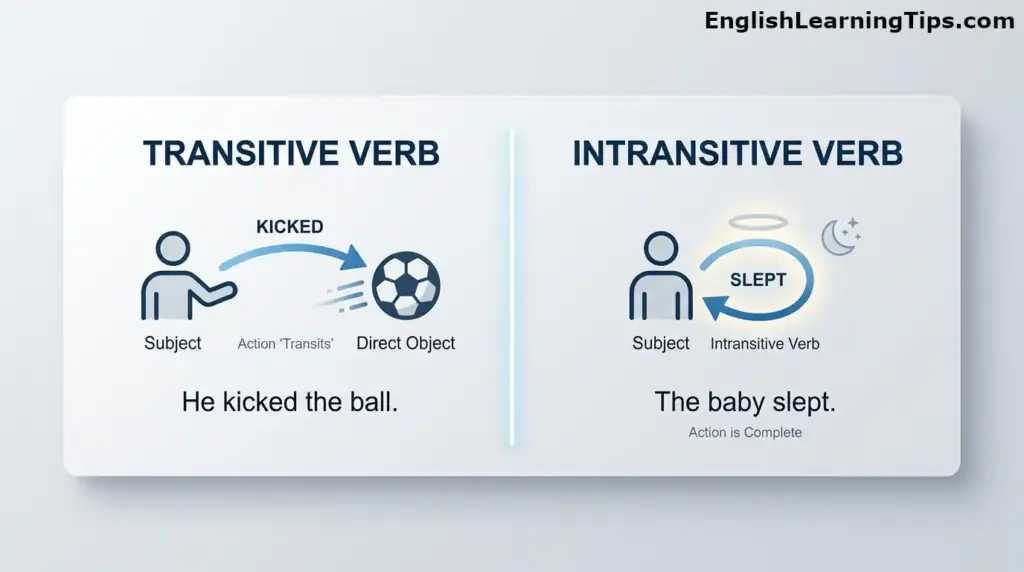
A transitive verb is an action verb that requires a direct object to complete its meaning. The action “transits” or passes from the subject to a person or thing. Without an object to receive the action, a transitive verb leaves the reader asking “What?” or “Whom?”
Examples of transitive verbs in sentences:
- She read the book. (Read what? → the book)
- They built a new house. (Built what? → a new house)
- The teacher praised the student. (Praised whom? → the student)
In the sentence “He gave her a gift,” gave is the transitive verb. While “gift” is the direct object, “her” acts as an indirect object, showing who received the direct object.
What is an intransitive verb?
An intransitive verb expresses an action or state that is complete on its own. It does not transfer action to a direct object. While these sentences often include adverbs or prepositional phrases to provide context, those additions are not objects.
Examples of intransitive verbs in sentences:
- The baby slept soundly. (“Soundly” describes how the baby slept; it is not an object.)
- Birds fly south in winter. (“South” is a direction, not a thing being “flown.”)
- Everyone laughed at the joke. (“At the joke” is a prepositional phrase.)
Common intransitive verbs include arrive, cry, die, fall, go, laugh, sleep, and wait.
Comparison: Transitive vs. intransitive verbs
Use this table to quickly identify the grammatical requirements of different verb types.
| Feature | Transitive verbs | Intransitive verbs |
| Needs direct object? | Yes | No |
| Sentence completeness | Incomplete without an object | Complete without an object |
| Passive voice | Possible (e.g., The ball was kicked) | Not possible |
| The “What/Whom” test | Answers “What?” or “Whom?” | No logical answer to “What?” |
| Example | She kicked the ball. | The ball rolled away. |
Verbs that can be both: Ambitransitive verbs
Many English verbs are flexible. Depending on the context, they can function as either transitive or intransitive. These are known as ambitransitive verbs.
- Eat
- Intransitive: We eat at noon. (Focuses on the act of eating.)
- Transitive: We eat fresh fruit. (Focuses on the item consumed.)
- Run
- Intransitive: She runs every morning. (Action of exercise.)
- Transitive: He runs a small business. (Action of managing.)
- Sing
- Intransitive: The choir sings beautifully.
- Transitive: She sang a lullaby.
How to identify transitive and intransitive verbs
If you are unsure which category a verb falls into, follow this simple three-step process:
- Locate the verb: Find the action word in the sentence.
- Ask “What?” or “Whom?”: Place the question immediately after the verb. For “The chef cooked dinner,” ask “Cooked what?” The answer is “dinner,” making it transitive.
- Check for a passive voice flip: Try to turn the sentence around. If you can say “The dinner was cooked by the chef,” the verb is transitive. You cannot do this with intransitive verbs (e.g., “Late was arrived by the guests” does not work).
FAQ: Common questions about verb types
Conclusion: Mastering your verb usage
Differentiating between transitive and intransitive verbs is more than just a grammar exercise—it is a tool for clear communication. By identifying whether a verb requires a direct object, you can eliminate awkward phrasing, master the passive voice, and write with greater authority.
Remember the “What?” or “Whom?” test whenever you are in doubt. If the action needs a receiver, it is transitive; if it stands alone, it is intransitive. With practice, these sentence patterns will become second nature in your daily writing.
Join the conversation: What’s your “tricky” verb?
Grammar can be unpredictable, and even the most seasoned writers get stuck on verbs like lay vs. lie or sit vs. set.
- Which verb pairs always trip you up? * Do you have a shortcut for remembering the difference?
Drop a comment below and let’s discuss! If you found this guide helpful, share it with a fellow writer or student to help them sharpen their English grammar skills.
Discover more from English Learning Tips
Subscribe to get the latest posts sent to your email.


