

Linking verbs in English: A complete guide to usage and examples

Linking verbs act as a bridge in a sentence. Instead of showing what a subject does, they describe what a subject is. Whether you are a student mastering English grammar or a writer refining your prose, understanding how these “copular verbs” function is essential for clear communication.
In this guide, you will learn the definition of linking verbs, see a comprehensive list of examples, and discover how to distinguish them from action and helping verbs.
What are linking verbs?
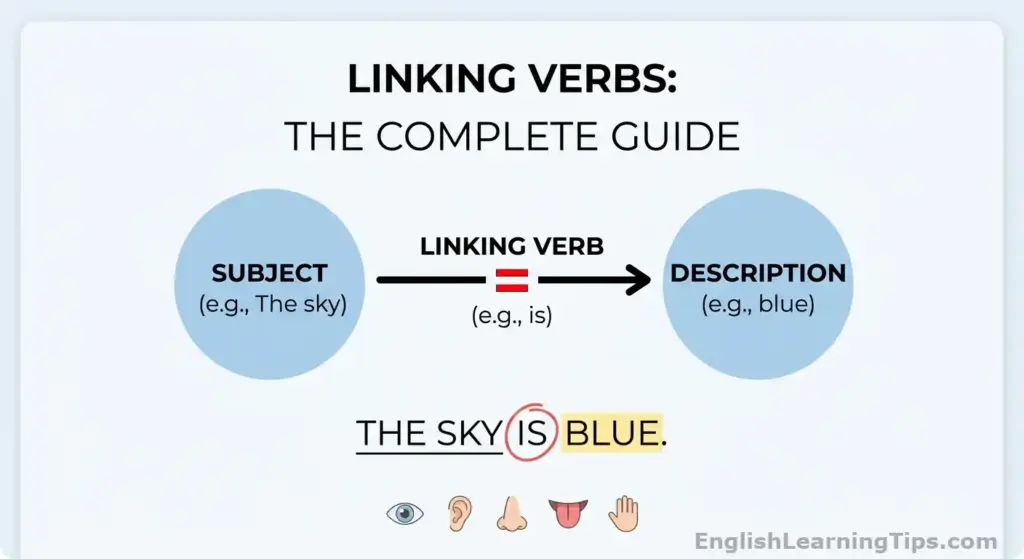
A linking verb connects the subject of a sentence to a subject complement. This complement can be a predicate adjective (which describes the subject) or a predicate nominative (a noun or pronoun that renames the subject).
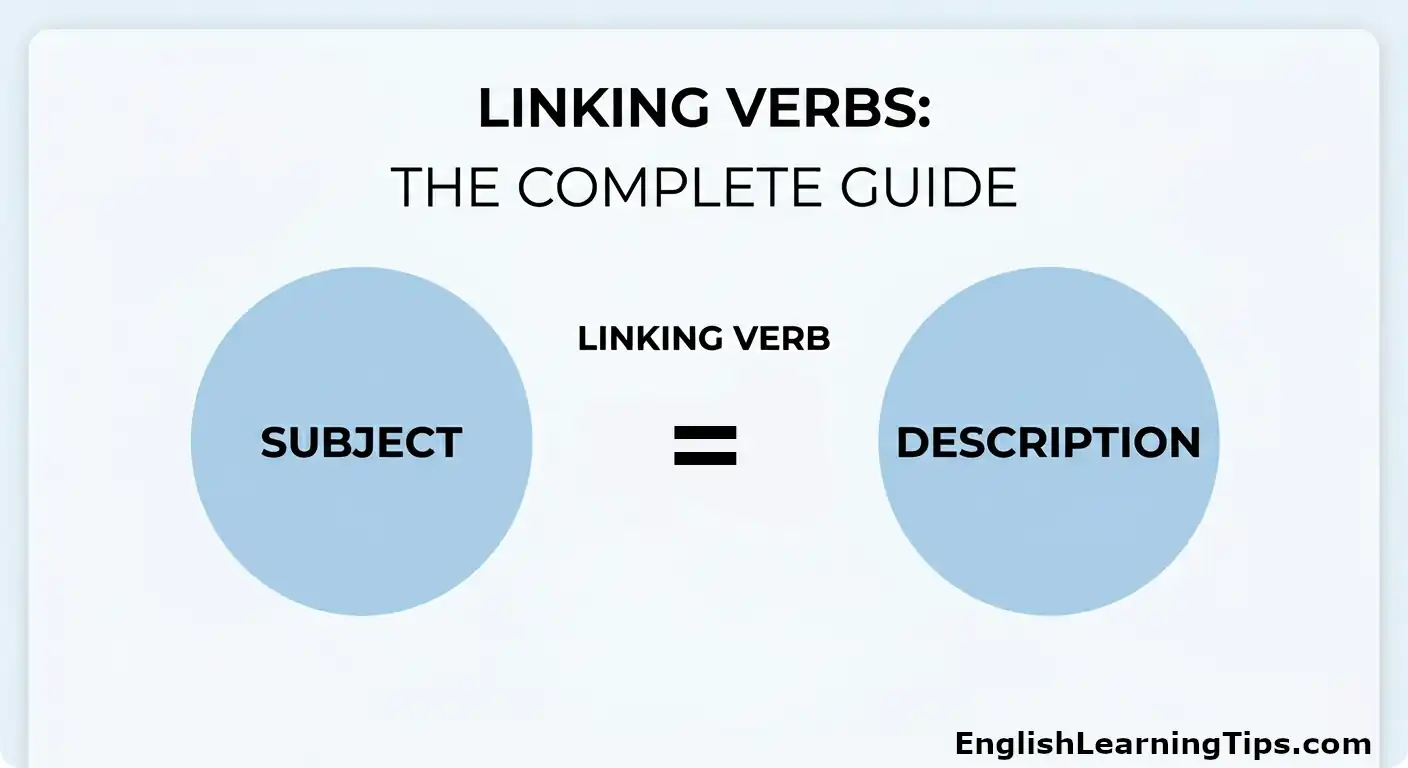
Unlike action verbs, linking verbs do not express physical or mental activity. Think of them as an equal sign (=) in a sentence:
- The coffee smells amazing. (Coffee = amazing)
- Jeremy is a pilot. (Jeremy = pilot)
Common linking verbs list
English linking verbs generally fall into three categories: those that are always linking, those related to the senses, and those that describe a state of result.
Verbs that are always linking
These words almost never function as action verbs:
- Forms of “to be“: am, is, are, was, were, be, being, been
- Become: “The caterpillar became a butterfly.”
- Seem: “The task seems difficult.”
Sensory linking verbs
These relate to the five senses and often transition between linking and action roles:
- Appear
- Feel
- Look
- Smell
- Sound
- Taste
Conditional and state verbs
- Grow (to become)
- Remain
- Stay
- Turn
- Prove
- Get
Linking verbs vs. action verbs: How to tell the difference
Distinguishing between a linking verb and an action verb is a common hurdle in English grammar. The easiest way to identify them is the “substitution test.”
The substitution test:
Replace the verb with a form of “to be” (am, is, or are). If the sentence still makes sense and retains its basic meaning, it is a linking verb.
| Sentence | Substitution | Result | Type |
| The stew tastes salty. | The stew is salty. | Logical | Linking |
| He tastes the stew. | He is the stew. | Illogical | Action |
| The actor appeared nervous. | The actor was nervous. | Logical | Linking |
| The actor appeared on stage. | The actor was on stage. | Different meaning | Action |
Linking verbs vs. helping verbs
It is easy to confuse these because they often use the same words (like is, are, or was).
- A linking verb stands alone as the main verb: “She is happy.”
- A helping verb (auxiliary verb) supports a main action verb: “She is running.”
Grammar rules for subject complements
When using linking verbs, you must follow them with a subject complement rather than a direct object. This complement usually takes one of two forms:
- Predicate adjective: Describes the subject.
- Example: “The ocean looks calm.”
- Predicate nominative: Renames the subject.
- Example: “My sister is a scientist.”
Pro tip: Because linking verbs describe the subject, they must be followed by adjectives, not adverbs.
Common mistakes to avoid
- Using adverbs incorrectly: Many people say, “I feel badly,” when they mean they are sad or ill. Since “feel” is a linking verb here, you should use the adjective: “I feel bad.“
- Misidentifying the “to be” verb: Always check if there is an action verb following “is” or “are.” If there is, you are looking at a helping verb, not a linking verb.
- Overuse of “to be”: While grammatically correct, relying solely on “is” and “was” can make writing feel static. Try using “remained,” “became,” or “seemed” for more variety.
Frequently asked questions about linking verbs
Conclusion: Master your sentence structure
Understanding linking verbs is one of the fastest ways to improve your English grammar skills. By recognizing the difference between a state of being and a physical action, you can write with more precision and variety. Whether you are using the “substitution test” to identify a copular verb or choosing the right predicate adjective, these small shifts in your writing make a massive impact on clarity.
We want to hear from you
Did this guide help clear up the “I feel bad” vs. “I feel badly” debate for you? Grammar can be tricky, and we love diving into the details with our readers.
- Leave a comment below: Tell us which linking verb always trips you up, or share a sentence for us to help you analyze.
- Share this guide: If you found these tips helpful, share this article with a fellow student or writer who wants to polish their English.
Discover more from English Learning Tips
Subscribe to get the latest posts sent to your email.


