

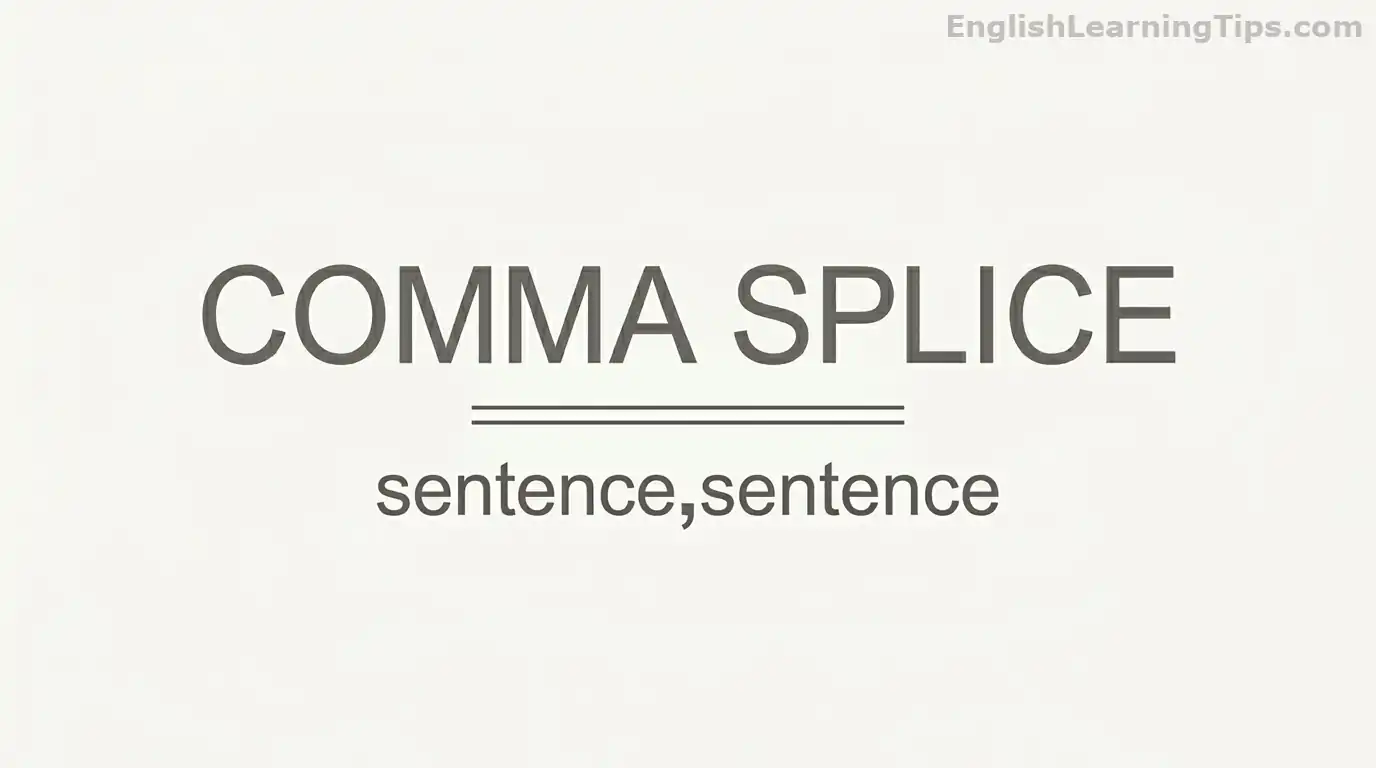
Comma splices: What they are and how to avoid using them

A comma splice happens when you join two independent clauses with only a comma. While common in quick emails or drafts, this punctuation error can lower your credibility in professional or academic writing. Here is how to identify and fix them.
What is a comma splice?
In grammar, a comma splice is a specific type of run-on sentence. It happens when a writer attempts to connect two complete thoughts using only a comma without a coordinating conjunction.
Incorrect example (comma splice)
I finished my report early, I sent it to my boss right away.
In this example, “I finished my report early” and “I sent it to my boss right away” are both independent clauses. Because they could each function as a standalone sentence, the comma alone creates a “splice” error.
Comma splice vs. fused sentence
While both are types of run-on sentences, they differ in punctuation:
- Comma splice: Joins clauses with only a comma.
- Fused sentence: Joins clauses with no punctuation at all.
Why comma splices matter in professional writing
A comma splice creates a “weak break” where a “strong break” is required. This can confuse readers or make your prose feel rushed. In professional environments, academic papers, or standardized tests like the SAT and ACT, these are flagged as significant errors. While casual texting or social media may allow for a more relaxed flow, polished writing depends on clear punctuation.
How to identify a comma splice
To spot a comma splice, use the “stand-alone test.” Read the words on either side of the comma. If both sides can function as complete, independent sentences, you have a comma splice.
Common comma splice examples
- Incorrect: The weather was perfect, we decided to go hiking.
- Incorrect: She loves reading novels, her favorite author is Jane Austen.
- Incorrect: The team worked hard all week, they still missed the deadline.
How to fix a comma splice: Four proven methods
You have four reliable ways to correct a comma splice. You can choose the method that best fits your desired tone or the relationship between your ideas.
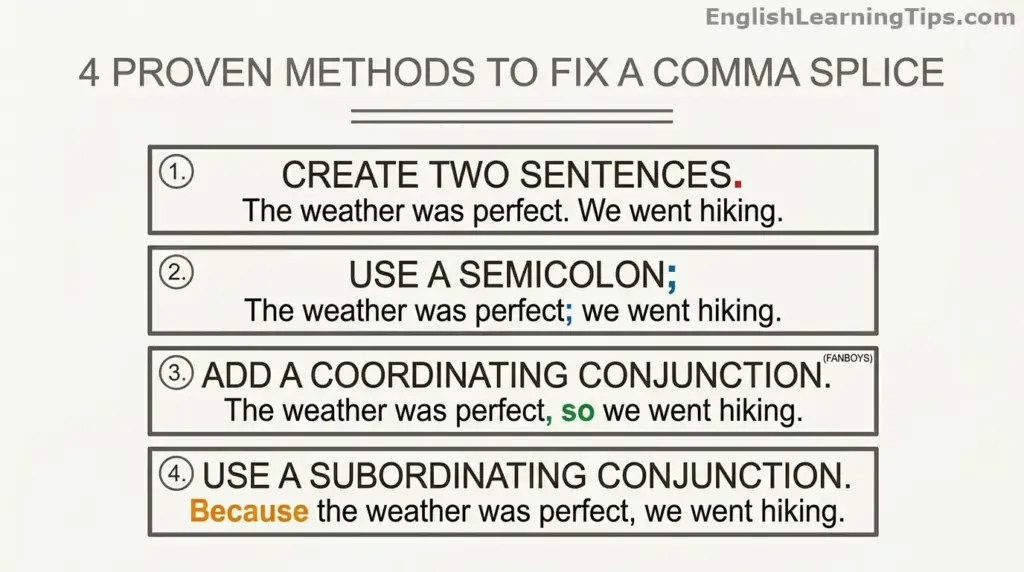
1. Create two separate sentences
Replace the comma with a period and capitalize the following word. This is the most straightforward fix for long or complex thoughts.
- Fixed: The weather was perfect. We decided to go hiking.
2. Use a semicolon
A semicolon is ideal when the two ideas are closely related and you want to maintain a tight connection without starting a new sentence.
- Fixed: The weather was perfect; we decided to go hiking.
3. Add a coordinating conjunction (FANBOYS)
Keep the comma and add a coordinating conjunction: for, and, nor, but, or, yet, or so.
- Fixed: The weather was perfect, so we decided to go hiking.
Remember, the conjunction doesn’t replace the comma; it supports it.
4. Use a subordinating conjunction
Transform one of the independent clauses into a dependent clause using words like because, although, if, or since.
- Fixed: Because the weather was perfect, we decided to go hiking.
Comparison of comma splice correction methods
| Method | When to use it | Example (fixed) | Effect on writing |
| Period | Ideas are distinct or very long | She studied late. She still felt unprepared. | Creates clear, punchy breaks |
| Semicolon | Ideas are closely related | She studied late; she still felt unprepared. | Maintains a smooth, sophisticated link |
| Comma + FANBOYS | To show a specific relationship | She studied late, but she still felt unprepared. | Enhances flow and logic |
| Subordinating conjunction | To emphasize one idea over another | Although she studied late, she still felt unprepared. | Shows complex cause and effect |
Tips to avoid comma splices in your writing
- Read aloud: If you notice a heavy pause where a comma is placed, you likely need a stronger mark of punctuation.
- Watch for pronouns: Sentences where the second clause starts with it, he, she, they, or this are high-risk areas for splices.
- Check your “however”: A common mistake is using a comma before “however” to join sentences. Always use a semicolon before “however” and a comma after it.
- Use grammar tools: Modern editors can flag these, but manual proofreading ensures you catch nuances AI might miss.
Frequently asked questions about comma splices
Conclusion: Final thoughts on comma splices
Understanding the comma splice is a vital step toward professional writing. Whether you choose to fix your sentences with a semicolon, a period, or a coordinating conjunction, the goal is always clarity. By identifying these common run-on errors, you ensure that your message remains strong and your credibility stays intact.
Join the conversation
Did this guide help you spot a comma splice you didn’t know was there? Or perhaps you have a “favorite” grammar rule that always seems to trip you up?
Leave a comment below and let us know your biggest writing hurdle. If you found these tips helpful, please share this article with a friend or colleague who wants to polish their prose. Your feedback helps us create better resources for writers everywhere.
Discover more from English Learning Tips
Subscribe to get the latest posts sent to your email.


