

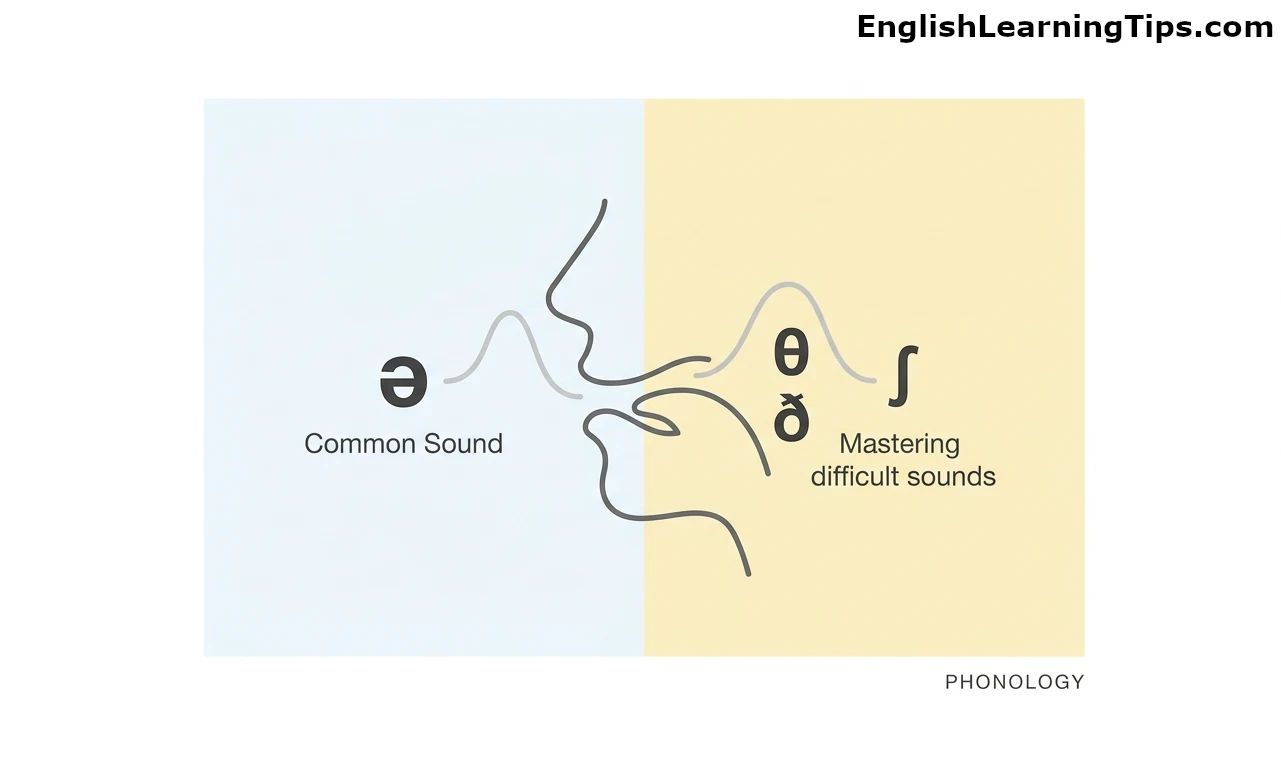
English phonology guide: Mastering the sounds of English

English phonology studies the sound system of the English language—the phonemes (distinct sounds that change word meaning), how they combine into syllables, and how pronunciation varies across global accents.
Unlike spelling, which often mismatches sounds (think of the “ough” in through vs. though), phonology focuses on actual spoken patterns. This guide simplifies the rules of pronunciation for learners, teachers, and linguistics fans.
Key take-aways: English phonology at a glance
To help you master the sounds of English, here are the most important points to remember from this guide:
- Phonemes vs. letters: English has 44 unique sounds (24 consonants and 20 vowels) despite having only 26 letters in the alphabet.
- The power of the schwa: The schwa /ə/ is the most common sound in English and is used in almost every unstressed syllable to create the language’s natural rhythm.
- IPA is your shortcut: Using the International Phonetic Alphabet allows you to pronounce any word correctly by looking it up in a dictionary, regardless of its confusing spelling.
- Stress changes meaning: Moving the emphasis from one syllable to another can transform a word’s meaning (e.g., REcord as a noun vs. reCORD as a verb).
- Regional variations: The biggest difference between British and American English is “rhoticity”—whether or not the /r/ sound is pronounced at the end of a word like car.
What is English phonology, and why does it matter?
Phonology examines the rules governing speech sounds within a specific language. It is distinct from phonetics, which focuses on the physical production and perception of sounds.
In English, phonology explains why “bit” and “beat” mean different things despite differing by only one vowel sound. It also explains why the same letter can represent multiple sounds depending on the context.
Understanding English phonological patterns helps with:
- Accurate pronunciation: Improving listening comprehension and speaking clarity.
- Dialect awareness: Distinguishing between British vs. American English phonology.
- Language teaching: Helping ESL students master difficult transitions in speech.
- Phonetic transcription: Using the International Phonetic Alphabet (IPA) to read dictionary pronunciations accurately.
Standard English typically consists of roughly 44 phonemes—about 24 consonants and 20 vowels—though this count fluctuates based on regional dialects.
The International Phonetic Alphabet (IPA) for English
The IPA bypasses irregular English spelling by using one symbol for one specific sound.
Consonant sounds in English
English consonants are classified by their place of articulation (where the sound is made), manner of articulation (how air is restricted), and voicing (vibration of vocal cords).
| IPA symbol | Example words | Sound classification |
| /p/ | pit, lip | Voiceless bilabial plosive |
| /b/ | bit, tub | Voiced bilabial plosive |
| /t/ | tip, sit | Voiceless alveolar plosive |
| /d/ | dig, sad | Voiced alveolar plosive |
| /k/ | cup, sky | Voiceless velar plosive |
| /g/ | guy, bag | Voiced velar plosive |
| /f/ | fish, cuff | Voiceless labiodental fricative |
| /v/ | vow, leave | Voiced labiodental fricative |
| /θ/ | thigh, breath | Voiceless dental fricative |
| /ð/ | thy, father | Voiced dental fricative |
| /s/ | sip, mass | Voiceless alveolar fricative |
| /z/ | zip, buzz | Voiced alveolar fricative |
| /ʃ/ | ship, push | Voiceless postalveolar fricative |
| /ʒ/ | measure, vision | Voiced postalveolar fricative |
| /tʃ/ | check, etch | Voiceless affricate |
| /dʒ/ | judge, age | Voiced affricate |
| /m/ | my, jam | Bilabial nasal |
| /n/ | not, ran | Alveolar nasal |
| /ŋ/ | sing, link | Velar nasal |
| /l/ | light, full | Alveolar lateral |
| /r/ | red, car | Alveolar approximant |
| /w/ | wet, away | Labial-velar approximant |
| /j/ | yes, use | Palatal approximant |
| /h/ | hat, ahead | Glottal fricative |
Vowel sounds in English: Monophthongs and diphthongs
English vowels show significant variation between accents. The following list covers the standard sounds found in General American (GenAm) and British Received Pronunciation (RP).
Short and long vowels (monophthongs)
- /ɪ/ (sit), /ɛ/ (bed), /æ/ (cat), /ʌ/ (but), /ʊ/ (foot).
- /ə/ (Schwa): The most common unstressed vowel in English (e.g., the ‘a’ in about).
- /iː/ (see), /ɑː/ (father), /ɔː/ (thought), /uː/ (food), /ɜː/ (bird).
Diphthongs (gliding vowels)
Diphthongs are sounds that move from one vowel target to another within the same syllable:
- /aɪ/ (price), /aʊ/ (mouth), /eɪ/ (face), /ɔɪ/ (choice), /oʊ/ or /əʊ/ (goat).
Syllables and word stress patterns
English is a stress-timed language, meaning the rhythmic beat of the language falls on stressed syllables.
- Syllable structure: A syllable typically has a nucleus (usually a vowel). English allows complex “consonant clusters,” such as in the word strengths.
- Word stress: Changing the stress can change the word’s meaning or part of speech. For example, REcord (noun) vs. reCORD (verb).
- Vowel reduction: In unstressed syllables, vowels often reduce to the schwa /ə/. This is why the ‘o’ in photograph sounds different than the ‘o’ in photography.
Regional differences: British vs. American English phonology
If you are learning English pronunciation, it is helpful to understand the primary differences between the two most common standards:
- Rhoticity: American English is generally rhotic, meaning the /r/ is pronounced after vowels (e.g., hard). Most standard British accents are non-rhotic and drop the /r/ unless a vowel follows it.
- The “flat A”: Words like bath or dance use /æ/ in American English but often use the “broad A” /ɑː/ in British RP.
- T-Glottalization and flapping (voiced alveolar tap): In American English, a /t/ between vowels often sounds like a quick /d/ (e.g., butter sounds like budder). In some British dialects, this becomes a glottal stop.
Frequently asked questions about English phonology
Final thoughts: Mastering the melody of English
English phonology can feel like a maze of silent letters and shifting stresses, but understanding these patterns is the key to clear communication. By moving beyond spelling and focusing on the 44 unique phonemes, you gain the tools to decode any accent and improve your own pronunciation with confidence. Whether you are mastering the schwa or navigating the differences between British and American English, remember that consistency and active listening are your best assets.
Join the conversation: Which English sound is your “final boss”?
We want to hear from you! Everyone has that one English word or sound that feels impossible to get right.
- Is the “th” sound giving you trouble?
- Do you prefer the rhotic /r/ of American English or the non-rhotic style of British English?
- Which minimal pair (like ship vs. sheep) do you find the most confusing?
Drop a comment below with your biggest pronunciation challenge or your favorite tip for learning the IPA. If you found this guide helpful, share it with a fellow learner or teacher to help them master the sounds of English!
Discover more from English Learning Tips
Subscribe to get the latest posts sent to your email.


