

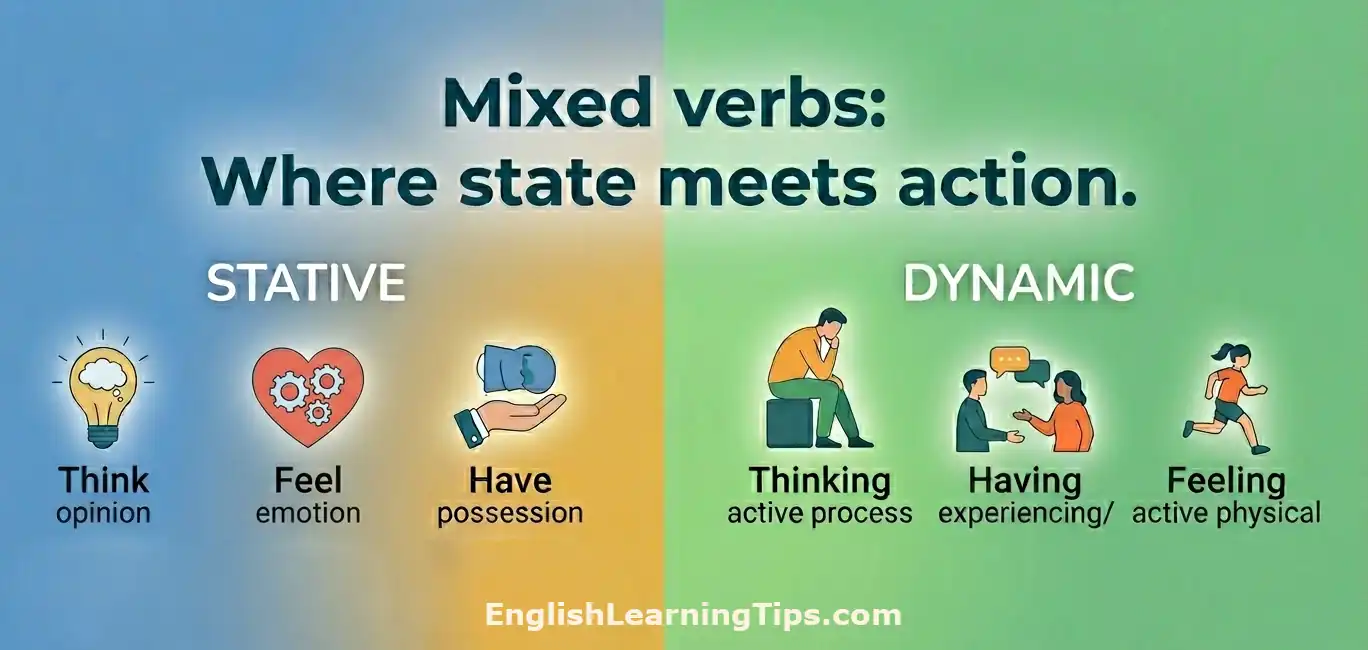
Mixed verbs in English grammar: A complete guide to stative and dynamic meanings

Mixed verbs in English grammar are verbs that change meaning depending on whether you use them in simple or continuous (progressive) forms. They occupy a unique space in the stative vs. dynamic verb classification. In one context, a mixed verb acts as a stative verb (describing a state); in another, it acts as a dynamic verb (describing an action).
Understanding these “double-meaning” verbs is essential for mastering the present continuous tense and avoiding common grammatical errors.
What are mixed verbs in English?
To understand mixed verbs, you first need to recognize the two main groups they bridge:
- Dynamic verbs (action verbs): These describe physical activities or processes. They work in both simple and continuous tenses (e.g., “I eat” or “I am eating”).
- Stative verbs (state verbs): These describe feelings, possession, or senses. They usually only appear in simple tenses (e.g., “I know,” not “I am knowing”).
- Mixed verbs: These carry multiple meanings. One meaning is stative (no continuous form), while the other is dynamic (continuous form is correct).
Common mixed verbs list and examples
The following table breaks down the most frequent mixed verbs. Notice how the verb form shifts the entire meaning of the sentence.
| Verb | Stative meaning (simple tense) | Stative example | Dynamic meaning (continuous) | Dynamic example |
| Think | To have an opinion | I think you are right. | To consider or ponder | I am thinking about my future. |
| Have | To possess or own | She has a fast car. | To experience or consume | They are having breakfast. |
| See | To understand/visualize | I see what you mean. | To meet or date | I am seeing a doctor today. |
| Taste | To have a flavor | The soup tastes salty. | To test or eat a sample | The chef is tasting the sauce. |
| Smell | To have a scent | The roses smell lovely. | To sniff something | He is smelling the perfume. |
| Feel | To have an opinion | I feel this is wrong. | To touch or experience | She is feeling the fabric. |
| Look | To appear or seem | You look exhausted. | To direct your eyes | They are looking at the map. |
| Appear | To seem like | It appears to be broken. | To perform or show up | The actor is appearing on stage. |
| Weigh | To have a specific weight | The bag weighs 10 kg. | To measure weight | The clerk is weighing the fruit. |
| Be | A permanent trait | He is a very rude person. | Temporary behavior | He is being rude right now. |
How to use mixed verbs correctly
When deciding between a simple or continuous tense, ask yourself: Is this a state or an action?
- Identify the intent: If you are describing a permanent fact or an opinion, use the simple form.
- Check for “action”: If the verb describes something you are actively doing with your mind or body, use the continuous form.
- Watch for context clues: Words like “right now” or “at the moment” often signal the dynamic, continuous use of a mixed verb.
Grammar tip: Perception verbs like “see,” “hear,” and “smell” are almost always stative when they happen involuntarily. They only become dynamic when you are intentionally performing the action.
When to use having for possession: The exceptions
While the general rule is that “have” is stative for possession, there are specific linguistic scenarios where the continuous form “having” is not only acceptable but preferred.
Pregnancy and birth
The phrase “I am having a baby” is a standard English expression. In this context, it doesn’t just mean “I possess a baby”; it describes the ongoing process of pregnancy or the active event of childbirth. Because it implies a physical process with a beginning and an end, the dynamic “-ing” form is used.
Idiomatic expressions and slang
English is full of idioms where “having” describes a temporary state of mind or a reaction rather than physical ownership:
- Having a cow: To be extremely upset or angry.
- Having a fit: To react with sudden, intense emotion or anger.
- Having a laugh: To enjoy oneself or find something funny.
Temporary “possession” of an experience
As mentioned earlier, when “have” shifts from ownership to experience, it becomes dynamic.
- “I am having a nightmare” (Currently experiencing).
- “He is having second thoughts” (Actively reconsidering).
Common mistakes with non-continuous verbs
Many English learners struggle with the stative vs. dynamic distinction. Here are a few common errors to avoid:
- Incorrect: I am having two sisters. (Possession is a state).
- Correct: I have two sisters.
- Incorrect: This pizza is tasting great. (Flavor is a state).
- Correct: This pizza tastes great.
- Incorrect: I am seeing what you mean. (Understanding is a state).
- Correct: I see what you mean.
Frequently asked questions about mixed verbs
Conclusion: Mastering the nuance of mixed verbs
Mastering mixed verbs is a significant milestone in your journey to sounding like a native English speaker. By recognizing the thin line between a stative state and a dynamic action, you can communicate more precisely and avoid the common “tense traps” that many learners fall into.
Whether you are “thinking” about a problem or “think” the solution is simple, understanding the context is your most powerful tool. Keep practicing these distinctions, and soon, choosing the right verb form will become second nature.
Join the conversation: What mixed verbs trip you up?
We want to hear from you! Is there a specific verb that always leaves you questioning your grammar? Or perhaps you’ve seen a “stative” verb used in a continuous way that surprised you?
- Drop a comment below with your toughest mixed verb questions.
- Share this guide with a fellow English learner or your study group to help them master their tenses.
- Bookmark this page for a quick reference the next time you are writing an essay or preparing for an English exam.
Discover more from English Learning Tips
Subscribe to get the latest posts sent to your email.


