

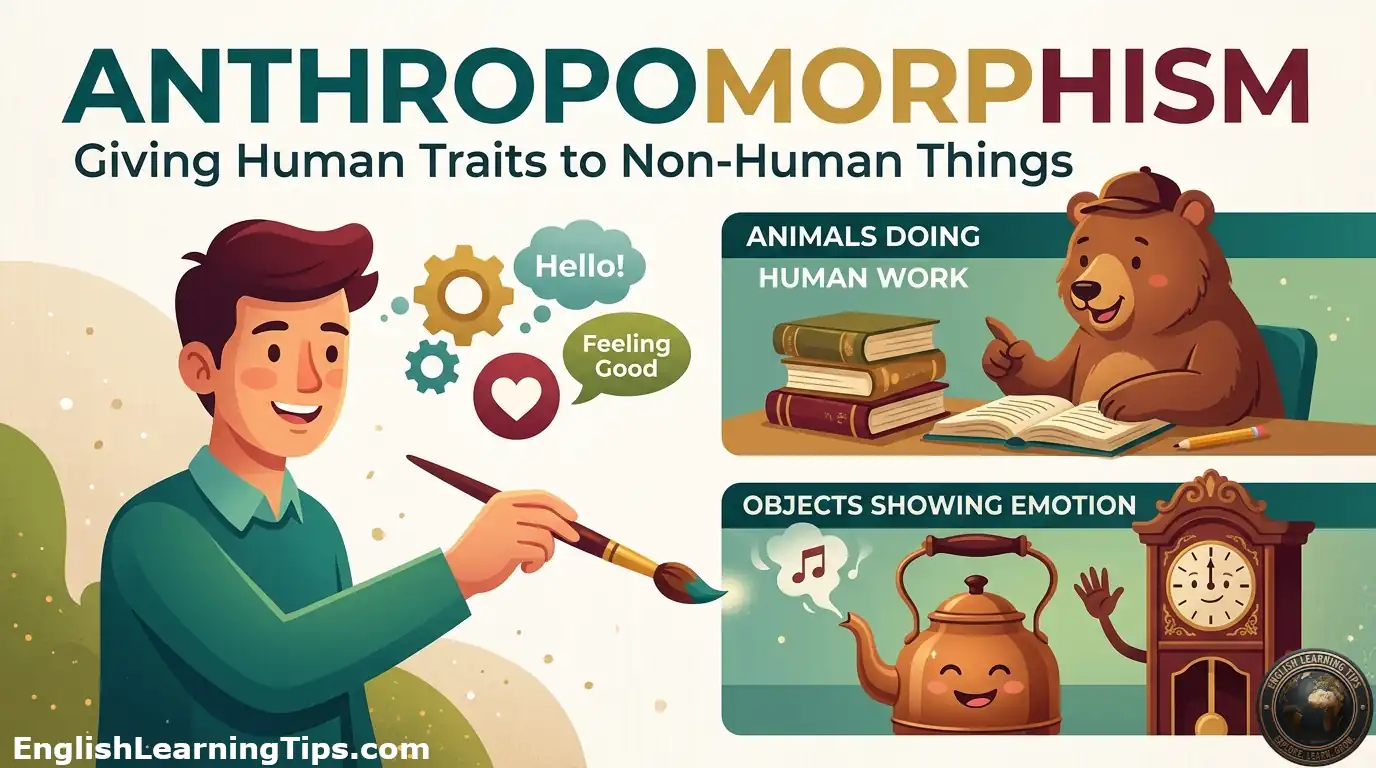
What is anthropomorphism in English grammar?

Anthropomorphism in English grammar refers to the attribution of human characteristics, emotions, behaviors, or intentions to non-human entities such as animals, objects, natural phenomena, or abstract concepts. Writers and speakers use this technique to make descriptions more vivid, relatable, or imaginative.
In grammar and style contexts, it often appears as a literary device rather than a strict rule violation. However, overusing it in formal or academic writing can sometimes lead to imprecise language. Understanding the nuances of anthropomorphism helps improve clarity in both creative and professional English.
Definition of anthropomorphism
The term anthropomorphism comes from the Greek words anthrōpos (human) and morphē (form). Essentially, it involves giving human traits—like thoughts, feelings, speech, or actions—to something that is not human.
Common applications of anthropomorphism
- Animals behaving or speaking like people: Often seen in folklore and modern animation.
- Inanimate objects showing emotions or intentions: Assigning a “will” to a machine or tool.
- Natural forces or concepts depicted with human qualities: Treating the sun, wind, or death as a sentient being.
This device appears across storytelling, everyday language, advertising, and even scientific descriptions, though it is used with caution in technical fields to maintain objectivity.
Anthropomorphism vs. personification: Key differences
Many writers confuse anthropomorphism with personification. While both involve human traits, they differ in degree and application. Anthropomorphism makes a non-human entity act like a human, whereas personification is a figurative comparison.
| Aspect | Anthropomorphism | Personification |
| Definition | Literal human traits, behaviors, or forms given to non-humans. | Figurative language attributing human qualities for poetic effect. |
| Example | The teapot in Beauty and the Beast sings and dances. | “The wind howled in anger”—the wind doesn’t literally feel anger. |
| Common use | Children’s books, animation, fables, and science fiction. | Poetry, descriptive prose, and metaphors. |
| Nature | Usually literal within the story world. | Always figurative or symbolic. |
Anthropomorphism examples in writing and literature
Writers frequently use this device to build empathy and make stories more memorable. Here are clear examples of how it functions across different genres:
- In children’s literature: Winnie-the-Pooh and his friends talk, worry, and plan adventures just like humans.
- In fables: Aesop’s tales feature animals like the sly fox or the hardworking ant that reason and converse to teach a moral lesson.
- In modern fiction: George Orwell’s Animal Farm shows farm animals organizing a rebellion and running a society with human-like politics and speech.
- In film and animation: Disney’s Beauty and the Beast gives furniture the ability to walk, talk, and express complex feelings.
- Everyday language: Phrases like “the computer is acting up today” or “the wind whispered through the trees” lightly anthropomorphize objects or nature.
How to use anthropomorphism effectively in writing
When incorporating human traits into your writing, consider these best practices to ensure your message remains clear:
1. Match the level to your audience
Full anthropomorphism works well in children’s stories or fantasy, while subtle uses suit general fiction.
2. Ensure consistency
If an animal speaks in one scene, maintain that trait throughout the narrative to avoid confusing the reader.
3. Reveal themes indirectly
Use non-human characters to represent human society or internal conflicts, as seen in many allegorical works.
4. Leverage emotional branding
In marketing, mascots like talking animals help create lasting emotional connections with products.
Avoiding anthropomorphism in academic and technical writing
In scholarly English, especially when following APA style, excessive anthropomorphism can reduce the perceived objectivity of your work. For instance, avoid saying “the study concluded” because studies do not have the cognitive ability to conclude; researchers do.
Preferred alternatives in research
- Instead of “The paper argues,” use “The authors argue.”
- Instead of “The data believes,” use “The data suggest.”
- Instead of “The experiment attempted,” use “The experiment was designed to.”
Relaxed modern guidelines now allow limited uses like “the table presents” or “the results indicate” if the meaning remains clear. However, always prioritize precise attribution to human agents in technical research.
Essential writing resources for mastering style
If you are looking to refine your prose and avoid common grammatical pitfalls like unintended anthropomorphism, these foundational texts are considered the industry standard for writers and students alike.
1. Publication Manual of the American Psychological Association (7th edition)
The APA Publication Manual is the definitive guide for scholarly communication. It provides specific rules on how to attribute actions to researchers rather than inanimate objects, helping you maintain a professional and objective tone in your papers.
- Best for: Students, researchers, and behavioral science professionals.
- Check price on Amazon: APA Publication Manual (7th Edition)
2. The Elements of Style (4th edition)
Often referred to simply as “Strunk and White,” The Elements of Style is a concise guide to clarity and precision. It is an invaluable tool for learning how to use literary devices—including anthropomorphism and personification—without cluttering your sentences or losing your reader.
- Best for: Creative writers and anyone looking to improve general writing clarity.
- Check price on Amazon: The Elements of Style by Strunk and White
3. The Merriam-Webster dictionary and thesaurus
Precision is the enemy of accidental anthropomorphism. Having a high-quality dictionary and thesaurus allows you to find the exact verb or noun needed to describe a non-human entity’s state without defaulting to human-centric language.
- Best for: All writers looking to expand their vocabulary and improve technical accuracy.
- Check price on Amazon: The Merriam-Webster Dictionary and Thesaurus
Benefits and potential drawbacks of humanizing non-humans
Benefits
- Relatability: Increases emotional engagement by giving readers a familiar lens.
- Simplicity: Explains complex ideas to younger or general audiences through familiar behaviors.
- Creativity: Enhances the imaginative scope of literature and advertising.
Drawbacks
- Scientific inaccuracy: Can blur reality in biology or physics contexts.
- Oversimplification: Risks misinterpreting animal behavior or natural processes.
- Tone mismatch: May feel out of place or “childish” if used in a serious professional context.
Frequently asked questions about anthropomorphism
Final thoughts on anthropomorphism
Whether you are writing a whimsical children’s story or a rigorous academic paper, understanding anthropomorphism in English grammar is essential for maintaining the right tone. This literary device bridges the gap between the human experience and the world around us, making complex ideas more accessible through shared emotions and behaviors.
By mastering the balance between literal anthropomorphism and figurative personification, you can ensure your writing is both engaging and technically precise. Remember to keep a close eye on your verb choices when writing for formal audiences to avoid the common pitfalls of APA style or technical reports.
What do you think?
Do you find yourself naturally giving your household appliances personalities, or do you prefer to keep your descriptions strictly literal? Perhaps you have a favorite example of an anthropomorphic character from a book or film that we missed.
Leave a comment below with your thoughts or your own examples of anthropomorphism in everyday life. If you found this guide helpful for your writing, share it with a fellow writer or student to help them master this unique grammatical device!
Discover more from English Learning Tips
Subscribe to get the latest posts sent to your email.


