
What is signposting in English grammar?

Signposting in English grammar refers to the use of specific words, phrases, or sentences that guide readers through a piece of writing. These elements act like directional markers, showing the structure, logical flow, and connections between ideas so the text becomes easier to follow.
Writers and speakers rely on signposting language to make arguments clear, prevent confusion, and help audiences anticipate what comes next. By using these verbal cues, you ensure your audience never loses the “thread” of your narrative or argument.
Why signposting matters in writing
Signposting improves readability and coherence in essays, reports, presentations, blog posts, and academic papers. Without it, readers may struggle to see how ideas link together or where the discussion is heading.
Effective signposting keeps the audience engaged, reduces cognitive load, and strengthens the overall message. In academic or professional contexts, it demonstrates clear thinking and logical organization. Common benefits include:
- Improving navigation: Helping readers track the main argument across long documents.
- Creating transitions: Highlighting shifts between points to avoid “choppy” prose.
- Clarifying intent: Signaling summaries, examples, contrasts, or conclusions.
- Structural integrity: Making longer texts feel cohesive rather than disjointed.
Types of signposting in English
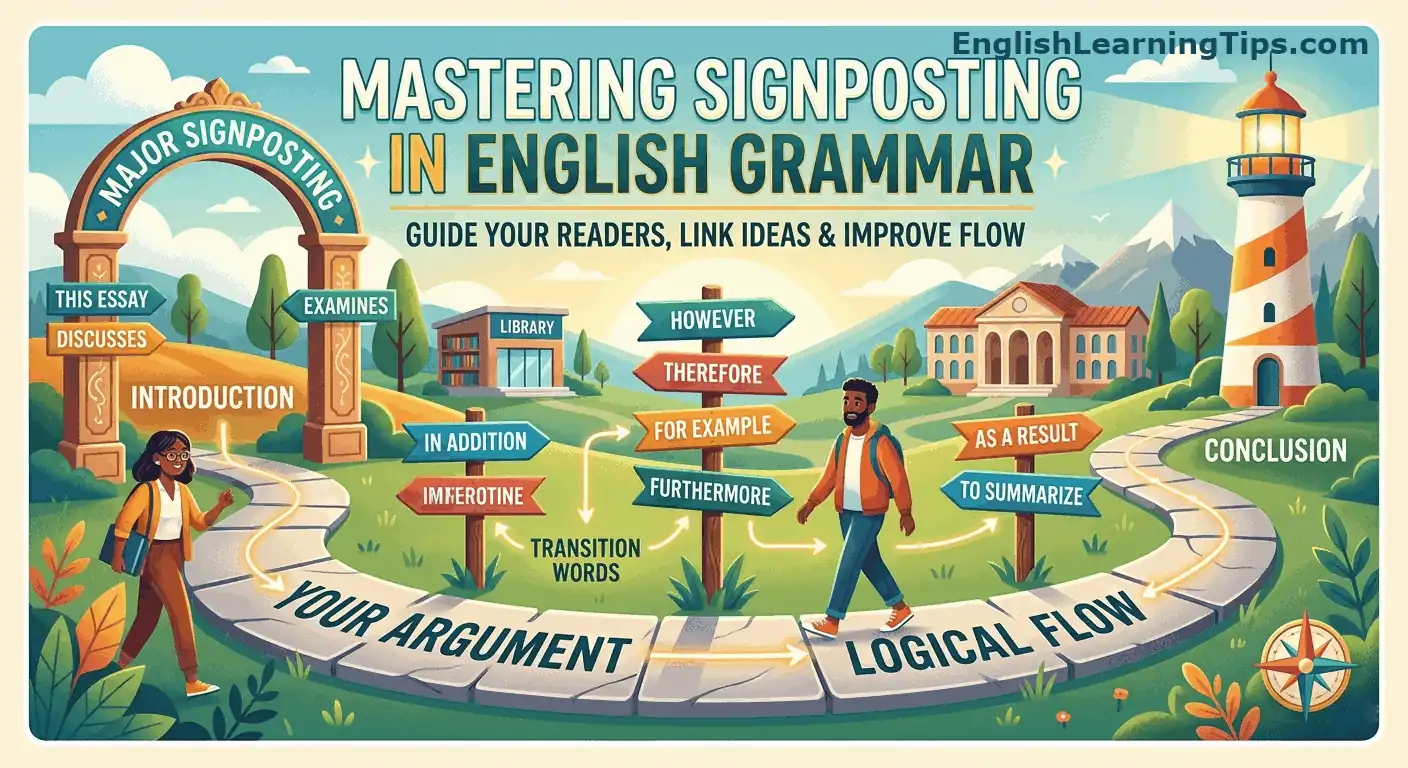
Signposting falls into two broad categories: major signposting and linking signposting.
Major signposting
This outlines the overall structure and “roadmap” of the work. It often appears in introductions, conclusions, or at the start of new sections. Examples include phrases that preview content or remind readers of what has already been covered.
Linking signposting
These connect ideas at the sentence or paragraph level. These smaller words, often called transition words, show relationships such as addition, contrast, cause and effect, or chronological sequence.
Common signposting phrases and examples
To improve your writing, use these phrases precisely. Avoid overusing a single term; variety keeps the writing natural.
Signposting phrases by function
| Function | Signposting examples | Best used for |
| Introducing structure | This essay discusses; The following section examines | Outlining a roadmap in an intro |
| Showing addition | Furthermore; In addition; Moreover | Building on a previous point |
| Indicating contrast | However; On the other hand; Conversely | Presenting opposing views |
| Cause and effect | Therefore; Consequently; As a result | Linking reasons to outcomes |
| Providing examples | For instance; Specifically; To illustrate | Clarifying a general statement |
| Summarizing | In summary; Overall; To conclude | Wrapping up a section or paper |
How to use signposting effectively
To rank well in clarity and SEO, your signposting should feel organic (yes, search engines check grammar, and it will affect your ranking). Place major signposts in your introduction to outline what follows and echo them in topic sentences. Use linking phrases at the start of sentences only when they add genuine value.
Tips for better results
- Match the signpost to the logic: Do not use “therefore” unless there is a clear causal link.
- Vary your vocabulary: Instead of using “however” five times, try “nevertheless” or “yet.”
- Check for flow: Read your draft aloud. If a transition feels forced, it likely is.
- Use visual signposts: Link key words and use headings to supplement your verbal signposts.
Signposting in academic writing vs. everyday use
Academic writing often demands explicit signposting because arguments are complex. Essays and research papers benefit from “roadmap sentences” like: “This paper will first explore the historical context, then evaluate recent studies, and finally propose a new framework.”
In contrast, blog posts and emails use lighter signposting to maintain a conversational tone. While you still want to guide the reader, overusing formal transitions like “moreover” in a casual email can feel stiff. The goal is to be helpful, not robotic.
Common mistakes to avoid
- Over-signposting: Adding a transition to every single sentence can interrupt the natural flow.
- Imprecise transitions: Using “furthermore” when you are actually introducing a contrast.
- Empty signposting: Signaling a conclusion but then continuing to introduce new points.
- Ignoring structure: Signposting cannot fix a disorganized argument; the logic must be there first.
Recommended tools for mastering flow
If you want to dive deeper into professional writing and structural flow, these highly-rated resources are the favorites of editors and students alike:
- Style: Lessons in Clarity and Grace – This is widely considered the best resource for learning how to use signposting and logical transitions effectively.
- The Blue Book of Grammar and Punctuation – A must-have for anyone who needs quick, clear answers to complex grammar rules.
- Dreyer’s English by Benjamin Dreye – A modern, humorous guide that helps you find your voice without sounding like a textbook.
FAQs: Mastering signposting in English
Conclusion: Mastering the flow of your writing
Effective signposting is the difference between a collection of random thoughts and a persuasive, professional argument. By using the right directional markers, you guide your reader through your logic, reduce confusion, and ensure your message hits home. Whether you are drafting a complex academic paper or a quick blog post, these structural cues are essential for clear communication.
As you link key words throughout your drafts, remember that the goal is clarity. Start with the major roadmap in your introduction and use subtle linking phrases to keep the momentum going. With practice, these transitions will become a natural part of your writing voice.
Join the conversation
Which signposting phrases do you find yourself using the most? Are there any specific transitions that always feel a bit clunky or robotic to you?
Drop a comment below with your favorite writing tips, or share this article with a friend who is working on their next big writing project. Let’s help each other build better, clearer content for everyone.
Discover more from English Learning Tips
Subscribe to get the latest posts sent to your email.


