

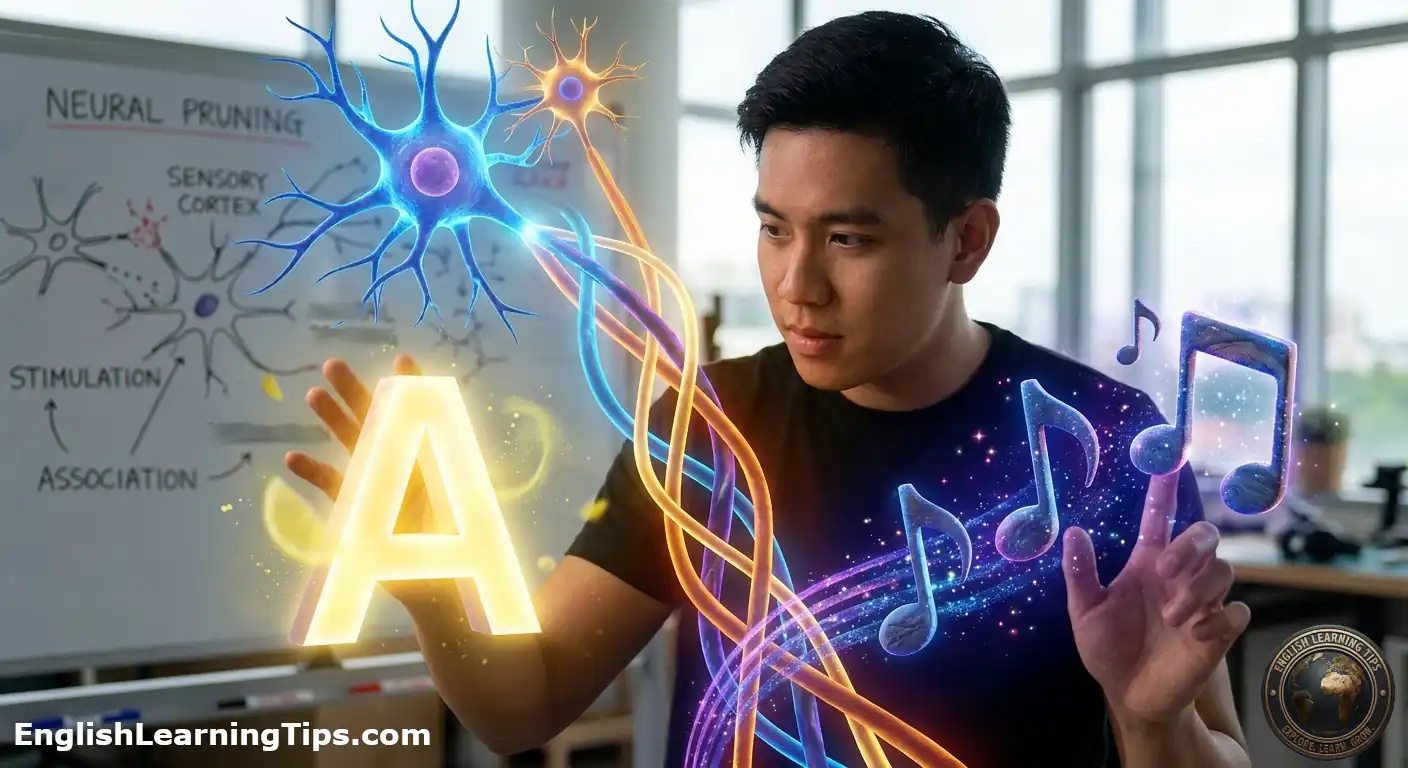
Understanding synesthesia: A neuroscience lesson on joined senses

Exploring the wonders of the human brain often leads us to fascinating phenomena in psychology like synesthesia, a neurological condition where the senses merge. In this lesson, we dive into the neuroscience of synesthesia to understand how “cross-wiring” in the brain allows some individuals to hear colors or taste shapes. By examining the sensory cortex and the process of neural pruning, students will gain insight into why our perceptions of the world can be so uniquely different.
Lesson plan: Exploring the union of senses
Level: Intermediate to advanced
Time: 60 minutes
Topic: Neuroscience and sensory perception
Objectives: To define synesthesia, explain the biological basis of sensory cross-wiring, and practice using scientific vocabulary in a conversational context.
Background
Synesthesia is a rare neurological phenomenon where the stimulation of one sensory pathway leads to automatic, involuntary experiences in a second sensory pathway. For example, a person with synesthesia might see the color red every time they hear a specific note on a piano, or they might experience a specific taste when reading certain words. This “union of the senses” affects a small percentage of the population and is often consistent throughout a person’s life.
From a biological perspective, this occurs in the sensory cortex, the part of the brain responsible for processing what we see, hear, smell, and touch. In most people, these regions are distinct, but in synesthetes, there is a high degree of cross-wiring. This is often attributed to a lack of neural pruning during brain development, where connections between different sensory areas remain intact rather than being trimmed away as the brain matures.
Basic vocabulary
Introduce essential words related to the brain and human perception. (Understanding synesthesia vocabulary handout sheet)
Vocabulary list
- Synesthesia (noun): A condition where one sense is perceived simultaneously with another. (Adjective: synesthetic; Person: synesthete).
- Example: Her synesthesia makes every Tuesday feel like the color lemon yellow.
- Neuroscience (noun): The scientific study of the nervous system. (Noun: neuroscientist; Adjective: neuroscientific).
- Example: He decided to study neuroscience to understand how memories are formed.
- Stimulation (noun): The raising of levels of physiological or nervous activity in the body. (Verb: stimulate; Adjective: stimulating).
- Example: The bright lights provided too much visual stimulation for the infant.
- Unrelated (adjective): Not connected or associated. (Noun: unrelatedness; Adverb: unrelatedly).
- Example: The two symptoms seemed unrelated, but they both stemmed from the same condition.
- Association (noun): A mental connection between ideas or things. (Verb: associate; Adjective: associative).
- Example: Many people have a strong association between the smell of pine and Christmas.
- Pruning (noun/verb): The process of eliminating weak or redundant neural connections. (Verb: prune).
- Example: Brain pruning during childhood helps make our neural pathways more efficient.
- Simultaneously (adverb): At the same time. (Adjective: simultaneous; Noun: simultaneousness).
- Example: The bell rang simultaneously with the flash of light.
- Perception (noun): The ability to see, hear, or become aware of something through the senses. (Verb: perceive; Adjective: perceptive).
- Example: Our perception of reality is shaped by how our brain processes data.
- Genetic (adjective): Relating to genes or heredity. (Noun: genetics; Adverb: genetically).
- Example: The doctor asked if the condition was genetic or caused by the environment.
- Involuntary (adjective): Done without conscious control. (Adverb: involuntarily; Noun: involuntariness).
- Example: Breathing is an involuntary action that happens while we sleep.
Vocabulary for extension
- Neurological (adjective; Noun: neurology): Relating to the anatomy, functions, and organic disorders of nerves and the nervous system.
- Fuchsia (noun/adjective): A vivid purplish-red color.
- Cortex (noun; Adjective: cortical): The outer layer of the cerebrum, playing an important role in consciousness.
- Mature (verb; Noun: maturity): To become fully grown or developed.
- Retain (verb; Noun: retention): To continue to have something; keep possession of.
- Activate (verb; Noun: activation): To make something operative or active.
- Subject (noun): A person or thing that is being discussed, described, or dealt with in an experiment.
- Memorize (verb; Noun: memorization): To commit to memory; learn by heart.
- Permanent (adjective; Adverb: permanently): Lasting or intended to last or remain unchanged indefinitely.
- Enlightening (adjective; Verb: enlighten): Providing spiritual or intellectual insight.
Teaching tips
- Word mapping: Have students draw a “brain map” and place the vocabulary words on the areas they think they relate to (e.g., “perception” near the eyes/ears).
- Context clues: Give students sentences with missing words and ask them to choose the correct conjugation based on the grammar of the sentence.
Grammar
The lesson focuses on passive voice and causative relationships. For example, “Connections are retained” or “Cells are activated.” We also look at conditional structures to discuss possibilities, such as “If pruning doesn’t happen, connections may remain.”
Useful phrases
Key phrases
- Cross-wiring between areas: Used to describe unexpected connections.
- A union of the senses: The literal translation of synesthesia.
- Involuntary sensory association: A formal way to describe a synesthetic experience.
- The likelihood that: Used to discuss probability (e.g., “It increases the likelihood that you have it”).
Teaching tips
- Encourage students to use “The likelihood that…” when discussing medical or scientific theories to practice hedging and formal probability.
Example conversations
Conversation 1: Basic description
Student A: Have you ever heard of synesthesia? Student B: I think so, isn’t that when you see colors when you hear music? Student A: Exactly, it is like a union of the senses. Student B: That sounds like a really cool way to experience the world.
Conversation 2: Adding details
Student A: Dr. Brain said that synesthesia might be caused by cross-wiring in the brain. Student B: Does that happen in the sensory cortex? Student A: Yes, it happens when the brain doesn’t finish the pruning process as a baby. Student B: So those extra connections stay active even as an adult.
Conversation 3: More advanced
Student A: If synesthesia is genetic, do you think anyone in your family has it? Student B: I’m not sure, but I read that some people don’t even realize their perception is different. Student A: That makes sense; if you’ve always tasted blue, you’d think everyone does. Student B: We should take one of those consistency tests to see if we have any permanent associations.
Teaching tips
- Have students perform these dialogues and then “ad-lib” two more sentences using a word from the extension vocabulary list.
Teaching strategy
Use the Inquiry-Based Learning approach. Instead of telling students what synesthesia is, start by asking, “What does the number five taste like?” This prompts curiosity and mimics the “Dr. Brain” approach of engaging the audience through sensory questions before providing the scientific explanation.
Here’s a 45-minute lesson plan
Step 1: Warm-up (5 minutes)
Ask students to close their eyes. Play a short snippet of various sounds (a bell, a car engine, a flute). Ask them if any of these sounds “feel” like a color or a shape.
Step 2: Vocabulary introduction (10 minutes)
Hand out the vocabulary list. Go over the pronunciation of “synesthesia” and “neuroscience.” Discuss the difference between “voluntary” and “involuntary.”
Step 3: Phrase practice (10 minutes)
In pairs, have students practice the “Key phrases” section. Ask them to create one sentence for each phrase related to their own lives or observations.
Step 4: Conversation practice (15 minutes)
Assign students to roles for the three example conversations. After reading, ask them to write a “Conversation 4” where they discuss a hypothetical test subject.
Step 5: Wrap-up and personalization (5 minutes)
Ask each student to share one thing they learned about the brain today that surprised them.
Discussion questions
- Question: Why is synesthesia often called a “union of the senses”?
- Answer: Because it comes from Greek roots meaning “together” and “sensation,” describing how different senses merge.
- Question: What is the role of the sensory cortex in this condition?
- Answer: It is the area where sight, sound, and touch are processed; in synesthetes, these regions have extra connections.
- Question: What is “neural pruning”?
- Answer: It is the process where the brain weakens unused connections to become more efficient.
- Question: How do researchers test if someone truly has synesthesia?
- Answer: They use consistency tests over time to see if the subject assigns the same colors or tastes to the same objects.
- Question: Is synesthesia considered a disease?
- Answer: No, it is a neurological trait or condition, often viewed as a neutral or even “beautiful” difference in perception.
Additional tips
- Cultural sensitivity: Remind students that neurological differences are not “weird” or “crazy,” but a natural part of human diversity.
- Visual aids: Use a color wheel or a diagram of the brain’s lobes to show the proximity of the sensory regions.
- Adapt for level: For lower levels, focus on color and sense words. For higher levels, focus on the “neural pruning” and “genetic” aspects.
- Technology: If possible, show the YouTube video “A Neuroscientist Explains Synesthesia” to provide audio-visual context.
Common mistakes to address
- Grammar: Confusing “sensory” (adjective) with “sensation” (noun).
- Word choice: Using “hallucination” instead of “perception.” Synesthesia is a consistent perception, not a random hallucination.
Example activity
The Consistency Challenge: Give students a list of 10 random words. Ask them to quickly assign a color to each. Wait 20 minutes (or until the end of class) and ask them to do it again. Compare the results to show how difficult it is to be “consistent” without having synesthesia.
Homework or follow-up
- Writing: Write a short paragraph imagining a day in the life of someone who can taste words.
- Speaking: Interview a friend or family member to see if they have any “involuntary sensory associations.”
- Research: Look up “famous people with synesthesia” (like Billie Eilish or Pharrell Williams) and report back.
FAQs
Conclusion: Join the conversation
The human brain is a complex landscape, and synesthesia is just one example of how varied our internal worlds can be. Whether you taste your favorite song or simply find the science of the sensory cortex fascinating, we want to hear from you!
Do you have any unique sensory associations? Perhaps you’ve always thought the number seven was a specific shade of green? Leave a comment below and share your thoughts! Don’t forget to share this article with a friend who loves neuroscience!
Discover more from English Learning Tips
Subscribe to get the latest posts sent to your email.


