

Their, there, or they’re: How to use them correctly every time

Stop second-guessing your spelling. While ‘their,’ ‘there,’ and ‘they’re’ sound identical, using the wrong one can stall your readers. Here is the fast, foolproof way to tell them apart.
Since these words are homophones—meaning they sound identical despite different spellings—even pro writers make mistakes. This guide ensures you won’t be one of them.
Quick guide: Their vs. there vs. they’re
If you are in a hurry, use this quick reference table to find the right word for your sentence.
| Word | Part of speech | Meaning | Quick example |
| Their | Possessive pronoun | Belonging to them | It is their car. |
| There | Adverb / Pronoun | A location or existence | Look over there. |
| They’re | Contraction | Short for “they are” | They’re coming over. |
When to use their
Their is the possessive form of the pronoun “they.” It indicates that something belongs to a group of people, animals, or things.
- Usage tip: Always follow “their” with a noun (the thing being owned).
- Examples:
- The students forgot their backpacks.
- Trees lose their leaves in the autumn.
- It was their decision to cancel the meeting.
When to use there
There is most often used to refer to a specific place or to state that something exists. It is the opposite of “here.”
- Usage tip: If you can replace the word with “here” and the sentence still deals with location, “there” is correct.
- Examples:
- Please put the groceries over there on the counter.
- There is a slight problem with the engine.
- I have been there many times before.
When to use they’re
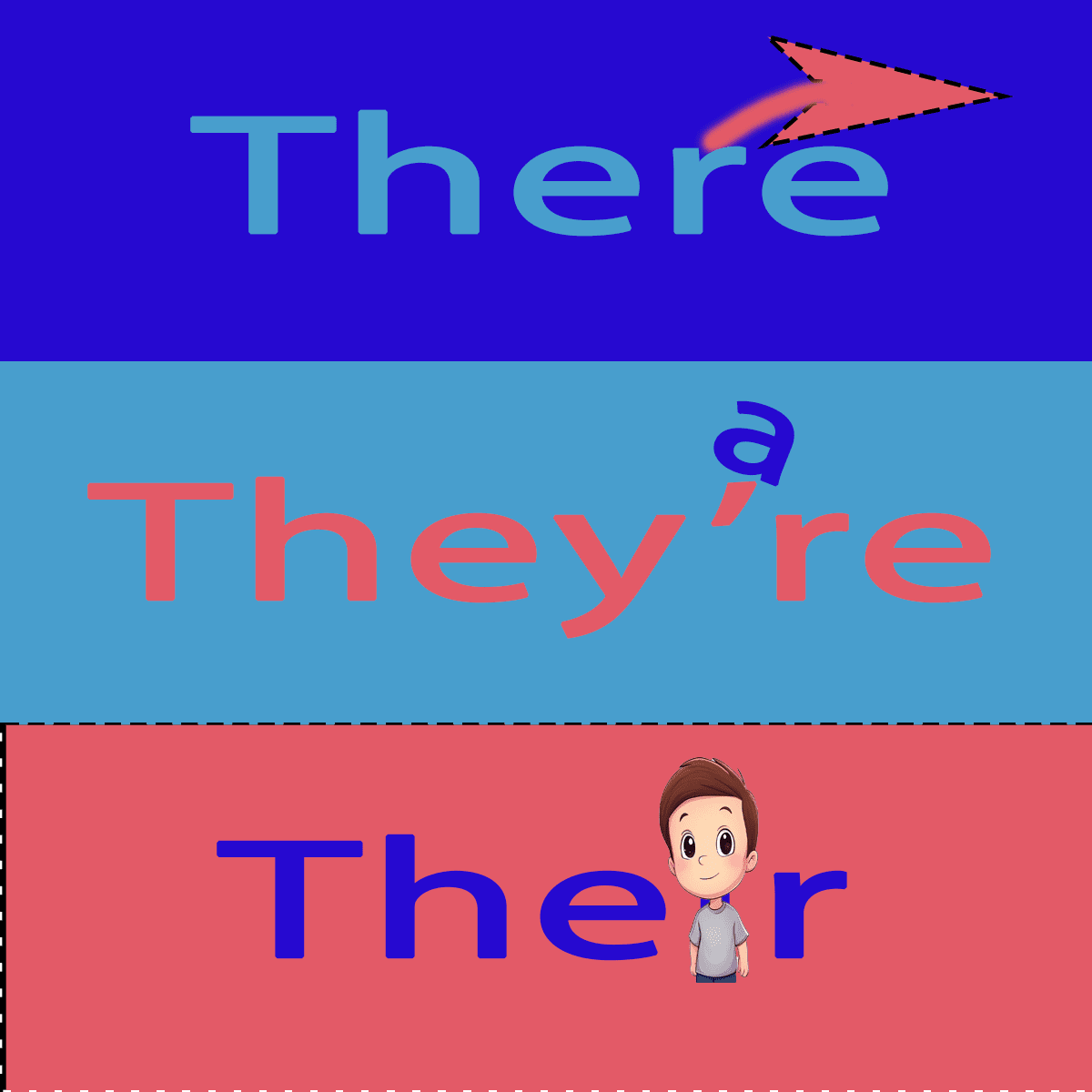
They’re is a contraction, which is a shortened version of the phrase “they are.” The apostrophe replaces the letter “a.”
- Usage tip: If you can replace the word with “they are” and the sentence still makes sense, use the apostrophe.
- Examples:
- They’re going to be late for the movie.
- I think they’re the best team in the league.
- They’re not interested in selling the house.
Mnemonics: How to remember the difference
Memory aids can help you choose the right spelling in a split second.
- Their: Notice the word “heir” inside “their.” An heir inherits property, which relates to ownership.
- T-here: Notice the word “here” inside “there.” Both words refer to place and location.
- They’re: The apostrophe is a tiny “a.” If you can’t say “they are,” don’t use it.
Pro tip for visual learners: If you find yourself second-guessing your spelling often, a desktop reference guide can be a lifesaver. Many writers keep a copy of The Elements of Style or a Grammar Cheat Sheet Poster near their workspace to catch errors before they happen.
Frequently asked questions about their, there, and they’re
Test your knowledge: Their, there, or they’re quiz
Choose the correct word to complete each sentence. (The answers are at the bottom—no peeking!)
- The neighbors said ________ dog barked all night.
- I’ve never been to Paris, but I’d love to go ________ someday.
- If ________ not here in ten minutes, we should leave without them.
- Put the boxes over ________ by the door.
- I think ________ going to love the surprise we planned.
Final checklist for better writing
If you are ever in doubt, run through this mental checklist before hitting “send” or “publish”:
- Is it about a place? Use there.
- Is it about ownership? Use their.
- Can I replace it with “they are”? Use they’re.
By mastering these three simple words, you distinguish yourself as a careful and professional writer. While a typo here or there won’t ruin your message, getting it right every time builds credibility with your audience.
Quiz answer key
- Their (Ownership)
- There (Location)
- They’re (They are)
- There (Location)
- They’re (They are)
Videos to guide your learning
Conclusion: Mastering the tricky trio
Using “their,” “there,” and “they’re” correctly is a simple way to make your writing look more professional and polished. While it is easy to let a typo slip through—especially with autocorrect making decisions for us—remembering the simple “here” vs. “heir” trick or using the “they are” substitution test will solve most of your grammar dilemmas.
Consistency is key. The more you consciously check these three words, the more the correct usage will become second nature.
What do you think?
We want to hear from you! Is there a specific sentence that always trips you up, or do you have a unique memory trick that we missed?
Leave a comment below and share your favorite way to remember the difference. If you found this guide helpful, feel free to share it with a friend who is tired of second-guessing their grammar!
Discover more from English Learning Tips
Subscribe to get the latest posts sent to your email.


