

What is the imperative mood in English: Rules, examples, and usage

The imperative mood is one of the three primary grammatical moods in the English language. It is a fundamental tool for direct communication, used to express commands, requests, instructions, advice, or invitations. While the indicative mood states facts and the subjunctive mood expresses hypotheticals, the imperative mood is used to direct action.
Whether you are writing a recipe, a technical manual, or a persuasive marketing email, understanding how to use imperative sentences is essential for clear communication.
How to form imperative sentences
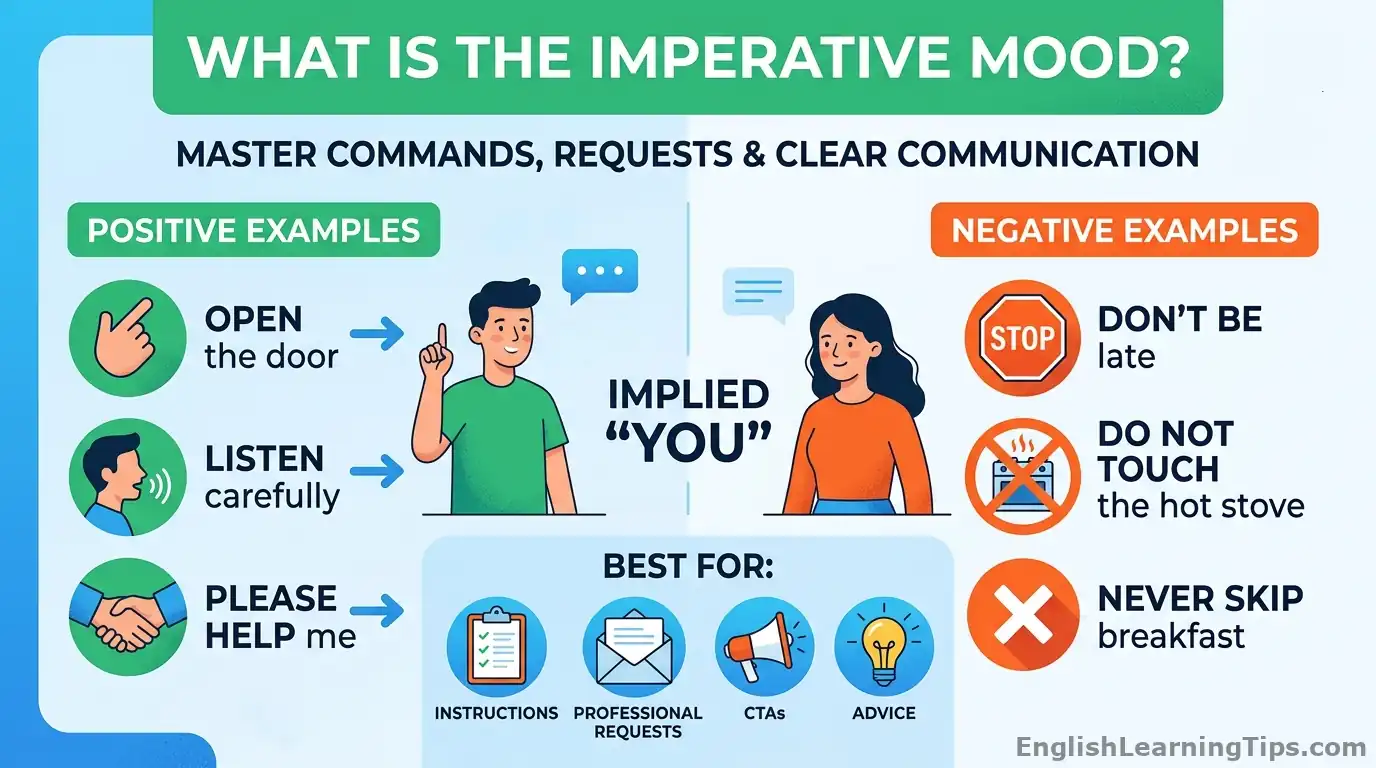
You typically begin with the base form of the verb (the infinitive without “to”). In these sentences, the subject “you” is implied, meaning it is understood by the reader even if it isn’t written.
Note: While native speakers will typically omit “you”, we sometimes add it in a command sentence for emphasis. For example, your child is misbehaving and not responding. A parent or teacher may point and sternly say, “You come here right now!”.
Positive imperative examples
- Come here.
- Open the door.
- Write your name clearly on the form.
- Take the next left turn after the light.
Negative imperative examples
To form a negative imperative, simply add “do not” or the contraction “don’t” before the base verb:
- Do not touch the hot stove.
- Don’t be late for the meeting.
- Never skip the warm-up before exercise.
- Do not enter without a security pass.
Adding politeness
To soften a command or make a request more professional, you can add words like “please” or “kindly”:
- Please pass the salt.
- Kindly wait in the lobby.
Pro-tip: The “emphasized please” In the United States, you may see signs like “Please, keep off the grass.” While the comma isn’t grammatically required, it is used to add a pause for emphasis, often appearing in places where the rule is frequently broken.
10 common examples of imperative sentences
- Stop the car immediately. (Command)
- Please bring me the file. (Request)
- Turn left at the next light. (Instruction)
- Don’t touch that wire! (Warning)
- Try the pasta; it’s delicious. (Advice)
- Have a great time at the party. (Invitation/Wish)
- Let’s go to the park. (First-person suggestion)
- Never skip your morning stretches. (Recommendation)
- Follow the prompts on the screen. (Technical instruction)
- Be quiet in the library. (Rule)
When to use the imperative mood in writing
Writers rely on this mood to create a direct connection with the reader. The imperative mood is most effective when:
- Giving instructions: Found in assembly guides, cookbooks, and software tutorials.
- Making requests: Used in social or professional invitations.
- Offering advice: Common in self-help content or safety warnings.
- Calls to action (CTAs): Essential for marketing to prompt a click or purchase.
- Issuing commands: Used in formal or authoritative contexts.
| Mood | Purpose | Example | Key difference |
| Imperative | Commands and requests | Close the window. | No explicit subject; direct address. |
| Indicative | Facts and statements | You close the window. | States information or habits. |
| Subjunctive | Wishes and doubts | I suggest you close it. | Expresses desire or hypothetical. |
Common mistakes with the imperative mood
To maintain a professional tone and ensure grammatical accuracy, avoid these frequent errors:
- Including an explicit subject: Saying “You come here” often sounds aggressive or unnatural unless you are specifically pointing someone out in a crowd.
- Mixing tenses: Always stick to the base verb. Avoid saying “Started the engine”; instead, use “Start the engine.”
- Overuse in formal writing: Using too many imperatives in a business letter can seem demanding. Balance them with polite modal verbs like “Could you…”
- Incorrect negative structure: A common mistake is using “Not run” instead of the correct “Do not run.”
Tips for using the imperative mood effectively
- Prioritize readability: Keep sentences short. Direct verbs help readers scan content quickly, which is a key factor for user experience.
- Vary your sentence rhythm: Mixing imperatives with declarative sentences prevents your writing from sounding like a list of demands.
- Use it for digital engagement: In web design, use the imperative for button text (e.g., “Sign up today”) to increase conversion rates.
- Provide a “why”: When giving advice, follow the command with a benefit. For example: “Save your work often to avoid losing data.”
Frequently asked questions about the imperative mood
Mastering the imperative mood for better communication
The imperative mood is more than just a grammatical rule; it is a powerful tool for clarity and engagement. By mastering how to form commands, requests, and instructions, you can make your writing more direct and your calls to action more effective. Whether you are drafting a technical manual or a friendly invitation, using the right tone ensures your message is received exactly as intended.
Share this guide with your community
Did you find this breakdown of the imperative mood helpful? If so, share this article with a student, writer, or colleague who wants to sharpen their English grammar skills. You can also bookmark this page as a quick reference for your next writing project. Have a specific question we didn’t cover? Leave a comment below and let us know!
Discover more from English Learning Tips
Subscribe to get the latest posts sent to your email.


