

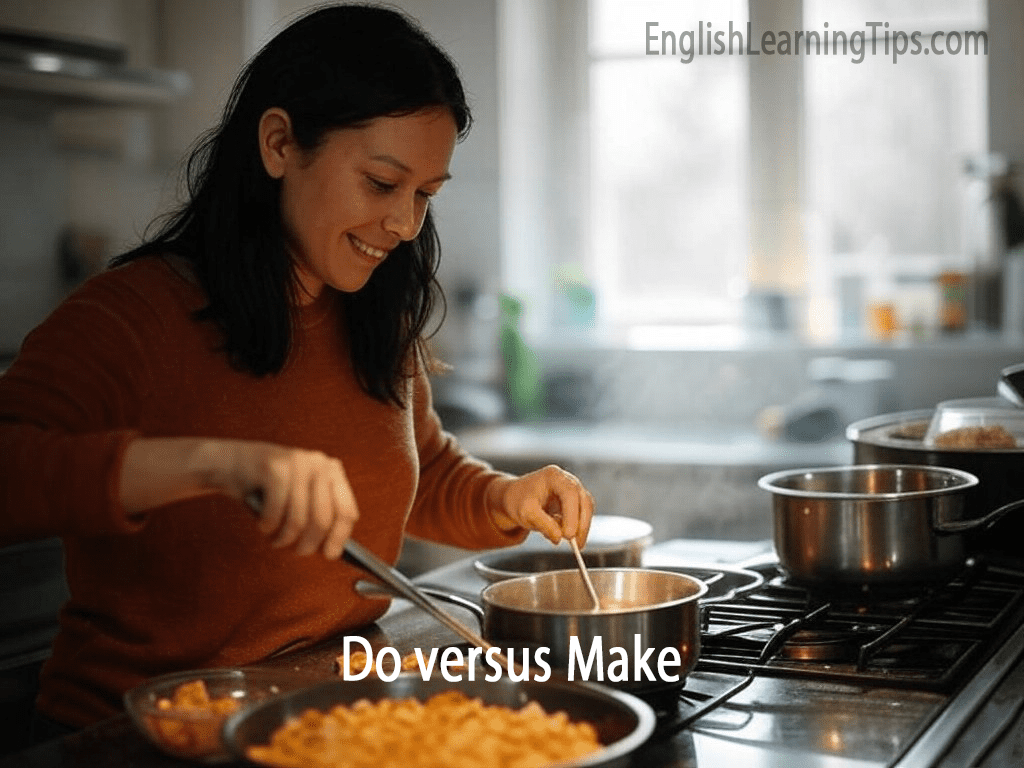
Do vs Make: How to use them properly

Confusing ‘do‘ and ‘make‘ is one of the most common hurdles for English learners.
Even though they both describe actions, picking the wrong one can make your English sound a bit ‘off’ to native speakers.
The golden rule: Do vs make
If you only remember one thing, remember this:
- Do is for actions, obligations, and repetitive tasks. It focuses on the process (the “doing”).
- Make is for creating, building, or producing something new. It focuses on the result (the “product”).
When to use do
We use “do” for general activities, jobs, and routine tasks. It is often used for things that are mandatory or part of a process.
1. Work, jobs, and tasks
When you are performing a duty or a task that doesn’t result in a physical object, use do.
- Do homework
- Do housework (chores)
- Do a job
- Do business
2. Non-specific activities
Use “do” when talking about things in general, often with words like something, nothing, anything, or everything.
- “What are you doing this weekend?”
- “I’m not doing anything right now.”
3. Replacing specific verbs
In informal English, “do” often replaces a more specific verb when the meaning is clear from the context.
- Do the dishes (washing/drying them).
- Do your hair (means brushing or styling it).
When to use make
We use “make” when we are constructing or creating something new, or when we are causing a specific reaction.
1. Food, drink, and creation
If you are preparing something or building a physical object, use make.
- Make a cup of tea
- Make dinner
- Make a dress
- Make a birdhouse
2. Communication and sounds
Actions involving your voice or speech usually take “make.”
- Make a phone call
- Make a joke
- Make a promise
- Make a noise
3. Plans and decisions
Abstract choices and arrangements almost always use “make.”
- Make a choice
- Make an appointment
- Make a plan
- Make a list
Comparison table: Common collocations
| Use “do” for… | Examples | Use “make” for… | Examples |
| Daily chores | Do the laundry, do the shopping | Food and drink | Make a sandwich, make coffee |
| Self-care | Do exercise, do your nails | Money | Make a profit, make money |
| Performance | Do your best, do well | Relationships | Make friends, make a move |
| Obligations | Do a favor, do your duty | Speech/Sound | Make a speech, make a comment |
When the meaning changes: Do vs make
Be careful! In some contexts, using the wrong verb doesn’t just sound “off”—it changes the entire meaning of your sentence. These are known as contrastive pairs.
- Do the hair: This refers to the process of styling, brushing, or washing someone’s hair (e.g., “I need to do my hair before the wedding”).
- Make the hair: This is rarely used in daily conversation; it implies the literal manufacturing of hair, such as creating a wig or extensions.
- Do the dinner: This is an informal way of saying you are “handling” the plans. If you say, “I’ll do dinner,” you might mean you’re making a reservation or buying takeout.
- Make the dinner: This specifically means you are physically cooking and preparing the food from ingredients.
Researching these differences in verb usage through sources like the Cambridge Dictionary can help you understand more complex sentence structures.
Common mistakes and exceptions
Some phrases don’t follow the rules perfectly. You’ll need to memorize these “set phrases” (collocations).
- Wrong: Do a mistake | Right: Make a mistake
- Wrong: Make homework | Right: Do homework
- Wrong: Do a phone call | Right: Make a phone call
- The “Bed” Exception: Even though you aren’t “building” a bed, we always say “make the bed” when tidying the sheets. You can find this and other set phrases in the Oxford Learner’s Dictionaries.
Frequently asked questions about do vs make
Do vs make: Practice quiz
Choose the correct verb (do or make) for each sentence:
- I need to _______ a phone call before the meeting starts.
- My roommate always forgets to _______ the dishes after dinner.
- It’s hard to _______ friends when you move to a new city.
- Did you _______ your best on the exam?
- She is going to _______ a special cake for his birthday.
- I have so much work to _______ this weekend.
- Please try not to _______ a mess in the kitchen.
- Can you _______ me a favor and carry this bag?
- We need to _______ a decision about which car to buy.
- I usually _______ my exercise routine in the morning.
Answer key and explanations
| No. | Answer | Why? |
| 1 | Make | Communication/speech (a phone call) always uses “make.” |
| 2 | Do | This is a repetitive household chore. |
| 3 | Make | You are “creating” a new relationship. |
| 4 | Do | “Best” is an abstract level of effort/action, not a product. |
| 5 | Make | You are creating/cooking something tangible. |
| 6 | Do | General work or tasks always use “do.” |
| 7 | Make | A mess is the “result” or product of an action. |
| 8 | Do | This is a standard collocation: “Do a favor.” |
| 9 | Make | Decisions and plans always use “make.” |
| 10 | Do | Exercise is a physical activity/process. |
Conclusion: Mastering the do vs make distinction
Learning the difference between do and make takes time and repetition. If you’re ever stuck, ask yourself: “Am I performing a task (do), or am I creating something new (make)?” Don’t be afraid to trip up—even native speakers occasionally use “informal” versions that break these rules!
Join the conversation
Which of these phrases is the hardest for you to remember? Is there a specific expression that always confuses you?
Leave a comment below with your examples or questions. Let’s help each other perfect our English!
Discover more from English Learning Tips
Subscribe to get the latest posts sent to your email.


