
The 8 parts of speech in English: How to identify and use them

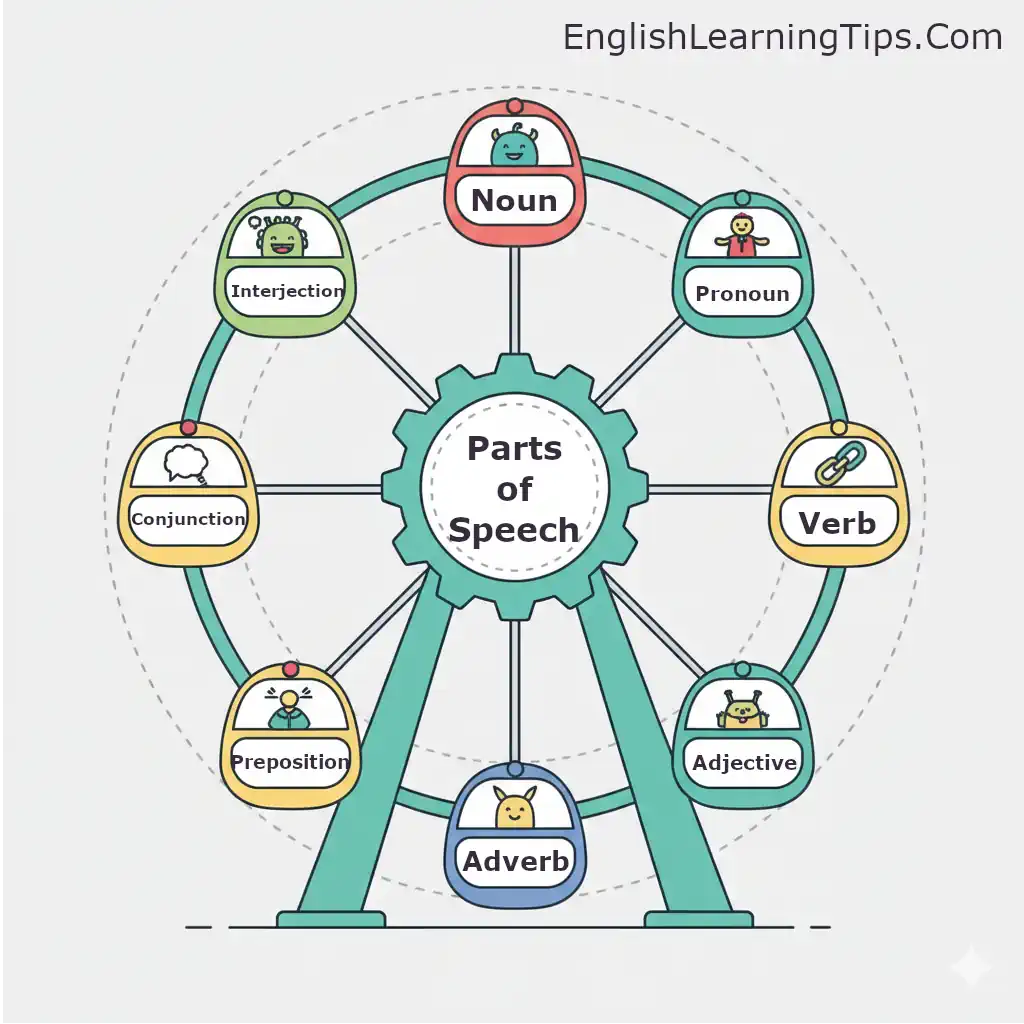
Every sentence you write is a puzzle made of eight basic building blocks. In linguistics, these are called the parts of speech. Mastering them is the fastest way to fix “clunky” writing and eliminate grammar errors that undermine your credibility.
While modern grammar sometimes adds a ninth category—determiners—understanding the traditional eight is the industry standard for clear communication.
Quick reference: Parts of speech cheat sheet
Google often pulls this data for “position zero.” I have optimized this table for maximum clarity.
| Part of speech | What it does | Example words | Quick test |
| Noun | Names a person, place, or thing | Pizza, London, Hope | Can you put “the” or “a” in front of it? |
| Pronoun | Replaces a specific noun | She, it, they, someone | Does it refer back to a person or object? |
| Verb | Shows action or state of being | Run, think, is, seem | Can you change the tense (past/present)? |
| Adjective | Describes a noun | Salty, giant, tired | Does it answer “What kind?” or “Which one?” |
| Adverb | Describes a verb or adjective | Quickly, very, too, now | Does it answer “How,” “When,” or “Where?” |
| Preposition | Shows relationships | On, after, with, above | Does it show a position in time or space? |
| Conjunction | Connects ideas/sentences | And, but, because, yet | Does it act as the “glue” between clauses? |
| Interjection | Expresses sudden emotion | Wow, ouch, hey, oops | Does it stand alone with an exclamation? |
Deep dive into the 8 word classes
1. Nouns (The labels)
Nouns aren’t just physical objects. They include abstract nouns (ideas like freedom or justice).
- Common Mistake: Forgetting to capitalize proper nouns (specific names like Microsoft or Sarah).
- Expert Tip: If you can make it plural or possessive, it’s almost certainly a noun.
2. Pronouns (The shortcuts)
Pronouns keep your writing from sounding repetitive. Instead of “John told John’s boss,” you write “John told his boss.”
- Types to know: Personal (I, you), Possessive (mine, yours), and Relative (who, which).
3. Verbs (The engine)
A sentence cannot exist without a verb. They are divided into action verbs (sprint) and linking verbs (become, are).
- Common Mistake: Confusing “stative” verbs (which describe a state, like know) with “dynamic” verbs (which describe an action, like jump).
4. Adjectives (The decorators)
Adjectives provide the “flavor.” They modify nouns and pronouns only.
- Expert Tip: Numbers (like seven) and colors are always adjectives when they describe a noun.
5. Adverbs (The context)
Adverbs are the most versatile part of speech. They can modify verbs (ran fast), adjectives (very tall), or even whole sentences.
- Common Pitfall: Not all adverbs end in -ly. Words like well, fast, never, and there are essential adverbs to watch for.
6. Prepositions (The bridges)
These words tell you where things are in relation to each other.
- Pro Tip: Think of a cloud. A bird can fly over it, under it, through it, or toward it. Those are all prepositions.
7. Conjunctions (The glue)
Conjunctions allow you to build complex thoughts. Use coordinating conjunctions (FANBOYS: for, and, nor, but, or, yet, so) for equal parts of a sentence.
8. Interjections (The spice)
These have no grammatical link to the rest of the sentence. They purely convey tone or emotion. Use them sparingly in professional writing.
Functional shift: When one word plays two roles
One of the hardest parts of identifying speech is that English words often change jobs. This is called functional shift.
- “Work” can be a Noun (I’m at work) or a Verb (I work hard).
- “Blue” can be an Adjective (the blue car) or a Noun (blue is my favorite color).
Rule of thumb: Always look at the words around the word to see what it is actually doing.
Frequently asked questions about parts of speech
Parts of speech: A video guide with word order
What’s your “grammar pet peeve”?
Even for experts, the line between a preposition and an adverb can get blurry. Which part of speech do you find the most confusing to identify in your own writing?
Let us know in the comments below! We love breaking down tricky sentences and helping you find the right word for the job.
Discover more from English Learning Tips
Subscribe to get the latest posts sent to your email.


