

Adjectives ending in -ed and -ing: The complete guide to participial adjectives

Are you bored or boring? One describes your mood; the other describes your personality. Using the wrong ending is one of the most common mistakes in English, but the fix is actually very simple.
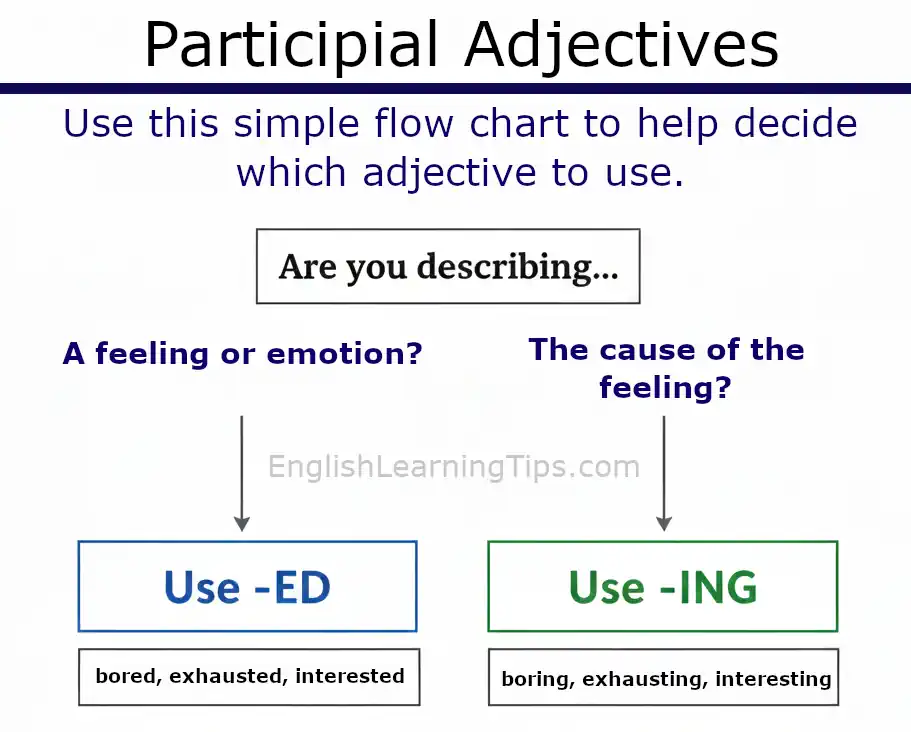
These are called participial adjectives. While they look like verbs, they function as descriptors. The secret to choosing the right one lies in whether you are describing a cause or a result.
Comparison: -ed vs. -ing at a glance
| If you want to describe… | Use the ending… | Example |
| A feeling or emotion | -ed | I am confused. |
| The cause of a feeling | -ing | This map is confusing. |
| A temporary state | -ed | The tired hiker sat down. |
| A permanent characteristic | -ing | The hike was tiring. |
Adjectives ending in -ed: The “result” adjectives
When an adjective ends in -ed, it describes a person’s internal state or emotion. Think of the -ed as the “effect” of something else happening to you.
Because these words describe feelings, they are almost always used for people and animals. You wouldn’t usually describe a toaster as “relaxed,” because a toaster doesn’t have feelings.
- How you feel: “I’m excited about the trip.”
- A reaction: “She was shocked by the news.”
Adjectives ending in -ing: The “cause” adjectives
If -ed is the result, -ing is the source. Use these adjectives to describe the thing, person, or situation that triggers the emotion.
- The source: “The movie was exciting.” (The movie caused the excitement).
- The nature of a person: “He is an interesting teacher.” (He causes others to be interested).
- The situation: “Public speaking can be frightening.” (The act causes fear).
Pro-tip: Be careful when describing people with -ing! Saying “I am boring” means you think you are a dull person. Saying “I am bored” means you just need something to do.
Common -ing adjectives to know
- Amazing: Something so good it leaves people in awe.
- Annoying: A fly in the room or a loud neighbor.
- Boring: A long lecture with no pictures.
- Satisfying: A job well done or a clean house.
- Worrying: Bad news that makes people feel anxious.
Why does this grammar matter for your writing?
Mixing these up doesn’t just look “wrong”—it changes your story. If you write, “The students were very interesting,” you are saying the students had great personalities. If you write, “The students were very interested,” you are saying they were paying close attention to your lesson.
Common participial adjective pairs
| The feeling (-ed) | The cause (-ing) | The feeling (-ed) | The cause (-ing) |
| Amazed | Amazing | Fascinated | Fascinating |
| Amused | Amusing | Frightened | Frightening |
| Annoyed | Annoying | Frustrated | Frustrating |
| Astonished | Astonishing | Fulfilled | Fulfilling |
| Baffled | Baffling | Horrified | Horrifying |
| Bored | Boring | Humiliated | Humiliating |
| Charmed | Charming | Inspired | Inspiring |
| Confused | Confusing | Interested | Interesting |
| Convinced | Convincing | Intimidated | Intimidating |
| Crushed | Crushing | Irritated | Irritating |
| Delighted | Delightful* | Motivated | Motivating |
| Depressed | Depressing | Overwhelmed | Overwhelming |
| Disappointed | Disappointing | Pleased | Pleasing |
| Disgusted | Disgusting | Puzzled | Puzzling |
| Disturbed | Disturbing | Relaxed | Relaxing |
| Embarrassed | Embarrassing | Satisfied | Satisfying |
| Enchanted | Enchanting | Shocked | Shocking |
| Excited | Exciting | Surprised | Surprising |
| Exhausted | Exhausting | Tired | Tiring |
| Worried | Worrying | Thrilled | Thrilling |
*Note: While “delighting” exists, “delightful” is more commonly used as the adjective form.
Frequently asked questions about -ed and -ing adjectives
Helpful video resources
If you prefer to learn by listening, these videos provide excellent visual examples of participial adjectives in action. They cover the subtle pronunciation differences and common conversational mistakes to avoid.
Participle adjectives
This video breaks down the grammatical structure of how verbs transform into adjectives.
Confusing adjectives: -ED and -ING
A deep look into the most common pairs that English learners struggle with, like “bored” vs. “boring.”
Test your knowledge: -ed and -ing adjectives quiz
See if you have mastered the difference between feelings and causes. Choose the best adjective to complete each sentence.
Part 1: Multiple choice
- I was so _________ after the 10-mile hike. a) tiring b) tired
- This grammar lesson is very _________. a) interesting b) interested
- The horror movie was absolutely _________. a) terrified b) terrifying
- Are you _________ in learning more about English? a) interested b) interesting
- I forgot my lines on stage; it was so _________. a) embarrassed b) embarrassing
- The instructions were _________, so I got lost. a) confusing b) confused
- My boss was _________ with my high-quality work. a) satisfying b) satisfied
- Cleaning the entire house alone is _________. a) exhausting b) exhausted
- We were _________ to hear the bad news. a) shocking b) shocked
- The roller coaster was _________! a) exciting b) excited
Part 2: Fill in the blank
Use the correct form of the word in parentheses.
- I am __________ (worry) about my exam results.
- The news about the accident was __________ (disturb).
- She is __________ (bore) because she has nothing to do.
- That long flight was very __________ (tire).
- He told a very __________ (amuse) story that made us laugh.
Answer key
Part 1: Multiple choice
- b) tired – Describes the hiker’s physical state/feeling after the hike.
- a) interesting – Describes the quality of the lesson (the cause).
- b) terrifying – Describes the nature of the movie (the source of fear).
- a) interested – Asks about your internal state/emotion.
- b) embarrassing – Describes the situation that caused the feeling.
- a) confusing – Describes the instructions that caused the confusion.
- b) satisfied – Describes the boss’s internal state of being pleased.
- a) exhausting – Describes the nature of the task (the cause of fatigue).
- b) shocked – Describes the internal emotional reaction to the news.
- a) exciting – Describes the quality of the roller coaster.
Part 2: Fill in the blank
- worried – Describes a person’s feeling about results.
- disturbing – Describes the nature of the news.
- bored – Describes a person’s state of being.
- tiring – Describes the nature of the flight.
- amusing – Describes the quality of the story.
Final wrap-up: Your 5-second checklist
Before you hit “publish” or “send” on your next piece of writing, run through this quick mental check:
- Are you describing how someone feels? Use -ed.
- Are you describing what caused the feeling? Use -ing.
- If you can put “very” in front of it, it’s likely a participial adjective.
Join the conversation
Did this guide help clear up the “bored vs. boring” debate for you? Grammar can be tricky, and we’d love to hear which adjective pairs you find the most confusing.
Drop a comment below with your own example sentence using an -ed or -ing adjective, and we’ll let you know if you nailed it! If you found this helpful, share it with a friend who is currently mastering English—they’ll thank you for making their life a little less tiring.
Understanding word endings is just the start. Check out our related guide on:
Discover more from English Learning Tips
Subscribe to get the latest posts sent to your email.


