
Pronouns: What they are and why they are important

Pronouns are the workhorses of the English language. We use them constantly to make our speech more fluid, yet we rarely stop to think about how they function. At their core, pronouns are words that stand in for nouns, allowing us to communicate efficiently without repeating the same names or objects over and over. According to the Linguistic Society of America, pronouns are a “closed class” of words, meaning the language rarely adds new ones, making them a foundational part of English grammar.
Understanding the different types of pronouns—and how to use them correctly—is essential for clear writing and respectful communication.
The primary functions of pronouns
Pronouns do more than just save space; they provide necessary context regarding who is speaking, who is being spoken to, and what belongs to whom.
1. Replacing nouns to improve flow
The most basic function of a pronoun is to act as a substitute for a specific noun (known as the antecedent). Without them, language becomes clunky and repetitive.
- Repetitive: Sarah went to the park because Sarah wanted to walk Sarah’s dog.
- Natural: Sarah went to the park because she wanted to walk her dog.
2. Indicating person, number, and gender
Standard pronouns carry “encoded” information that helps the listener follow the story.
| Category | Singular examples | Plural examples |
| First person (The speaker) | I, me, mine | We, us, ours |
| Second person (The listener) | You, yours | You, yours |
| Third person (Others) | He, she, it, him, her | They, them, theirs |
3. Showing possession and ownership
Possessive pronouns like mine, yours, his, hers, its, ours, and theirs indicate who owns an object without requiring a lengthy explanation. Instead of saying “The book belongs to Mark,” you can simply say “It is his.”
The 8 essential types of pronouns in English
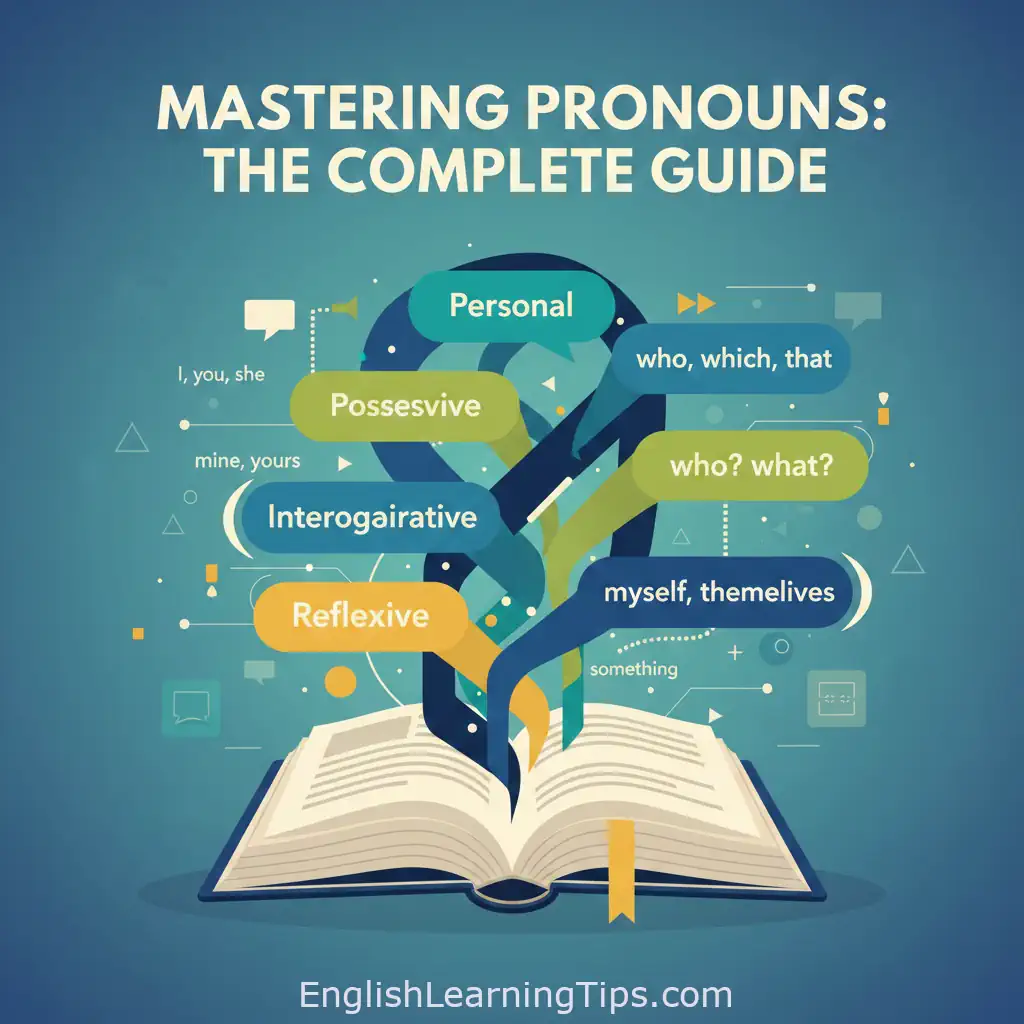
To master English grammar, you must recognize that not all pronouns function the same way. While some replace people, others point to objects or ask questions. Here is a breakdown of the categories used in modern communication.
Recommended resource: If you’re looking for a physical reference to keep on your desk, the Merriam-Webster’s Guide to Punctuation and Style is an excellent tool for mastering pronouns and complex sentence structures.
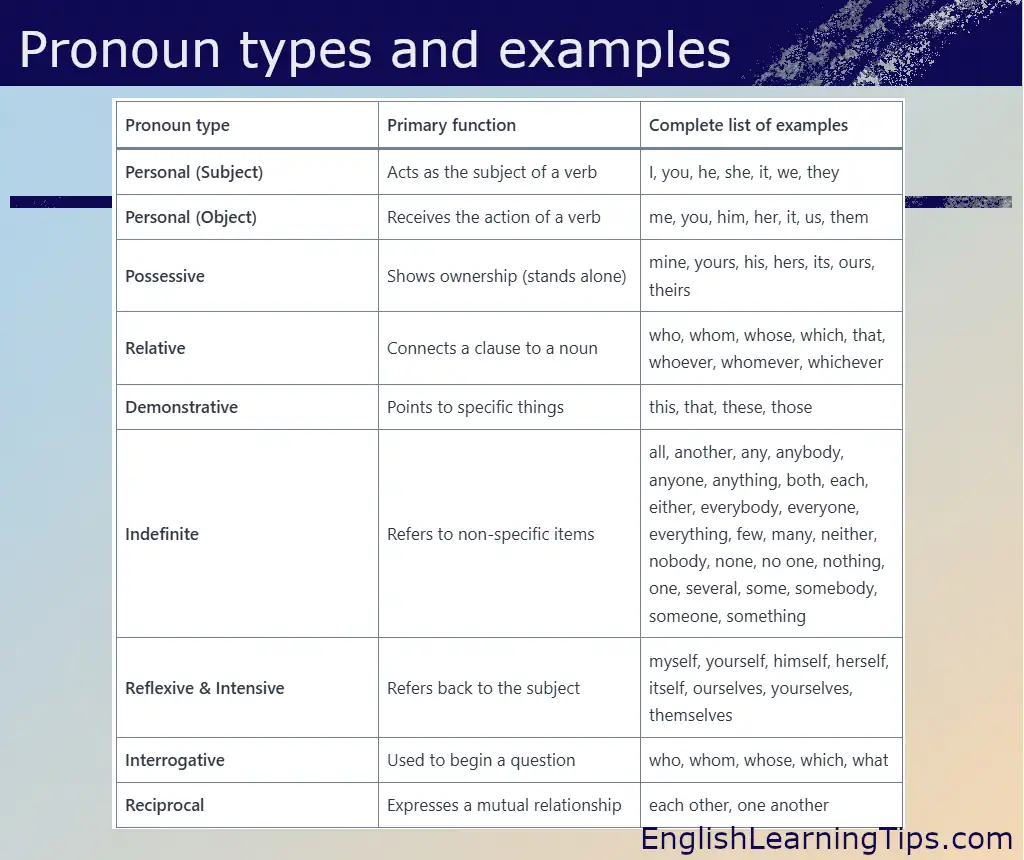
1. Personal pronouns
These are the most common pronouns. They refer to specific people or things and change form based on whether they are the subject or the object of a sentence.
- Subject: I, you, he, she, it, we, they.
- Object: me, you, him, her, it, us, them.
2. Possessive pronouns
These indicate ownership. Unlike possessive adjectives (like “my” or “your”), these stand alone and do not need a noun following them.
- Examples: mine, yours, his, hers, ours, theirs.
- Correct: “That coffee is mine.”
3. Relative pronouns
Relative pronouns connect a clause or phrase to a noun or pronoun. They add more information about the subject.
- Examples: who, whom, whose, which, that.
- Correct: “The driver who won the race is from Italy.”
- Pro Tip: Choosing between “who” and “whom” can be tricky; check out our guide on how to use relative pronouns correctly to avoid common errors.
4. Reflexive and intensive pronouns
These end in -self or -selves.
- Reflexive: Used when the subject and object are the same (e.g., “He taught himself to code”).
- Intensive: Used to add emphasis to a noun (e.g., “I myself saw the accident”).
5. Demonstrative pronouns
These “point” to specific things. They indicate whether something is near or far in distance or time.
- Examples: this, that, these, those.
6. Indefinite pronouns
These refer to non-specific people or things. They are extremely common in daily conversation when the exact identity isn’t known.
- Examples: someone, anybody, everything, nowhere, few, many, all.
7. Interrogative pronouns
These are used specifically to ask questions.
- Examples: who, what, which, whom, whose.
- Correct: “What is the best way to learn grammar?”
8. Reciprocal pronouns
These are used when two or more people are carrying out the same action toward one another.
- Examples: each other, one another.
Comprehensive reference guide to pronoun types and examples
Why pronouns matter in modern communication
The importance of pronouns extends beyond simple grammar. They are tools for clarity, professional branding, and social respect.
Efficiency in language
Pronouns allow for faster processing of information. In fast-paced environments—from business emails to news headlines—being able to refer back to a “company” as “it” or a “team” as “they” keeps the narrative moving.
Precision and narrative perspective
In creative writing and journalism, pronouns dictate the “point of view” (POV).
- First-person (“I”): Creates intimacy and a personal connection.
- Second-person (“You”): Directly engages the reader (common in tutorials).
- Third-person (“He/She/They”): Provides an objective or “God’s eye” view of events.
Inclusivity and identity
In recent years, the use of gender-neutral pronouns like the “singular they” has become more common in both casual and professional settings. Academic institutions, such as the University of Wisconsin-Madison, provide resources on how using correct pronouns to foster a culture of respect and accurate communication. However, this is probably more of a point of social contention rather than a need, as we don’t refer to one another in conversation with a pronoun.
Frequently asked questions about pronouns
Videos to help you learn pronouns
The 8 types of English pronouns
A visual guide
Summary of pronoun usage
Pronouns are versatile tools that streamline our sentences and reflect attributes like person, number, and case. Far more than simple placeholders, they are vital for efficient expression and social connection. Whether you are writing a technical report or having a casual conversation, mastering pronouns is key to becoming a more effective communicator.
Practice Your Skills: Understanding the theory is one thing, but practice is where it sticks. The English Grammar in Use Workbook by Raymond Murphy is widely considered the best resource for practicing pronoun usage through interactive exercises.
What questions do you have? Do you have any tips that you’ve used to learn pronouns? Let us know in the comment section below!
Discover more from English Learning Tips
Subscribe to get the latest posts sent to your email.


