
Adjectives: what they are and what they do in English

Adjectives do more than just describe nouns—they provide the context and precision needed for clear communication. If you’ve ever wondered why ‘a red big house’ sounds wrong but ‘a big red house’ sounds right, you’re in the right place. This guide breaks down how adjectives work, from basic types to the strict rules of adjective order.
What is an adjective?
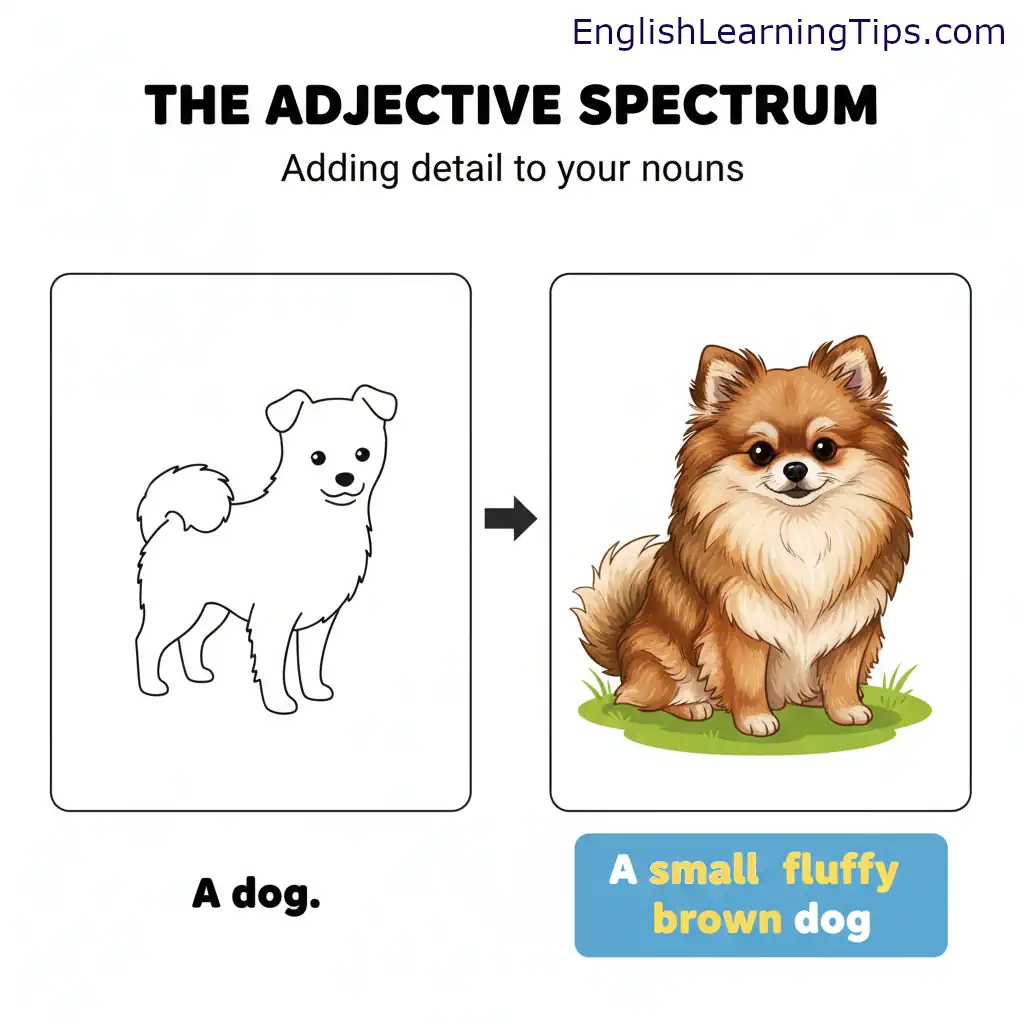
An adjective is an essential part of speech that describes, identifies, or quantifies a noun or pronoun. Their primary job is to answer questions like:
- What kind? (The blue car)
- Which one? (That specific person)
- How many? (The three cats)
Types of adjectives with examples
English uses several categories of adjectives to convey different types of information. Understanding these helps you avoid repetitive sentence structures.
| Type | Function | Examples |
| Descriptive | Describes qualities or states | Brave, soft, hungry, loud |
| Possessive | Shows ownership | My, your, his, her, their |
| Demonstrative | Points to specific things | This, that, these, those |
| Quantitative | Indicates amount or number | Several, few, many, twelve |
| Interrogative | Used to ask questions | Which, what, whose |
| Proper | Formed from proper nouns | Italian, Shakespearean, Christian |
The correct order of adjectives in English
When you use more than one adjective to describe a single noun, you cannot just list them randomly. To a native speaker, “a wooden small bowl” sounds “wrong,” while “a small wooden bowl” sounds “right.” This is governed by a rule often called OSASCOMP:
- Opinion: Lovely, ugly, difficult
- Size: Big, tiny, enormous
- Age: New, ancient, young
- Shape: Square, flat, oblong
- Color: Yellow, reddish, transparent
- Origin: American, lunar, solar
- Material: Cotton, metal, silk
- Purpose: Sleeping (bag), running (shoes)
Example: She found a beautiful (opinion), small (size), antique (age), silver (material) mirror.
Pro tip: Most native speakers rarely use more than two or three adjectives in a row. Using all eight categories at once (like our example mirror) is grammatically correct but usually avoided in natural writing.
Adjective placement: Before or after the noun?
In English, adjectives generally sit in two places within a sentence:
1. Attributive position
The adjective comes directly before the noun.
- The heavy rain soaked the ground.
- I saw a bright star.
2. Predicative position
The adjective follows a linking verb (such as to be, seem, become, feel, or look) to describe the subject.
- The weather is cold.
- That cake smells delicious.
Degrees of comparison: Comparative and superlative
To compare two or more things, adjectives change their form. While most follow standard rules, irregular adjectives are among the most searched grammar topics in English.
- Positive: The basic form (e.g., fast).
- Comparative: Used to compare two things. Usually ends in -er or uses “more” (e.g., faster or more creative).
- Superlative: Used to compare three or more things. Usually ends in -est or uses “most” (e.g., fastest or most creative).
Common irregular adjectives
Some of the most common adjectives do not follow the standard rules. You should memorize these to avoid common writing errors:
| Positive | Comparative | Superlative |
| Good | Better | Best |
| Bad | Worse | Worst |
| Far | Farther / Further | Farthest / Furthest |
| Little (amount) | Less | Least |
| Many / Much | More | Most |
Using commas for stylistic emphasis
While the rules for coordinate and cumulative adjectives are standard, experienced writers sometimes break them for stylistic effect.
If you want to slow the reader down or give an adjective special weight, you might see a comma used where it “technically” shouldn’t be.
- Standard: The cold dark night.
- Emphatic: The cold, dark night.
In the second version, the comma forces the reader to pause on the word “cold,” making the temperature feel more significant to the mood. However, use this sparingly; overusing commas for emphasis can make your prose feel choppy and disjointed.
Frequently asked questions about adjectives
Videos to help you learn
If you prefer a visual or auditory explanation, these high-quality resources explain tricky adjective rules in more detail:
-ED and -ING adjectives
Perfect for learning the difference between feeling “bored” and being “boring.”
Using adjectives in English (Oxford Online English)
A look into placement and professional usage.
Super descriptive adjectives
A great resource for writers looking to move beyond “basic” vocabulary.
Conclusion: Master your adjectives to improve your writing
Adjectives are more than just “filler” words; they are the tools that provide clarity and precision to every sentence you write. By mastering the correct adjective order and understanding the difference between attributive and predicative placement, you can significantly elevate your English grammar skills. Whether you are describing a simple object or a complex emotion, the right adjective makes all the difference.
What is your favorite adjective?
We want to hear from you! Do you have a favorite descriptive word that you love to use in your writing? Or is there a specific rule about adjective order that always trips you up? Leave a comment below and join the conversation—we answer every question to help you perfect your English.
Discover more from English Learning Tips
Subscribe to get the latest posts sent to your email.


