

Person, persons, people, and peoples: When to use each term

The words person, persons, people, and peoples are often used interchangeably, but they carry distinct grammatical weights and stylistic nuances. Choosing the wrong one can make your writing feel overly formal, legally dense, or grammatically incorrect.
Whether you are writing a legal contract, a sociological paper, or a casual blog post, understanding these differences ensures your message is precise.
Person, persons, people, or peoples: Quick summary
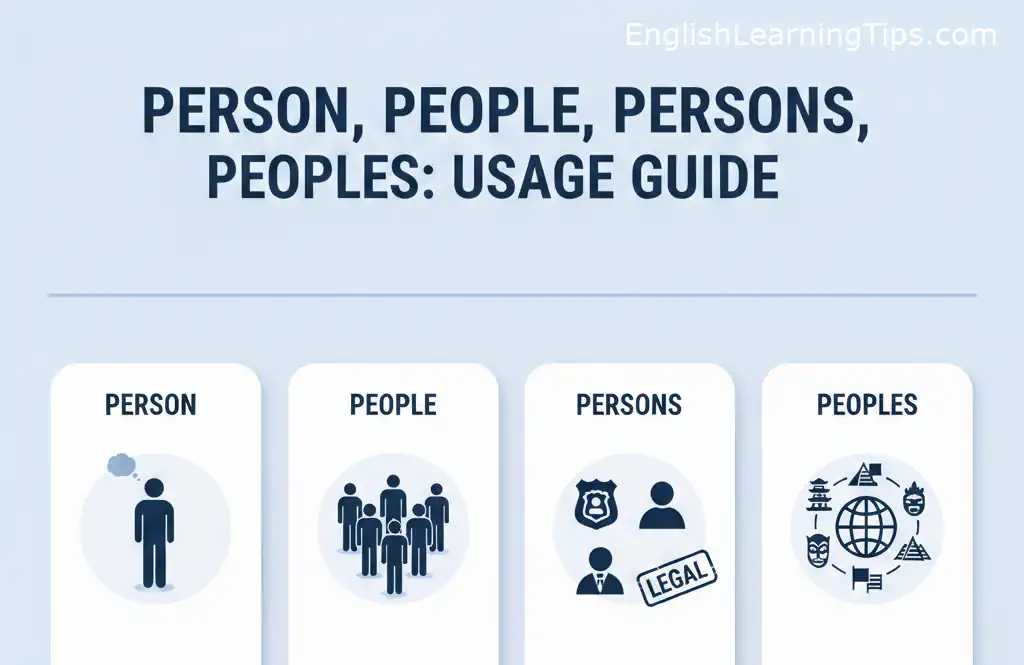
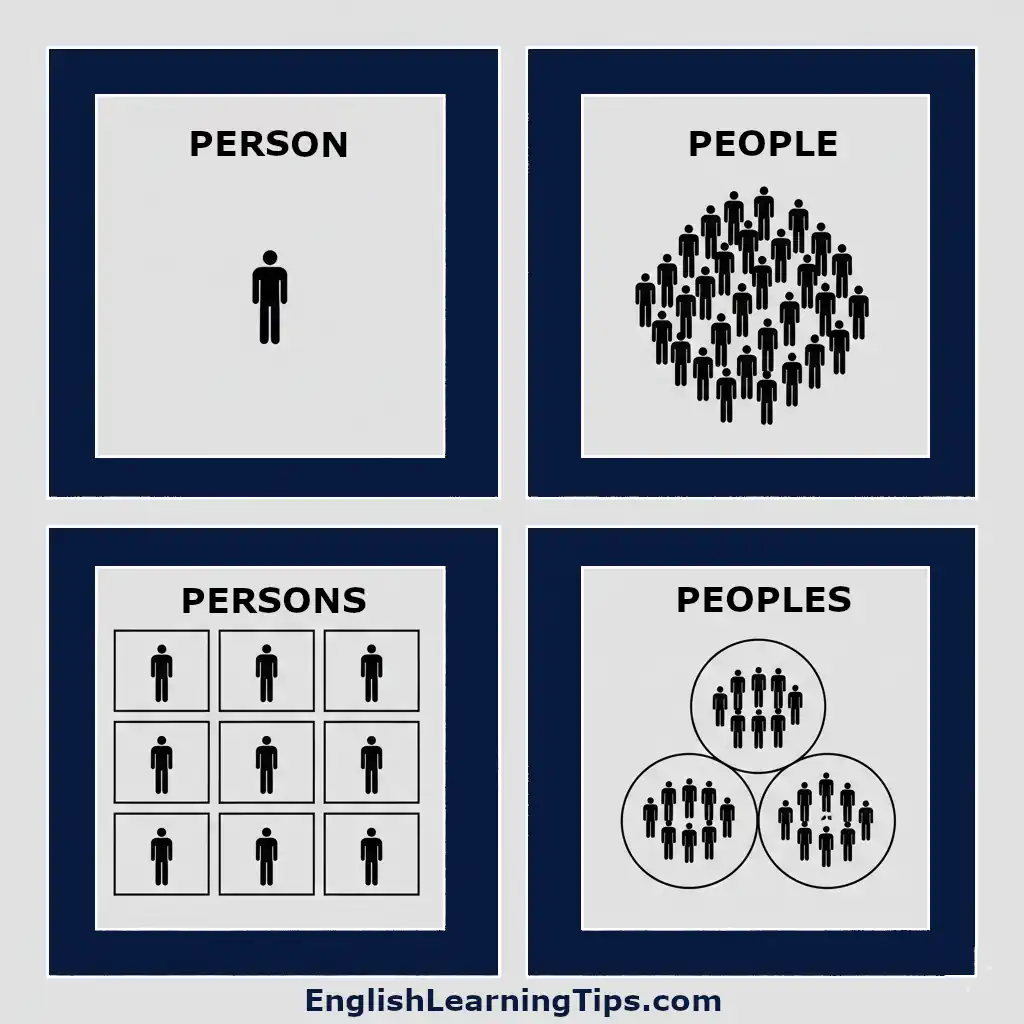
The main difference between these terms lies in count and formality. Person is the singular form for one individual. People is the standard plural for groups. Persons is a formal or legal plural used to emphasize individuals (e.g., in police reports). Peoples refers to multiple distinct ethnic groups or nations (e.g., “the peoples of Asia”).
Person: The individual unit
Definition: A single human being.
The word person is the standard singular noun used to describe an individual. In most contexts, it refers to a specific human, regardless of gender or status. You can find more details in the Merriam-Webster definition of person.
- Grammar: Singular noun requiring singular verbs (e.g., “The person is waiting”).
- Usage example: “She is a kind person who always helps her neighbors.”
- Synonyms: Individual, human being, soul, or man/woman.
Common phrases using person
- In person: To be physically present. (Example: “I need to sign the documents in person.”)
- Be one’s own person: To be independent in thought and action.
- In the person of: Represented by a specific individual.
People: The collective plural
Definition: A group of humans in a general or collective sense.
People is the most common plural of “person.” While “persons” focuses on individuals as separate entities, “people” focuses on the group as a whole. It can refer to a small gathering or the entire population of a country.
- Grammar: Plural noun requiring plural verbs (e.g., “The people are voting”).
- Usage example: “The people of the city are demanding better public transit.”
- Key phrase: Man of the people – A leader who understands and identifies with the common population.
Persons: The formal and legal plural
Definition: A formal or legal plural used to emphasize individuals within a group.
You will rarely hear the word persons in casual conversation. It is primarily reserved for legal documents, police reports, and official signage. It treats the group not as a collective “mass,” but as a specific count of individual units. This is the difference between formal and informal writing.
- Grammar: Takes plural verbs (e.g., “Several persons were detained for questioning”).
- Usage example: “The elevator has a maximum capacity of 12 persons.”
- When to use: Use this in contexts like “missing persons” or “persons of interest” to maintain a professional, objective tone.
Peoples: Distinct ethnic or national groups
Definition: Multiple distinct ethnic groups, nations, or communities.
Peoples is the “plural of a plural.” Use this term when you are referring to several different cultural or national identities simultaneously. If you use “people,” you might be referring to one group; if you use “peoples,” you are highlighting the diversity between multiple groups.
- Grammar: Takes plural verbs (e.g., “The indigenous peoples of the Amazon have unique traditions”).
- Usage example: “The treaty was signed by the various peoples of the Balkan Peninsula.”
- Usage tip: This is common in anthropology, history, and international law.
Comparison table: Person vs. people vs. persons vs. peoples
| Term | Number | Context | Best for… |
| Person | Singular | General | Describing one individual. |
| People | Plural | General/Informal | Describing a group or population. |
| Persons | Plural | Legal/Formal | Official notices and law enforcement. |
| Peoples | Plural | Sociological | Multiple ethnic or cultural groups. |
Frequently asked questions about usage
A video tool for mastering these terms
Summary of key differences
To choose the right word, consider your audience:
- Use person for one.
- Use people for many.
- Use persons for legal counts.
- Use peoples for multiple cultures or nations.
Conclusion: mastering the nuances of person and people
Understanding the subtle shifts between person, people, persons, and peoples is a hallmark of sophisticated writing. While these words may seem interchangeable at a glance, choosing the correct one helps you signal the right level of formality and respect for your subject matter. Whether you are drafting a legal brief that requires the precision of persons or an anthropological study discussing the peoples of the world, your word choice dictates the clarity of your message.
By sticking to people for everyday plural use and saving the alternatives for specific legal or cultural contexts, you will ensure your writing remains both natural and professional.
Join the conversation: How do you use these terms?
We want to hear from you! Grammar rules often evolve based on how we use them in the real world. Does using the word persons in a casual text message feel too stiff to you, or do you prefer the precision it offers?
Leave a comment below with your thoughts, or share a sentence using one of these terms that always used to trip you up. Have you ever seen a sign or a document where you thought the wrong version was used? Let’s discuss it in the comments!
Discover more from English Learning Tips
Subscribe to get the latest posts sent to your email.


