


Essential English phrasal verbs for travel: A complete guide

Learning essential travel phrasal verbs can significantly enhance your communication skills and overall confidence when traveling abroad. Whether you are navigating an international airport, booking a boutique hotel, or asking for directions in a new city, these terms help you sound more like a native speaker.
While studying English for tourists might seem like a small detail, these phrasal verbs are the tools that help you navigate both linguistically and culturally. Mastering this international travel vocabulary will improve your:
- Listening comprehension: Understand announcements and locals.
- Efficiency: Say more with fewer words.
- Navigation: Get directions and manage transport without confusion.
The journey timeline: Phrasal verbs in action
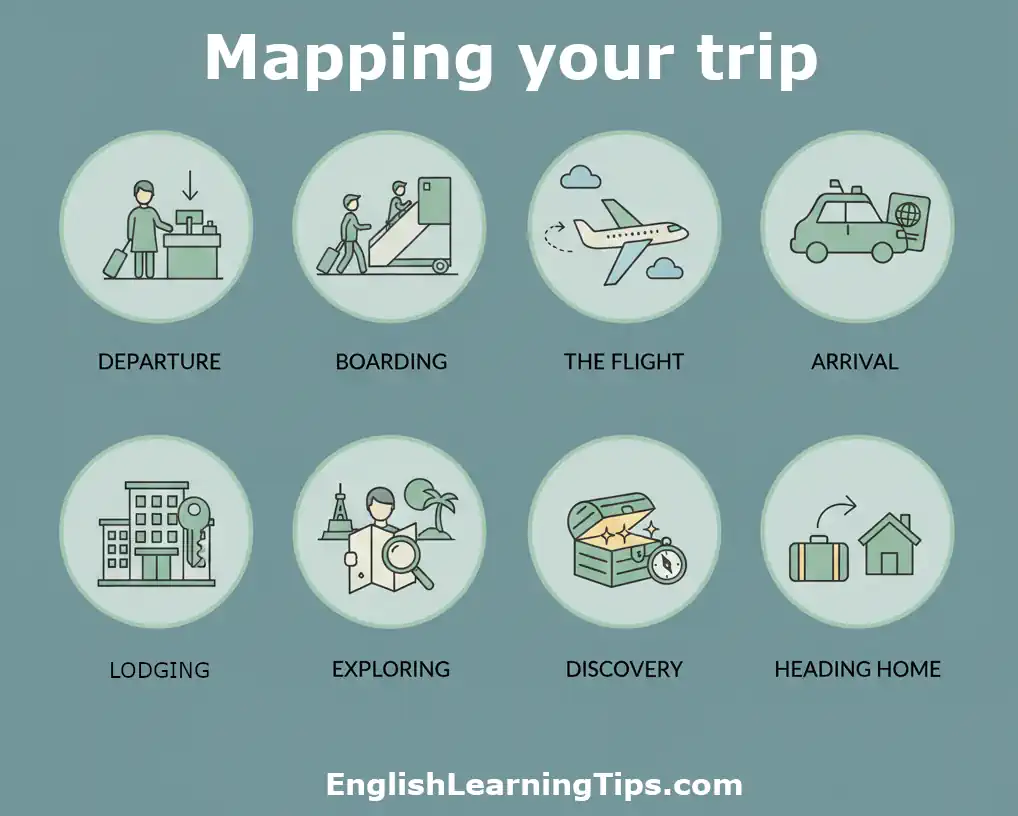
One of the easiest ways to master English phrasal verbs for beginners is to visualize your trip from start to finish. Phrasal verbs usually follow a chronological order during a vacation.
Mapping your trip
- Departure: You set off for the airport early in the morning.
- Boarding: Once you reach the gate, you get on the plane.
- The flight: You feel the G-force as the plane finally takes off.
- Arrival: Your flight gets in at 6:00 p.m. local time.
- Lodging: You head straight to the hotel to check in and drop your bags.
- Exploring: You spend the first afternoon looking around the historic district.
- Discovery: You might come across a hidden gem or a local cafe while wandering.
- Heading home: Finally, you check out of your hotel and head home, enriched by your journey.
Master the ‘Drop Off’ & ‘Check In’ To make your check-in smoother, keep your travel documents organized. I recommend a RFID Blocking Travel Wallet to keep your passport and cards safe while you look around new cities. If you need to drop off your bags but your room isn’t ready, a set of AirTags is perfect for tracking your luggage.
Essential travel phrasal verbs for your next trip
Below is a comprehensive list of phrasal verbs for travel, categorized by how they are used in real-life situations.
Transportation and transit
Using the correct transportation expressions in English ensures you never miss a connection.
- Break down: When a vehicle stops working.
- Example: “Our car broke down on the highway, and we had to call a tow truck.”
- Get in: To arrive at a destination (train, plane, or bus).
- Example: “What time does your flight get in tonight?”
- Get off: To leave a bus, train, or plane.
- Example: “We need to get off at the next stop to reach the museum.”
- Get on: To board a vehicle.
- Example: “Hurry up and get on the bus before it leaves!”
- Head for: To go toward a specific place.
- Example: “Let’s head for the station at 6:00 p.m.”
- Set off / Set out: To begin a journey.
- Example: “We plan to set off for the coast at sunrise.”
- Speed up: To increase velocity.
- Example: “The taxi driver had to speed up to make it to the airport on time.”
- Take off: When an aircraft leaves the ground.
- Example: “The plane finally took off after a two-hour delay.”
Hotels and accommodation

| Phrasal verb | Meaning | Example sentence |
| Check in | To register at a hotel or airport | “We can check in at the hotel starting at 3:00 p.m.” |
| Check out | To pay the bill and leave | “We must check out by noon or we will be charged extra.” |
| Check into | To register arrival (formal) | “I need to check into my flight online.” |
| Drop off | To set something/someone down | “I will drop off my bags at the hotel before sightseeing.” |
| Fill up | To become completely full | “During peak season, the hotels fill up months in advance.” |
| Put up | To provide temporary lodging | “Could you put up my friend for the night?” |
Exploring and socializing
Mastering these is especially important for English for solo travelers who want to meet locals and find unique spots.
- Come across: To find something by chance.
- Example: “I came across a hidden cafe while walking through the alleyways.”
- Drop by / Drop in: To visit a place informally without an appointment.
- Example: “Let’s drop by the souvenir shop on our way back.”
- Look around: To explore or search an area.
- Example: “We spent the afternoon looking around the local markets.”
- See off: To go to the airport or station to say goodbye to someone.
- Example: “My family came to the station to see me off.”
- Show around: To give someone a tour of a place.
- Example: “Our host offered to show us around the city.”
Tips for using travel phrasal verbs correctly
If you are just starting to learn English phrasal verbs for beginners, pay close attention to these two:
Separable vs. inseparable phrasal verbs
One of the trickiest parts of English is knowing if you can put a word between the verb and the particle.
- Separable: “I dropped the bags off.” (Correct)
- Inseparable: “I got off the bus.” (You cannot say “I got the bus off.”)
Noun forms to watch for
Many travel phrasal verbs turn into nouns. Note the use of the hyphen or closed compound:
- Check-in (The counter)
- Getaway (A vacation)
- Setback (A delay)
Frequently asked questions about travel phrasal verbs
Test your travel phrasal verbs knowledge
Travel Phrasal Verbs Mastery Quiz
Test your knowledge of international travel vocabulary and see if you’re ready for your next getaway!
Further reading for English learners
If you found this guide to travel vocabulary helpful, you might also enjoy our other deep dives:
- Technical terms: Phrasal verbs for mechanics— Essential if your rental car happens to break down.
- Mastering the basics: Why study phrasal verbs? — Learn why these are the secret to sounding natural.
- Emotional English: Phrasal verbs for emotions — Express how you feel during your journey.
- Daily life: Phrasal verbs for everyday — Transition from travel talk to daily conversation.
- Relationships: Phrasal verbs for relationships —Relationships can be a rollercoaster of emotions. Learn how to better communicate with your partner.
Recommended resources for your journey
To help you master these phrasal verbs even faster, check out these highly-rated resources:
- English for Everyone: English Phrasal Verbs: A great visual guide for beginners.
- Kindle Paperwhite: Perfect for downloading English phrasebooks to look through while you’re on the plane.
Videos to help you learn
Conclusion: your ticket to confident travel
Mastering travel phrasal verbs is about more than just passing a quiz; it is about feeling at home anywhere in the world. When you can confidently tell a taxi driver where to drop you off or understand exactly when your flight gets in, you remove the stress that often comes with international trips. These small linguistic shifts allow you to focus on what really matters: enjoying the sights and connecting with new people.
By integrating these terms into your daily practice, you move closer to sounding like a native speaker and navigating the globe with ease.
Share your travel stories
We would love to hear from you! Using the phrasal verbs we covered today, tell us about a memorable moment from your last trip. Did your bus break down in a remote village? Did you come across a beautiful hidden beach?
Leave a comment below and share one sentence about your travels using a phrasal verb. Not only does this help you practice, but it also helps other learners see these words in a real-world context!
Discover more from English Learning Tips
Subscribe to get the latest posts sent to your email.


