

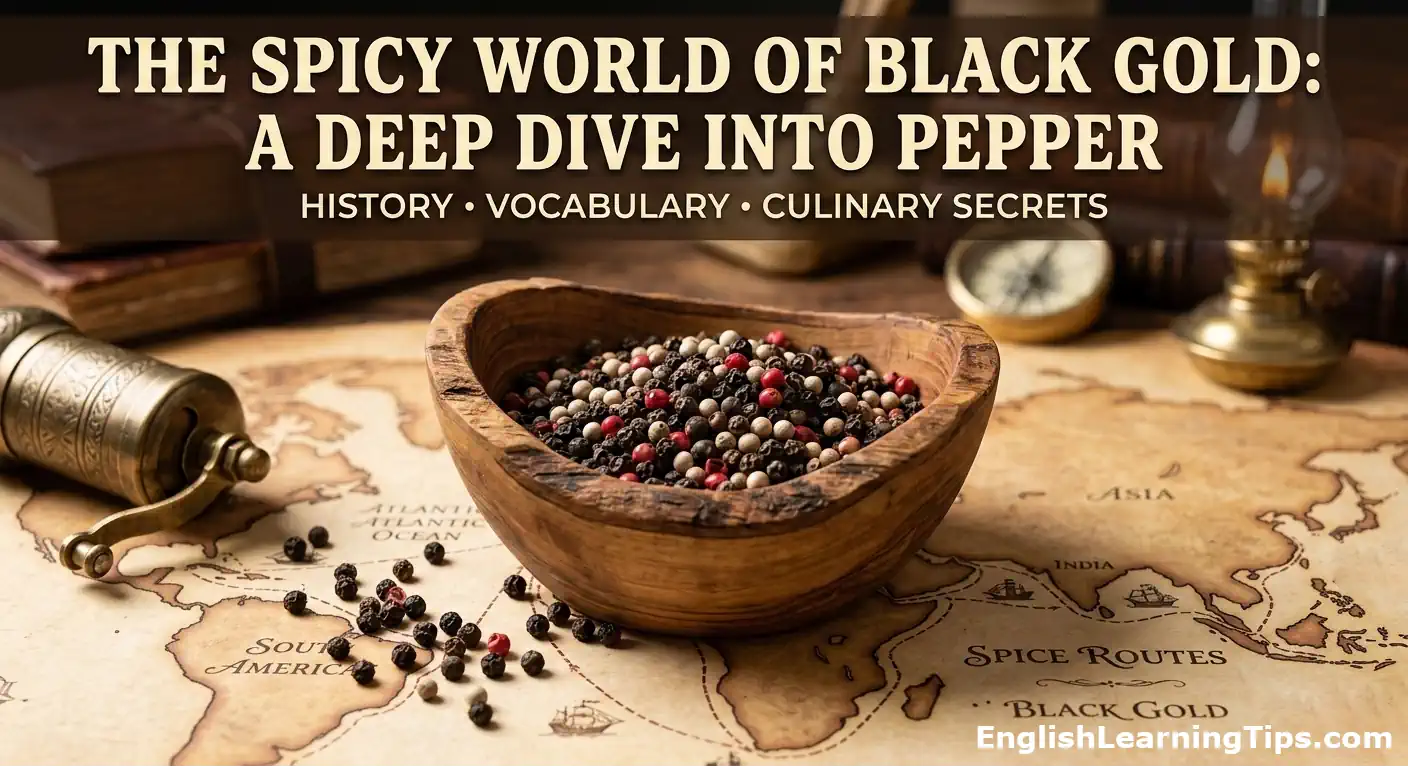
Black gold: A look into the history of pepper — Video-based ESL lesson

Pepper is more than just a table condiment; it is a historical powerhouse that once drove global exploration. Often referred to as “black gold,” this tiny peppercorn has influenced economies and transformed cuisines across the globe. In this lesson, we explore the nuances of pepper varieties, from the pungent black corns to the surprising cheesy notes of Vietnamese white pepper, while building your English vocabulary and descriptive skills.
Lesson plan: Spice up your English with the history of pepper
Level: Intermediate (B1-B2)
Time: 45 minutes
Topic: Culinary spices and the history of pepper
Objectives: Students will be able to define culinary vocabulary, use descriptive metaphors in English, and discuss the maturity and processing of food items.
Background
Pepper comes from the fruit of climbing vines that can grow over ten meters high. Historically, it was so valuable that explorers like Christopher Columbus and Vasco da Gama crossed vast, dangerous oceans to find new routes to the spice lands of Asia. From ancient Greece to modern-day kitchens, pepper has remained the world’s most traded spice, prized for its ability to enhance the natural flavors of ingredients.
Today, we recognize that the different colors of pepper—green, black, and red—are not necessarily different species but represent various stages of the fruit’s development. Whether it is the woody aroma of Sarawak pepper or the fruity notes of Kampot pepper, this spice acts as a “flavour catalyst,” providing a necessary punch to dishes worldwide.
Basic vocabulary
To discuss spices and cooking effectively, you need to understand terms that describe both the physical state of the food and its effect on our senses. This list focuses on the essential terms found in our discussion about pepper and its culinary impact.
Vocabulary list
| Word | Part of speech | Conjugations | Definition | Example sentence |
| Pepper | Noun | Peppery (Adj) | A pungent spice made from dried berries. | I always add a bit of pepper to my soup for extra flavor. |
| Grind | Verb | Ground (Past), Grinder (Noun) | To crush something into a powder. | You should grind the peppercorns right before serving. |
| Maturity | Noun | Mature (Adj/Verb) | The stage when food is fully grown. | The color of the berry depends on its maturity at harvest. |
| Catalyst | Noun | Catalytic (Adj), Catalyze (Verb) | Something that causes a change or reaction. | Pepper acts as a catalyst, bringing out other flavors. |
| Kick | Noun | Kick (Verb) | A sharp, stimulating, or spicy excitement. | This chili sauce really gives the chicken a kick. |
| Variety | Noun | Various (Adj), Vary (Verb) | A specific type or sort of something. | There is a huge variety of peppers in the spice shop. |
| Enhance | Verb | Enhancement (Noun), Enhanced (Adj) | To improve the quality or strength of something. | Salt and pepper enhance the savory taste of meat. |
| Aroma | Noun | Aromatic (Adj) | A pleasant or distinctive smell. | The aroma of fresh black pepper is quite woody. |
| Harvest | Verb | Harvest (Noun), Harvester (Person) | To pick or collect a crop. | Farmers harvest the berries when they turn red. |
| Distinguish | Verb | Distinctive (Adj), Distinction (Noun) | To recognize the difference between things. | It is easy to distinguish between white and black pepper. |
Vocabulary for extension
- Pungent (Adjective): Having a sharply strong taste or smell.
- Seasoning (Noun / Verb: Season): Salt, herbs, or spices added to food to enhance flavor.
- Condiment (Noun): A substance such as a spice or sauce used to add flavor to food (e.g., mustard, pepper).
- Botanical (Adjective / Noun: Botany): Relating to plants or plant biology.
- Industrial (Adjective / Noun: Industry): Related to large-scale manufacturing rather than natural growth.
- Overpower (Verb / Adjective: Overpowering): To be too strong for something else; to drown out other flavors.
- Sprinkle (Verb / Noun: Sprinkling): To scatter small drops or particles over a surface.
- Wrinkle (Verb / Noun: Wrinkles): To form small lines or folds, often due to drying or age.
- Tasting (Noun / Verb: Taste): An event where people sample various foods or drinks to judge quality.
- Authentic (Adjective / Noun: Authenticity): Of undisputed origin; genuine or real.
Teaching tips
When teaching spice vocabulary, try a “multi-sensory” approach. If possible, bring actual peppercorns (black, white, and pink) to class. Let students smell them and describe the aroma before learning the word. For the word grind, use a manual pepper mill in class so they can see the action while saying the verb. Use physical gestures to explain sprinkle versus pour.
To get the perfect consistent grind mentioned here, check out the Peugeot Paris u’Select Pepper Mill, a favorite for its lifetime-guaranteed mechanism.
Grammar
In this lesson, we focus on metaphors and similes to describe sensory experiences. Spices are often described using non-literal language.
- Similes with “Like”: Mathilde says pepper is “like an exclamation mark.” This compares the sharp impact of the spice to the punctuation mark used for emphasis.
- Structure: [Subject] + [Verb] + like + [Noun phrase].
- Phrasal Verbs for Preference: The phrase “keen on” is used to show a liking for something.
- Example: “She’s not very keen on grey pepper.”
- Participial Adjectives: We use words like “award-winning” or “artificially produced” to provide detail. These are formed by combining a noun or adverb with a past participle.
Useful phrases
Key phrases
- Give something a kick: To add excitement or a spicy edge to something.
- I’m (not) keen on…: Used to express whether you like or dislike something.
- Ready for harvest: When a crop has reached full maturity.
- A huge range of…: Used to describe a wide variety of options.
- Read along with us: An invitation to follow a text while listening.
Teaching tips
Encourage students to use “give it a kick” in non-food contexts to show flexibility. For example, “Adding a bright tie to that suit really gives it a kick.” For “keen on,” remind students that it is more common in British English and is usually followed by a noun or a gerund (an “-ing” verb).
Example conversations
Conversation 1: Basic description
Student A: Do you like to use a lot of pepper when you cook?
Student B: Yes, I usually sprinkle some on every meal.
Student A: I prefer to grind it fresh because the aroma is stronger.
Student B: That’s true; pre-ground pepper can sometimes taste like dust.
Conversation 2: Adding details
Student A: Did you know that green and black pepper come from the same plant?
Student B: Really? I thought they were different varieties.
Student A: No, it just depends on the maturity of the berry when it’s harvested.
Student B: That’s fascinating; I’ll have to look for red peppercorns next time.
Conversation 3: More advanced
Student A: This soup is okay, but I feel like it needs something more.
Student B: Why don’t you add some of this Kampot pepper? It will give it a real kick.
Student A: You’re right, it acts as a flavor catalyst and makes the vegetables taste better.
Student B: I’m quite keen on this variety because it’s not too overpowering.
Teaching tips
Have students perform these dialogues in pairs, then ask them to “remix” Conversation 3 by replacing pepper with a different spice, like ginger or cinnamon, and changing the descriptions accordingly.
Teaching strategy
Use the Task-Based Learning (TBL) approach for this lesson. Start by giving students a “mystery” (the quiz question about the cheese-flavored pepper) to pique their interest. Let them struggle a bit with describing flavors before providing the vocabulary. This “need-to-know” moment helps the new words stick better than simple memorization.
Here’s a 45-minute lesson plan
Step 1: Warm-up (5 minutes)
Ask students: “What are the two most common things you find on a restaurant table?” (Salt and pepper). Ask them why they think pepper is so universal compared to other spices like cumin or paprika.
Step 2: Vocabulary introduction (10 minutes)
Distribute the vocabulary chart. Use a “matching” activity where students match the word (e.g., Maturity) to a picture of a plant at different stages.
Step 3: Phrase practice (10 minutes)
Have students write three sentences using “I’m keen on…” and “Give it a kick.” Share these in small groups to check for correct grammar.
Step 4: Conversation practice (15 minutes)
Assign roles for the three example conversations. After reading them aloud, have students create a 4th conversation where they recommend a spice to a “chef” who has a bland dish.
Step 5: Wrap-up and personalization (5 minutes)
Ask the students: “What is the ‘exclamation mark’ of your favorite national dish?” (e.g., lime in Mexican food, chili in Thai food).
Additional tips
- Cultural sensitivity: Acknowledge that “spice” levels vary wildly between cultures; what is a “kick” to one person might be “overpowering” to another.
- Visual aids: Use a world map to show the trade routes of the “Age of Discovery” and where pepper is primarily grown today (Vietnam, India, Brazil).
- Adapt for level: For lower levels, focus on “like/dislike.” For higher levels, focus on the “catalyst” metaphor and the history of colonization related to spices.
- Technology: Use a “digital poll” tool to have students vote on their favorite spices in real-time.
Common mistakes to address
- Grammar: Students often forget that “pepper” is usually an uncountable noun when referring to the spice (e.g., “too much pepper”), but countable when referring to the vegetable (e.g., “three bell peppers”).
- Word choice: Confusing “spicy” (hot/chili) with “flavorful” or “aromatic.” Pepper is pungent, but not necessarily “spicy” in the same way a habanero is.
Example activity
The Spice Sommelier: Divide the class into groups. Give each group a “secret ingredient” (a description of a spice). They must write a short pitch to “sell” this spice to a famous chef, using at least five vocabulary words from the list and the phrase “gives it a kick.”
Homework or follow-up
- Writing: Write a short paragraph describing your favorite meal and which spices are used to enhance its flavor.
- Speaking: Record a 1-minute “review” of a spice you have in your kitchen at home.
- Research: Look up the “Kampot pepper” from Cambodia and find out why it is considered one of the best in the world.
To help with your research, we suggest using the Oxford Advanced Learner’s Dictionary, which offers the most comprehensive definitions for advanced academic terms.
Conclusion: Join the spicy conversation
We hope this lesson helped you discover why pepper is the undisputed king of the spice rack! From its role as a historical catalyst to its ability to give any dish a much-needed kick, there is always more to learn about the food we eat.
What is the one spice you can’t live without? Do you prefer the woody aroma of black pepper or something more exotic? Let us know in the comments below, and don’t forget to share this article with your fellow foodies and English learners!
Discover more from English Learning Tips
Subscribe to get the latest posts sent to your email.


