
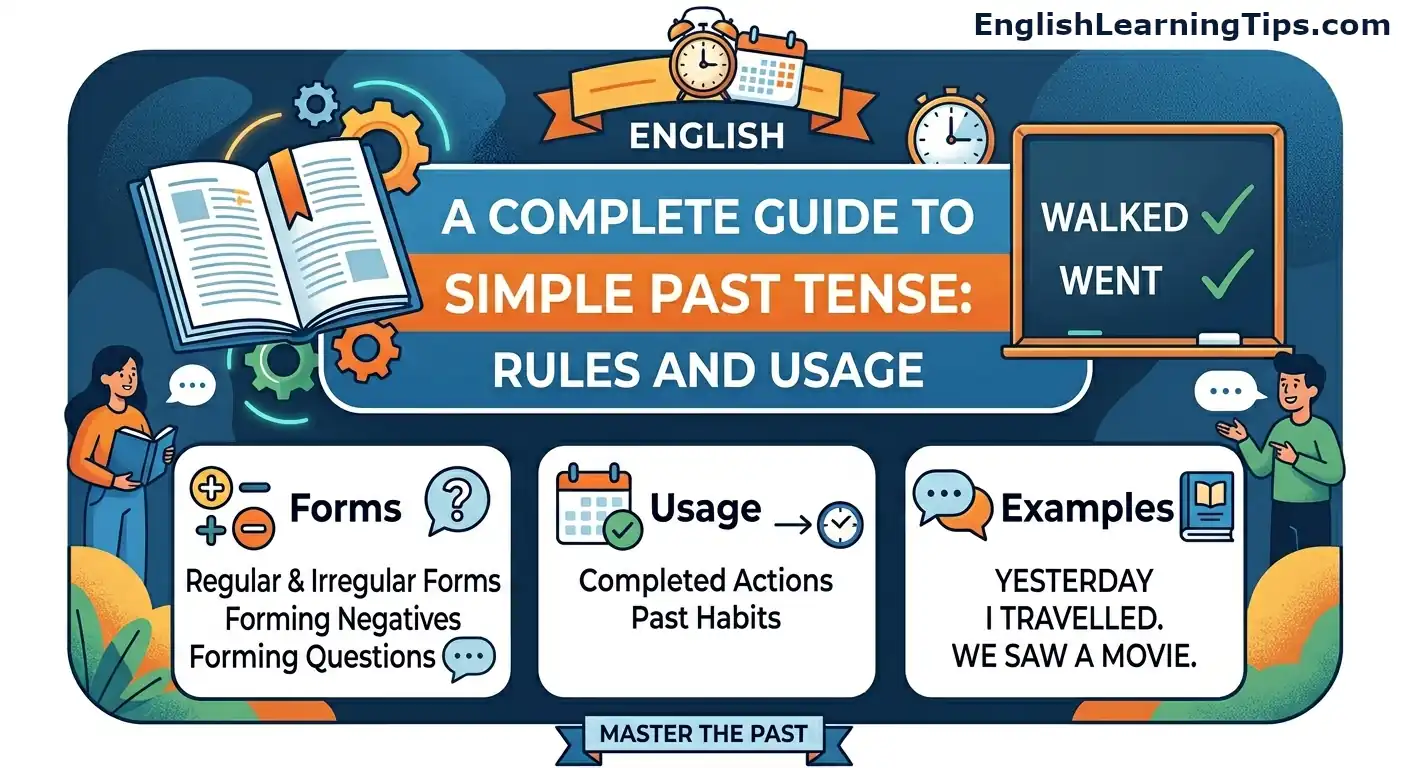
A complete guide to simple past tense: Rules and usage

Mastering the simple past tense is the fastest way to improve your English storytelling. Whether you’re recounting yesterday’s lunch or writing a business report, you need to know how to handle finished actions. This guide breaks down the rules, irregular verbs, and common pitfalls to help you speak more naturally.
What is the simple past tense?
The simple past tense, also known as the past simple, describes completed actions, habits, or states that occurred at a specific time in the past. These events have no direct connection to the present moment.
Key characteristics of the simple past tense
- Finished events: Focuses on completed actions.
- Specific time markers: IPairs with specific time references like “yesterday,” “last week,” “in 2020,” or “two hours ago.”
- Verb variety: It applies to both regular and irregular verbs.
Examples:
- She visited Paris last summer.
- They played football every weekend when they were kids.
How to form the simple past tense
Regular verbs
For most regular verbs, you form the past tense by adding -ed to the base form. However, spelling changes occur depending on the verb’s ending.
Struggling with the three different sounds of -ed? Check out our -ed pronunciation guide to master the ‘t’, ‘d’, and ‘id’ endings.
| Verb ending | Rule | Example |
| Standard | Add -ed | Walk → walked |
| Ends in -e | Add only -d | Love → loved |
| Consonant + y | Change y to i and add -ed | Try → tried |
| Short vowel + consonant | Double the final consonant | Stop → stopped |
Note: For one-syllable verbs ending in a single vowel and a single consonant (like stop or plan), double the final consonant before adding -ed.
Irregular verbs
Irregular verbs do not follow the -ed pattern. These forms must be memorized as they are among the most frequently used words in English.
| Base verb | Simple past | Example sentence |
| Be | Was/were | It was cold yesterday. |
| Go | Went | We went to the beach. |
| Eat | Ate | She ate breakfast at 7 am. |
| See | Saw | I saw my friend at the mall. |
| Buy | Bought | They bought a new car. |
| Take | Took | She took the train to work. |
| Write | Wrote | The student wrote an essay. |
Pro-tip: Memorizing irregular verbs is the hardest part of the simple past. I recommend using the English Irregular Verbs Flashcards to practice on the go. If you prefer a structured workbook, English Grammar in Use is the gold standard for self-study.
Negative and question forms
To create negatives and questions in the simple past, use the auxiliary verb did.
- Negative form: Use did not (didn’t) + the base verb.
- I did not watch the movie.
- Question form: Use Did + subject + base verb?
- Did you finish your homework?
- Short answers: “Yes, I did” or “No, I didn’t.”
When to use the simple past tense
Understanding when to use this tense versus other verb tenses is key to sounding like a native speaker. Use the simple past for:
- Completed actions: “I finished the report at 5 pm.”
- Past habits: “When I was young, I played piano every day.”
- Past states or feelings: “She felt tired after the long flight.”
- Chronological stories: “First she woke up, then she brushed her teeth.”
Simple past vs. other past tenses
| Tense | Use case | Example |
| Simple past | Completed action | I visited London in 2019. |
| Past continuous | Action in progress in the past | I was visiting London when it rained. |
| Present perfect | Action connected to the present | I have visited London three times. |
Common mistakes and how to avoid them
- Using the present instead of the past: Avoid saying “Yesterday I go.” Instead, use “Yesterday I went.”
- Irregular verbs: Phrases like “buyed” or “eated” are incorrect. Use “bought” and “ate.”
- Double pasts in questions: Do not use the past tense form of the verb after “did.”
- Incorrect: “Did you went?”
- Correct: “Did you go?“
- Confusing with present perfect: If you mention a specific time (like “at 2 pm”), always use the simple past rather than the present perfect.
Frequently asked questions about simple past tense
Wrapping up: Mastering the simple past tense
The simple past tense is the backbone of English storytelling. Whether you are describing a weekend trip or writing a professional report, using the correct past tense forms ensures your message is clear and easy to follow. While irregular verbs and auxiliary rules like “did” can be tricky at first, consistent practice makes them second nature.
By focusing on the patterns we’ve covered—like the “i to a” vowel shift or the subject-verb agreement for “was” and “were”—you’ll quickly move past common learner mistakes. Remember that even native speakers occasionally trip up on complex irregulars, so don’t be afraid to keep a reference list handy as you write.
Join the conversation
Which irregular verb do you find the most difficult to remember? Or do you have a trick for keeping “was” and “were” straight? Drop a comment below and let’s discuss!
If you found this guide helpful, share it with a friend who is working on their English fluency. Your shares help us create more free resources like this one.
Discover more from English Learning Tips
Subscribe to get the latest posts sent to your email.


