

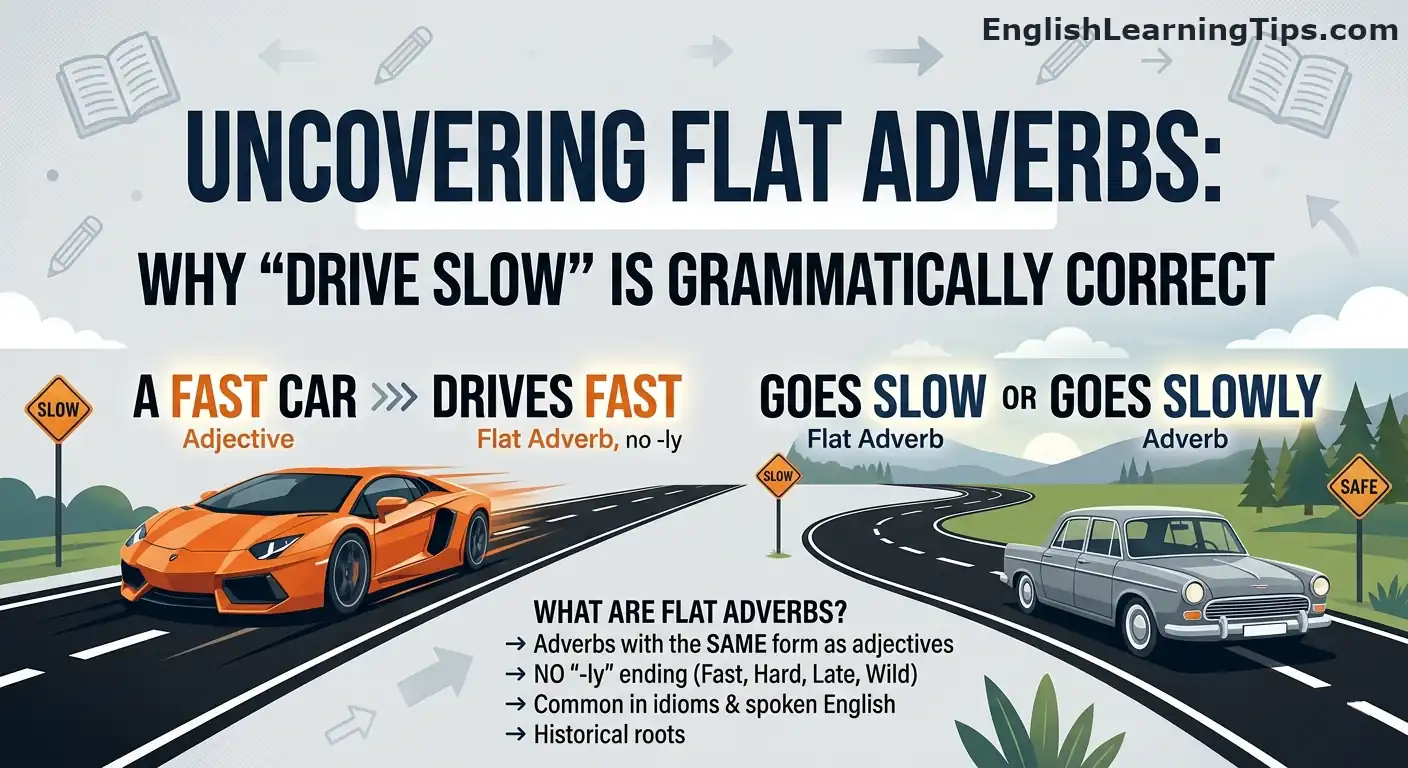
Understanding flat adverbs: Definitions, examples, and usage rules

A flat adverb (also called a bare adverb or simple adverb) is an adverb that shares the exact same form as its corresponding adjective. Unlike the majority of adverbs in the English language, a flat adverb does not end in -ly.
You likely use these every day without realizing it. For instance, the word “fast” works as both an adjective (“a fast car”) and a flat adverb (“she runs fast”). Similarly, you might see a road sign that says “drive slow” instead of “drive slowly.”
These adverbs modify verbs, adjectives, or other adverbs, answering questions like “how?” or “in what manner?” They have deep roots in Old English, where many adverbs used specific endings that eventually simplified or disappeared, leaving us with the flat form we use today.
Why do flat adverbs exist, and why do they matter?
English once featured a much higher volume of flat adverbs. However, 18th-century grammarians began pushing for the -ly suffix to more clearly distinguish adverbs from adjectives. This historical shift is why some flat forms feel informal or “incorrect” to modern ears, even though many remain grammatically sound.
Flat adverbs persist in modern English because they are often more direct, concise, and idiomatic. In casual conversation, marketing slogans (“think big”), or instructions (“hold tight”), the flat version is frequently the preferred choice. In formal contexts, the -ly form typically sounds more polished and professional.
Common flat adverbs list and examples
To help you identify when to use these words, here is a breakdown of widely used flat adverbs grouped by their relationship with their -ly counterparts.
Flat adverbs with no common -ly counterpart
In these cases, the flat form is the standard and the only correct choice.
- Fast: She runs fast. (Never “fastly”)
- Hard: They work hard.
- Late: We arrived late.
- Straight: Go straight home.
- Far: We didn’t travel far.
- Soon: See you soon.
Flat adverbs that pair with -ly forms
These forms are often interchangeable, though the flat version is more casual.
- Slow / slowly: Drive slow vs. drive slowly.
- Quick / quickly: Think quick vs. think quickly.
- Bright / brightly: The moon shines bright vs. shines brightly.
- Loud / loudly: Speak loud vs. speak loudly.
- Easy / easily: Take it easy vs. move easily.
- Tight / tightly: Hold tight vs. hold tightly.
Flat adverbs with distinct meanings
Be careful with these, as adding -ly changes the definition of the word entirely.
| Adjective/Flat form | Flat adverb example | -ly Adverb meaning |
| Right | Turn right. | Rightly: Correct or justly. |
| Near | Come near. | Nearly: Almost. |
| Short | Stop short. | Shortly: In a short time; soon. |
| Clean | Come clean (confess). | Cleanly: In a clean manner. |
| Hard | Hit hard. | Hardly: Barely or scarcely. |
| High | Aim high. | Highly: To a high degree or with favor. |
If you love geeky deep dives into why we use language the way we do, Dreyer’s English is an essential (and hilarious) read for any serious writer.
Flat adverbs vs. -ly adverbs: Key differences
When deciding between a bare adverb and a standard adverb, consider the following three factors:
- Formality: Most -ly adverbs are the standard for academic, legal, or professional writing. Flat adverbs feel conversational and emphatic.
- Sentence structure: Use the flat form in imperatives (commands) or short, punchy phrases: “Drive safe,” “Sit tight,” “Go slow.”
- Regional dialect: Flat adverbs like “real good” or “doing fine” appear more frequently in American English casual speech compared to British English.
How to use flat adverbs for better writing
Understanding when to use these forms can make your writing feel more natural and engaging.
- In marketing and social media: Flat forms feel punchy and approachable.
- In fixed expressions: You should always use the flat form in idioms like “sleep tight” or “aim high.”
- For rhythm: In poetry or song lyrics, a short flat adverb often fits the meter better than a three-syllable -ly adverb.
Pro-tip: Avoid using flat adverbs in highly formal documents if a standard -ly version is available. If you are unsure, the -ly version is almost always the safer bet for professional clarity.
For a definitive guide on professional style and adverb usage, I highly recommend keeping a copy of The Chicago Manual of Style or the latest AP Stylebook on your desk.
Frequently asked questions about flat adverbs
Mastering flat adverbs in your writing
Flat adverbs are more than just a grammatical quirk; they are a bridge to the history of the English language. While the -ly ending remains the standard for formal and academic work, the flat form offers a level of punchiness and rhythm that -ly adverbs often lack. By understanding the nuance between “driving slow” and “driving slowly,” you gain greater control over the tone and impact of your prose.
The next time you are drafting a blog post, a marketing slogan, or even a simple text message, pay attention to these bare adverbs. Choosing the right form can make your communication feel more authentic and idiomatic.
Join the conversation: Flat adverbs in the wild
Do you find yourself sticking to the strict -ly rules, or do you prefer the direct feel of a flat adverb? Some people find “drive safe” perfectly natural, while others find it jarring.
We want to hear from you:
- What is one flat adverb you use every day?
- Are there any “bare” adverbs that still sound “wrong” to your ears?
- Do you have a favorite idiom that wouldn’t be the same without its flat adverb?
Drop a comment below to share your thoughts! If you found this guide helpful for your grammar and writing skills, please share it with your fellow writers and word nerds. Every share helps us create more in-depth content for the writing community.
Discover more from English Learning Tips
Subscribe to get the latest posts sent to your email.


