

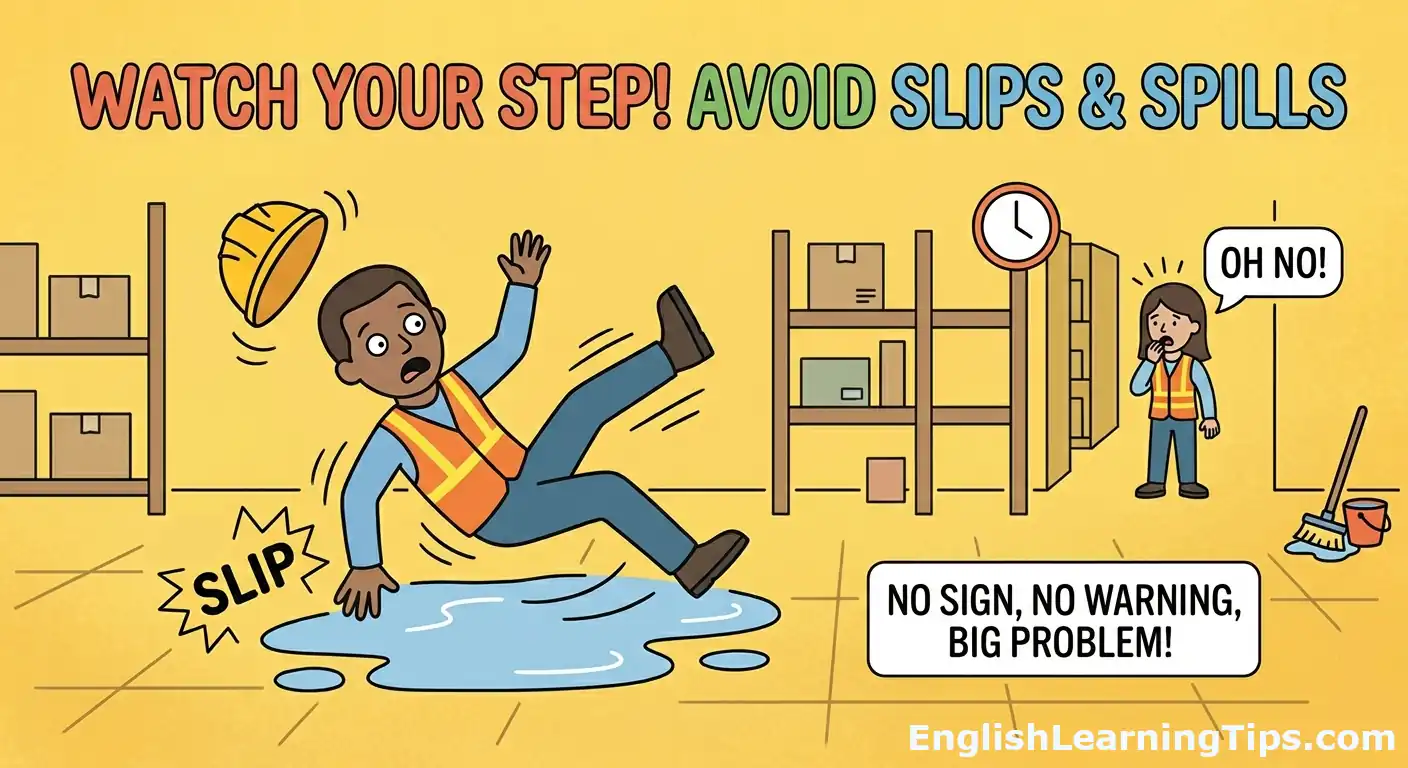
Jobs: Talking about workplace safety

This lesson plan introduces essential workplace safety vocabulary and practical phrases for learners to communicate effectively in various work environments. Designed for beginner to intermediate learners, it focuses on simple, commonly used terms like “hazard,” “protective gear,” and “emergency,” alongside functional phrases for discussing safety rules, reporting issues, and asking questions.
Through engaging activities like role-plays, visual aids, and a safety inspection game, learners will connect vocabulary to real-world contexts, such as offices, factories, or construction sites. The lesson emphasizes clear pronunciation, correct grammar, and cultural sensitivity to accommodate diverse workplace settings.
By the end, learners will be equipped to describe safety practices, identify hazards, and engage in basic workplace safety conversations confidently.
Basic vocabulary
Start with essential words related to workplace safety. These should be simple, commonly used terms that learners can easily apply.
Vocabulary list
- Safety: Protection from harm or danger.
- Workplace: The place where people work (e.g., office, factory, construction site).
- Hazard: Something that could cause harm (e.g., a wet floor, exposed wires).
- Accident: An unexpected event that causes injury or damage.
- Injury: Harm to the body (e.g., a cut, a burn).
- Equipment: Tools or machines used at work (e.g., ladder, computer).
- Protective gear: Items worn to stay safe (e.g., helmet, gloves, safety glasses).
- Fire exit: A door or path to leave during a fire.
- First aid: Basic medical help given after an injury.
- Warning sign: A sign that alerts about danger (e.g., “Wet floor,” “High voltage”).
- Training: Lessons to learn safety rules.
- Emergency: A serious situation needing quick action (e.g., fire, injury).
- Rule: An instruction to follow for safety (e.g., “Wear a hard hat”).
- Risk: The chance of something dangerous happening.
- Supervisor: The person in charge who oversees safety.
Vocabulary for extension
- Evacuation: The process of leaving a workplace during an emergency.
- Spill: Liquid accidentally dropped (e.g., oil spill on the floor).
- Fire extinguisher: A device to put out small fires.
- Drill: A practice for emergencies (e.g., fire drill).
- Ventilation: Air flow to keep a workplace safe and comfortable.
- Slip: Losing balance and falling (e.g., slipping on a wet floor).
- Harness: Safety equipment to prevent falling from heights.
- Checklist: A list of safety tasks to complete (e.g., safety inspection checklist).
- Protocol: Official steps to follow for safety (e.g., emergency protocol).
- Incident: A minor event that could have caused harm (e.g., a near-miss incident).
Teaching tip:
- Use visuals like pictures of protective gear or warning signs to connect vocabulary to real contexts.
- Practice pronunciation: HAZ-ard and e-MER-jen-see.
- Create flashcards with words on one side and definitions or images on the other.
Useful phrases
Teach simple sentence structures for discussing workplace safety. These phrases should be practical and adaptable for different work settings.
Key phrases
- Talking about safety rules:
- “We must wear [protective gear] at work.”
- “The safety rule is to [action].”
- “There’s a warning sign for [hazard].”
- Describing hazards or risks:
- “This [item/area] is a hazard because [reason].”
- “There’s a risk of [injury/accident] here.”
- “Be careful of [hazard].”
- Reporting issues or emergencies:
- “I saw an accident in [place].”
- “There’s a problem with [equipment/area].”
- “We need first aid for [person/injury].”
- “Please call the supervisor.”
- Asking questions:
- “What are the safety rules here?”
- “Where’s the fire exit?”
- “Do we need protective gear for this?”
Teaching tip:
Write phrases on the board and model their use. Have learners substitute their own workplace details into the phrases (e.g., linking specific gear to their job).
Grammar spotlight: Expressing obligation and necessity
In workplace safety, we use specific modal verbs and structures to tell people what is required, what is optional, and what is dangerous. Use these patterns to help learners communicate rules clearly.
Using “must” for strict rules
We use must to describe formal rules, laws, or essential safety requirements. It is a strong way to express that there is no other choice.
- Structure: Subject + must + base verb.
- Example: “You must wear a helmet on the construction site.”
- Example: “All employees must attend safety training.”
Using “have to” for general requirements
While must is often for written rules, have to is very common in spoken English to explain what is necessary because of a situation or a supervisor’s instruction.
- Structure: Subject + have to / has to + base verb.
- Example: “We have to check the equipment every morning.”
- Example: “She has to report the spill to the supervisor.”
Describing hazards with “there is” and “there are”
To report a problem or a risk, use there is (singular) or there are (plural). This helps identify the location of a hazard.
- Structure: There is + a/an + singular noun.
- Example: “There is a wet floor near the entrance.”
- Structure: There are + plural noun.
- Example: “There are exposed wires in the break room.”
Giving warnings with “be careful” and “watch out”
When you see someone about to make a mistake or enter a dangerous area, use these short imperative phrases.
- Be careful of… (used for general awareness)
- “Be careful of the hot surface.”
- Watch out for… (used for moving hazards or immediate danger)
- “Watch out for the forklift!”
Related: Using look, see, and watch
Common mistake: Forgetting the article
Learners often forget to use a or an when describing a single hazard.
- Incorrect: “This is hazard.”
- Correct: “This is a hazard.”
- Incorrect: “I saw accident.”
- Correct: “I saw an accident.”
Example conversations
Conversation A: Basic exchange
Anna: Hi, I’m new here. What are the safety rules?
Tom: Welcome! You must wear a helmet and safety boots.
Anna: Okay. Where’s the fire exit?
Tom: It’s over there by the red sign.
Conversation B: Reporting a hazard
Sara: Hey, Juan, there’s a hazard in the warehouse.
Juan: What is it?
Sara: There’s a wet floor near the boxes.
Juan: Thanks for telling me. I’ll put up a warning sign.
Teaching strategy
| Step | Duration | Activity |
| Warm-up | Five minutes | Ask: “What’s one thing that makes you feel safe at work?” |
| Vocabulary | Ten minutes | Practice the list using visuals and pronunciation drills. |
| Phrase practice | Ten minutes | Model key phrases; learners practice with fill-in-the-blanks. |
| Conversation | Fifteen minutes | Role-play dialogues in pairs; encourage personalization. |
| Wrap-up | Five minutes | Share one safety rule from a personal workplace. |
Common mistakes to address
- Grammar: Correct “This is hazard” to “This is a hazard.” Emphasize articles for singular nouns.
- Pronunciation: Focus on IN-jur-ee and PRO-tek-tiv.
- Word choice: Clarify that a hazard is a potential danger, while an accident is an event that has already occurred.
Example activity: Safety inspection game
- Set up a mock workplace scenario using pictures (e.g., a spilled drink or loose cables).
- Give learners a “safety checklist” to find hazards and name the corresponding safety rule.
- Learners must use the target vocabulary: “There is a hazard: a wet floor. We need a warning sign.”
Homework or follow-up
- Writing: Write a few sentences about a safety rule or a hazard you have seen at work.
- Speaking: Record a short audio clip acting out a dialogue about reporting a hazard.
- Research: Look up one safety sign at your workplace and describe it in a few sentences.
Discover more from English Learning Tips
Subscribe to get the latest posts sent to your email.


