

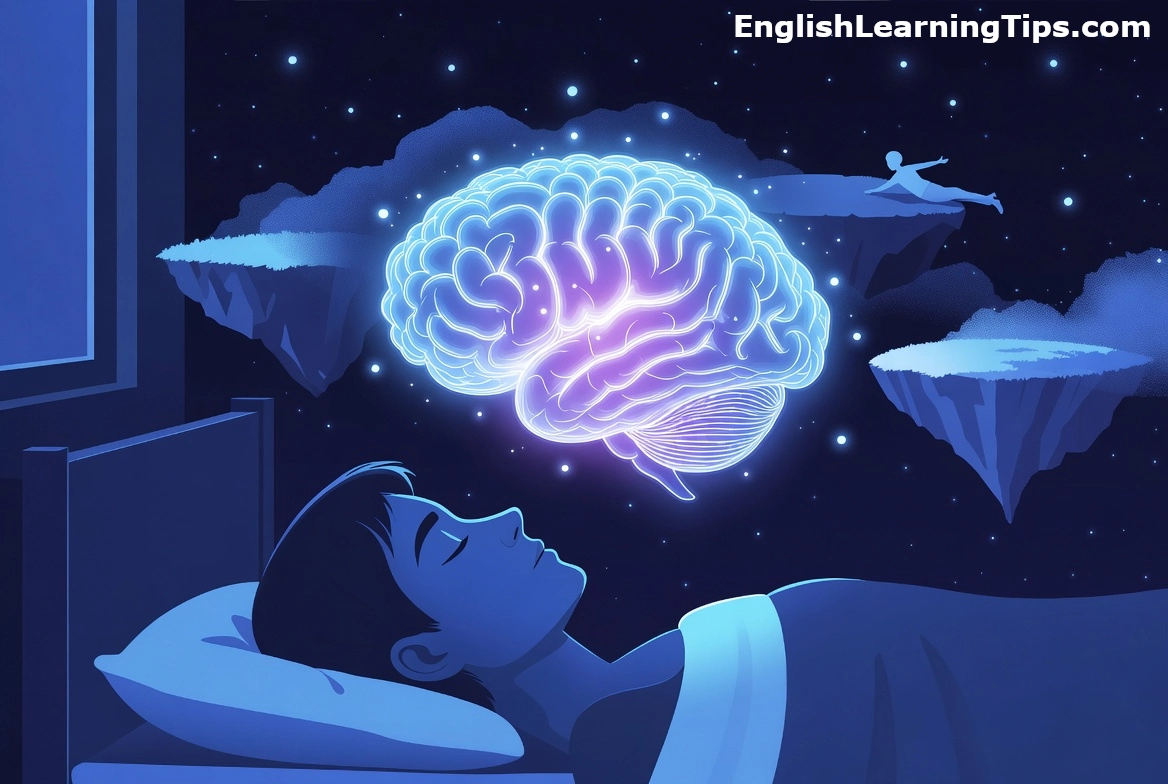
How lucid dreaming works: English ESL lesson plan

Have you ever wondered what it would be like to take control of your own mind while you sleep? For many language learners, discussing deep psychological and scientific phenomena offers a fantastic way to build advanced communication skills.
This English lesson explores how lucid dreaming works, diving into the fascinating science of sleep, neurobiology, and human consciousness.
By engaging with this high-interest topic, students will master advanced vocabulary, practice realistic conversations, and refine their grammar skills. Whether you are an educator or a self-directed learner, this guide provides all the tools needed to explore the mysteries of our subconscious minds while improving English fluency.
Lesson plan: Exploring the science of sleep and conscious dreaming
Level: Intermediate to Advanced (B2-C1)
Time: 45 minutes
Topic: How lucid dreaming works and the neuroscience of sleep
Objectives: Students will be able to define lucid dreaming, use complex variations of sleep-related vocabulary, apply conditional structures to hypothetical scenarios, and discuss scientific studies confidently.
Video: “How Lucid Dreaming Works”
Background
Lucid dreaming is the fascinating phenomenon where an individual becomes aware that they are dreaming while they are still asleep. During a typical dream, our thoughts and actions feel involuntary, making us passive observers in a narrative that plays out like a movie. However, when someone experiences a lucid dream, they gain volitional control over their actions and can actively manipulate their surroundings.
This state allows dreamers to perform spectacular feats, such as teleporting to new locations or learning to improve real-life skills, effectively turning their subconscious mind into an interactive video game.
For centuries, scientific communities lacked the advanced technology needed to prove whether conscious dreaming was a real biological state or just a far-fetched imagination. This changed with modern neuroscience experiments, notably a landmark 2012 study utilizing functional magnetic resonance imaging (fMRI) scanners.
By measuring changes in blood flow to specific regions of the brain, scientists objectively proved that when a participant dreamed about clenching their fist, the exact same brain regions lit up as when they were awake.
While only about twenty to thirty percent of the human population are natural lucid dreamers, ongoing research continues to explore what this unique ability tells us about human evolution and the boundaries of human consciousness.
Recommended reading: If you want to dive deeper into the science of sleep engineering, pick up a copy of Exploring the World of Lucid Dreaming on Amazon. It is widely considered the definitive guide on the subject.
Basic vocabulary
Introducing essential words related to sleep science, neurology, and psychology helps students navigate academic texts and everyday discussions about the mind.
Vocabulary list
- Involuntary (adjective)
- Other forms: Involuntarily (adverb), involuntariness (noun)
- Definition: Done without conscious control or intention.
- Example sentence: Breathing is an involuntary bodily function that continues while we sleep.
- Volitional (adjective)
- Other forms: Volition (noun), volitionally (adverb)
- Definition: Relating to the use of one’s own will or conscious choice.
- Example sentence: The patient demonstrated volitional movement in their hands during the neurological test.
- Phenomenon (noun)
- Other forms: Phenomenal (adjective), phenomenally (adverb), phenomena (plural noun)
- Definition: A fact or situation that is observed to exist or happen, especially one whose cause or explanation is in question.
- Example sentence: Northern lights are a natural phenomenon that attracts millions of tourists.
- Objective (adjective)
- Other forms: Objectively (adverb), objectivity (noun), objectivism (noun)
- Definition: Not influenced by personal feelings or opinions in considering and representing facts.
- Example sentence: Scientists need objective data from laboratory experiments before publishing their results.
- Participant (noun)
- Other forms: Participate (verb), participation (noun), participatory (adjective)
- Definition: A person who takes part in something, such as a research study or activity.
- Example sentence: Each participant in the sleep study was asked to wear a heart rate monitor.
- Mantra (noun)
- Other forms: Mantric (adjective)
- Definition: A statement or slogan repeated frequently to aid concentration or change one’s mindset.
- Example sentence: She repeated a calming mantra to herself before giving the presentation.
- Subconscious (noun)
- Other forms: Subconscious (adjective), subconsciously (adverb), subconsciousness (noun)
- Definition: The part of the mind that is inaccessible to immediate conscious awareness but influences actions and feelings.
- Example sentence: Dreams often reveal the fears and desires buried deep within our subconscious.
- Beneficial (adjective)
- Other forms: Benefit (noun/verb), beneficially (adverb), beneficiary (noun)
- Definition: Resulting in good; advantageous, or helpful.
- Example sentence: Getting eight hours of sleep every night is highly beneficial for your mental health.
- Evolution (noun)
- Other forms: Evolve (verb), evolutionary (adjective), evolutionist (noun)
- Definition: The gradual development of something, especially from a simple to a more complex form.
- Example sentence: The evolution of human language took place over thousands of years.
- Conscious (adjective)
- Other forms: Consciously (adverb), consciousness (noun), subconscious (adjective)
- Definition: Aware of and responding to one’s surroundings; awake.
- Example sentence: He became conscious of a strange tapping sound coming from the window.
Vocabulary for extension
- Teleport (verb)
- Other forms: Teleportation (noun)
- Definition: To move or be moved across space instantly by advanced technology or psychic power.
- Far-fetched (adjective)
- Other forms: Far-fetchedness (noun)
- Definition: Unlikely to be true; difficult to believe.
- Shed light (idiom/verb phrase)
- Other forms: Shedding light (participle)
- Definition: To make something clearer or easier to understand by providing new information.
- Deliberative (adjective)
- Other forms: Deliberate (verb/adjective), deliberately (adverb), deliberation (noun)
- Definition: Relating to or marked by careful consideration or intentional action.
- Distinguish (verb)
- Other forms: Distinguishable (adjective), distinguishably (adverb), distinction (noun)
- Definition: To recognize or treat someone or something as different.
- Example sentence: It can be difficult to distinguish a vivid dream from real life.
- Hominid (noun)
- Other forms: Hominid (adjective)
- Definition: A primate of a family that includes humans and their fossil ancestors.
- Forefront (noun)
- Other forms: None
- Definition: The most prominent, leading, or important position.
- Sensation (noun)
- Other forms: Sensational (adjective), sensationally (adverb), sensationalism (noun)
- Definition: A physical feeling or perception resulting from something that happens to or comes into contact with the body.
- Preference (noun)
- Other forms: Prefer (verb), preferable (adjective), preferably (adverb)
- Definition: A greater liking for one alternative over another; a favored choice in natural selection.
- Demonstrate (verb)
Teaching tips
- Use word family trees on the whiteboard to help students visualize how a base word shifts forms (e.g., conscious to consciousness or subconsciously).
- Have students sort the vocabulary terms into two categories: “scientific terms” and “everyday descriptions” to build situational awareness.
- Encourage students to create their own personalized mantras using at least one vocabulary extension word to practice target vocabulary naturally.
Grammar
This lesson provides an excellent opportunity to master mixed conditionals and hypothetical structures using words like wish, if, and what if. When discussing dream control or scientific theories, we often look at how past actions affect present states, or how permanent truths impact imagined scenarios.
Consider this example from the lesson text: “Perhaps if it was so beneficial, Mother Nature would have had all of us being capable of lucid dreaming.” This structure bridges an ongoing or permanent condition with a hypothetical past result.
Additionally, we use the subjunctive mood to talk about wishes or things that are far-fetched:
- Form: Subject + wish + past simple / past perfect
- Example: I wish I could control my actions in my dreams last night.
When talking about ongoing brain research, remember to emphasize the contrast between the past simple (for completed experiments, like the 2012 study) and the present simple (for established scientific facts).
Useful phrases
Key phrases
- To play out: To happen or develop in a specific way.
- To lack the technology: To not possess the tools or machinery needed for a specific task.
- To shed light on: To reveal new information that clarifies a confusing topic.
- Sure enough: Used to confirm that something happened exactly as expected.
- With ease: Effortlessly; without experiencing any difficulty.
- To distinguish reality from…: To recognize the difference between real life and an illusion.
Pro-tip: For a highly engaging and modern guide filled with practical cues, check out A Field Guide to Lucid Dreaming on Amazon. It serves as an excellent supplementary text for classroom reading assignments.
Teaching tips
- Ask students to rewrite the phrase “sure enough” using synonyms like “as anticipated” or “predictably” to expand their academic writing repertoire.
- Create a matching game where students must connect the idiom “shed light on” to its appropriate scientific context.
Example conversations
Conversation 1: Basic description
Student A: Have you ever had a dream where you suddenly realized you were dreaming? Student B: Yes, it actually happened to me last week, and it was a bizarre sensation. Student A: That means you experienced a lucid dream, which is pretty rare. Student B: Really? I just thought my mind was playing tricks on me while I was asleep.
Conversation 2: Adding details
Student A: Scientists have used fMRI scanners to track what happens when we experience these conscious dreams. Student B: That sounds fascinating, but how can an image track someone’s thoughts? Student A: The machine measures blood flow to specific regions of the brain in real time. Student B: So, if a participant clenches their fist in a dream, the machine registers the activity? Student A: Exactly, the scanner shows the exact same areas lighting up as when they are awake.
Conversation 3: More advanced
Student A: Some researchers believe that frequent lucid dreamers might be at the forefront of hominid evolution. Student B: That is a provocative hypothesis, though it feels a bit far-fetched to assume it is our next species preference. Student A: True, but if it allows people to expand their conscious boundaries, it must serve some evolutionary purpose. Student B: Perhaps, but we must also consider the frightening accounts where people struggle to distinguish reality from their dreams.
Teaching tips
- Have students perform these dialogues in pairs, intentionally swapping roles to practice different conversational pacing.
- Challenge advanced students to substitute at least two phrases in Conversation 3 with their own vocabulary extension words.
Teaching strategy
When teaching abstract concepts like neuroscience and sleep psychology, utilize the flipped classroom approach. Assign the video clip as homework before the class session so students can internalize the auditory input and pronunciation at their own pace. During the live session, minimize lecture time and maximize collaborative communication. Use concept-checking questions to ensure students understand the scientific mechanics (like blood flow in fMRI scanners) before moving into conversational practice. This keeps engagement high and shifts the cognitive load onto the learners.
Here’s a 45-minute lesson plan
Step 1: Warm-up (5 minutes)
- Write the phrase “Who is in control when you dream?” on the board.
- Ask students to share if they usually feel like they are watching a movie or playing a video game when they sleep.
Step 2: Vocabulary introduction (10 minutes)
- Distribute the vocabulary list and chorally drill pronunciation for terms like volitional and phenomenon.
- Pro-tip: Highlight the shifting stress pattern between phenomenon and phenomenal to prevent common pronunciation errors.
- Have students complete a quick fill-in-the-blank activity using the primary vocabulary words.
Step 3: Phrase practice (10 minutes)
- Introduce the useful phrases, focusing on “shed light on” and “distinguish reality from.”
- Ask students to write two original sentences applying these phrases to scientific discoveries.
Step 4: Conversation practice (15 minutes)
- Divide the class into pairs and assign the three example conversations.
- Circulate the room to provide error correction on mixed conditional structures and intonation.
Step 5: Wrap-up and personalization (5 minutes)
- Bring the class back together and ask one or two students to summarize how an fMRI scanner works using their new vocabulary.
- Assign the homework tasks.
Discussion questions
- Question: Why do you think only twenty to thirty percent of the population can naturally experience lucid dreaming?
- Answer: Scientists do not know for certain, but it could be linked to specific variations in brain structure or heightened activity in the prefrontal cortex during sleep.
- Question: Would you want to use a mantra to gain volitional control over your dreams tonight? Why or why not?
- Answer: Yes, because it would be exciting to teleport to new locations, or no, because it might make me feel tired or blurred when I wake up.
- Question: How do modern fMRI scanners help researchers study human consciousness objectively?
- Answer: They track blood flow to specific regions of the brain, allowing scientists to see physical evidence of thoughts and imagined actions without relying solely on a patient’s description.
- Question: What are the potential dangers of not being able to distinguish reality from a dream state?
- Answer: It can cause severe psychological distress, confusion, anxiety, and in severe cases, it might be an early indicator of an underlying mental illness.
- Question: Do you agree with the theory that lucid dreaming could be the next stage of human evolution?
- Answer: It is a fascinating idea, but since it is not universally beneficial to everyone yet, it is too early to tell if it is an evolutionary preference.
Additional tips
- Cultural sensitivity: Remember that dreams carry deep spiritual, religious, or cultural meanings in various societies. Avoid dismissing any student’s personal cultural interpretations of dreams while focusing on the scientific aspects of the text.
- Visual aids: Show a simple diagram of a human brain highlighting the prefrontal cortex, or project an image of what an fMRI scan looks like to give abstract scientific terms immediate visual context.
- Adapt for level: For lower-intermediate students, drop the complex adjective and adverb conjugations and focus strictly on the base nouns and verbs. For highly advanced students, require them to debate the evolutionary merits of dreaming using mixed conditionals.
- Technology: Use interactive digital whiteboards or live polling tools to let students submit their vocabulary sentences anonymously for real-time peer review.
Common mistakes to address
- Grammar: Students often misuse the past simple instead of the subjunctive after the verb “wish” (e.g., saying “I wish I can control my dream” instead of “I wish I could control my dream”).
- Word choice: Confusing the plural form phenomena with the singular form phenomenon is highly common during scientific presentations.
Example activity
In this activity, called The Dream Lab, students will work in groups of three to design their own sleep experiment. They must choose a specific real-life skill (like playing piano or practicing a language) and outline an objective method to test if lucid dreaming can improve that skill. Each group must use at least five vocabulary words from the list and present their experimental design to the class using conditional structures (e.g., “If the participant practices in their sleep, their brain waves will show…”).
Homework or follow-up
- Writing: Write an opinion paragraph consisting of 150 words analyzing whether you believe conscious dream control is a beneficial human trait or an evolutionary glitch.
- Speaking: Record a two-minute audio summary explaining the 2012 fMRI fist-clenching experiment as if you were a scientist reporting to a news station.
- Research: Look up another sleep-related phenomenon, such as sleep paralysis or rapid eye movement (REM) cycles, and write down three facts about how it works.
FAQs
What triggers a lucid dream naturally?
Natural triggers are often linked to heightened self-awareness, consistent sleep schedules, and high activity levels in the prefrontal cortex of the brain. Some individuals naturally have a higher density of gray matter in these areas, making them more prone to spontaneous awareness during sleep cycles.
Can you train yourself to have a lucid dream?
Yes, many people successfully train their minds using specific deliberative techniques. Common methods include keeping a detailed dream journal, performing regular reality checks throughout the day (like flipping light switches), and repeating a focused mantra right before falling asleep.
Is lucid dreaming safe for everyone?
For the vast majority of people, it is a safe and entertaining experience. However, individuals who struggle with certain dissociative disorders or mental health conditions may find that it exacerbates difficulties in distinguishing between real life and sleep states.
What does an fMRI scan show during sleep?
An fMRI scanner measures the tiny changes in blood oxygenation and flow that occur in response to neural activity. When a specific part of the brain becomes more active, more blood flows to that region, creating a visible map of mental activity while the subject is sound asleep.
Conclusion
Understanding how lucid dreaming works opens up an incredible window into the capabilities of the human mind and the boundaries of our subconscious. By breaking down the neuroscience behind sleep and mastering advanced language patterns, you can elevate your English communication skills to an entirely new level.
What are your thoughts on conscious dreaming? Have you ever successfully controlled a dream using a mantra or reality check? Let us know in the comments below, and don’t forget to share this article with fellow language learners and science enthusiasts!
Discover more from English Learning Tips
Subscribe to get the latest posts sent to your email.


